Ruck training suggestions

I live in McCall and I ruck 2 miles around my neighborhood around 4 times a week with 45lb this winter. It’s flat, but it has still keeps me in shape. I also do high intensity Air Bike workouts in the summer. Honestly if you have good cardio from rucking and your legs are accustomed to some short steep hills, then you will benefit most from absolutely dialing in your boots. I made the mistake of rucking for 6 months in comfortable Brooks shoes then hunted in boots and it was terrible. I currently ruck in Altras and will hunt in them.
 
Imo training is personal to ensure you're healthy & stay away from injuries because they will crush your fitness goals quicker than anything. Personally, I don't like to heavy ruck to stay away from injuries. I enjoy HIIT swimming & cycling routines to increase endurance while sucking air a couple times a week. Also, I run/speed walk with a 20lb vest 10-15 miles a week to increase aerobic endurance & strength. My strength training comes from low weight high rep full body training a couple times a week. I try to do yoga for 15-20 minutes every morning so I can move freely. I try to do this year round, but as I get closer to fall I'll replace 50% of my run miles with my 5-7 day pack. This has served me well over the years & to stay injury free, atleast injuries from training. I also believe mentally strength is important to excersise which is pushing through uncomfortable things when you can stop the pain at any time. I get this through sucking air while swimming, cycling, cold plunging & contrast therapy
 
Hello all, flat lander here, planning on trying to take down an elk in ID this fall. Wondering if anyone could give any good suggestions for a training schedule that would help. I started about 2.5 months ago rucking with 30lbs in my pack for 3 miles 3 days a week. Just last week was the first sessions I had where my shins weren't on fire. Looking for input on when I should start incrementing weight vs distance and what size of increments would be best. Should I go straight into large elevation changes with the current weight or should I bump up weight first then add more elevation? Any suggestions/discussions are greatly appreciated.
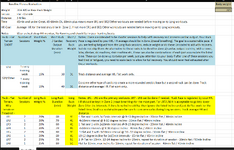
Lots of methods for ruck training. Here is a screenshot of some of my Ruck Plan. I do ruck work year-round, so I typically program 1 Short and 1 Long in for a 3-week block, then switch things around to 1 Short, 1 Other Cardio, and some ME work for the next 3-week block, then switch again to a different combination.

I do have some heavy pack workouts to simulate a packout, or for some muscular endurance work, but the vast majority of my work is done with 15%-20% of body weight. IMO, ruck training is more about getting efficient while moving under load; it's not about just adding more and more weight.

Limit what you add to one thing at a time, e.g., add weight, or add incline, or add distance, don't add all at the same time.

Winter, which is typically all treadmill work and a variety of muscular endurance work. I have, on some occasions, done some snowshoeing or AT skiing, but I prefer to play with my snowmobile/snowbike instead. Once I can start getting into the mountains, I try to only do treadmill work for the midweek Short ruck sessions, but if you are a flatlander, an inclining treadmill is worth the money.

If you are not doing some type of strength training, do yourself a favor and start doing it in addition to your ruck/cardio training. If you want more info, let me know.
1774759800970.png1774759800970.png
 
Mountain Tactical Institute has some programs specifically built for backcountry hunting. I've had good success with some of their stuff. Also, weighted step-ups with your pack for 20 minutes, then increasing time is great. You step up, but also back down, which is neglected with the commercial gym stair machines.
 
Nothing gets you ready to carry stuff up, down, and across steep hills like carrying stuff up, down, and across steep hills.

Find the steepest hill you can find, and get to work.

Stairs don’t mimic the mountain. Nothing in the gym mimics the mountain. Rucking on flat ground doesn’t translate at all to performance in the mountains, in my experience.


Sent from my iPhone using Tapatalk
 
I walk on the treadmill at 15% incline at 2-3 mph for an hour with my pack in. That builds great zone 2 fitness. As season gets closer I will move up from 30 lbs to 70lbd in the pack

I also highly recommend Mtn Tough. I do it 3 days a week with the rucking 1-2 days.

This combo has made going from 600 feet to 12,000 feet a breeze.
 
I think everyone needs to post their age with their advice...

All I have to say is once you get a decent base of fitness you don't have to wreck yourself to get in shape. You also don't need to wreck yourself to get that base. Just take your time getting fit, listen to your body, and then just stay in shape.

Edited to post my Age: 41 :ROFLMAO:
 
Nothing gets you ready to carry stuff up, down, and across steep hills like carrying stuff up, down, and across steep hills.

Find the steepest hill you can find, and get to work.

Stairs don’t mimic the mountain. Nothing in the gym mimics the mountain. Rucking on flat ground doesn’t translate at all to performance in the mountains, in my experience.


Sent from my iPhone using Tapatalk
From a work capacity standpoint, stairs are significantly more demanding than hiking, and will cause adaptation faster. Massive similarity in specificity there.
 
I think everyone needs to post their age with their advice...

All I have to say is once you get a decent base of fitness you don't have to wreck yourself to get in shape. You also don't need to wreck yourself to get that base. Just take your time getting fit, listen to your body, and then just stay in shape.
No doubt. My body could handle some pretty stupid training at 23, less so at 40. I generally don't use over 60lbs now rucking yet I hauled out a whole mule deer plus camp 2x last season. I've also hauled out 1/2 a bull plus camp. My point, there is still some stupid left in me, it just doesn't come out in training anymore.
 
From a work capacity standpoint, stairs are significantly more demanding than hiking, and will cause adaptation faster. Massive similarity in specificity there.

I’ve yet to see a flight of stairs that mimics a mountain, but you do you.

I have mountains within an hour of me that I get as much work in as possible leading up to hunting season. When I can’t get to the mountain for a work out, it’s a very steep hill that we do reps on. In my experience, the hill is much better a mimicking the mountain than stepping on a flat stair. I’ve done both in preparation for the fall, and I know which one led to me being more prepared in the mountains.

Good luck this fall!


Sent from my iPhone using Tapatalk
 
No doubt. My body could handle some pretty stupid training at 23, less so at 40. I generally don't use over 60lbs now rucking yet I hauled out a whole mule deer plus camp 2x last season. I've also hauled out 1/2 a bull plus camp. My point, there is still some stupid left in me, it just doesn't come out in training anymore.
This really is
I’ve yet to see a flight of stairs that mimics a mountain, but you do you.

I have mountains within an hour of me that I get as much work in as possible leading up to hunting season. When I can’t get to the mountain for a work out, it’s a very steep hill that we do reps on. In my experience, the hill is much better a mimicking the mountain than stepping on a flat stair. I’ve done both in preparation for the fall, and I know which one led to me being more prepared in the mountains.

Good luck this fall!


Sent from my iPhone using Tapatalk
I'm talking objective/quantifiable data, not feel.

I too live in the mountains. Saying stairs don't mimic the mountains in terms of physiological response/adaptations simply isn't true though.
 
This really is

I'm talking objective/quantifiable data, not feel.

I too live in the mountains. Saying stairs don't mimic the mountains in terms of physiological response/adaptations simply isn't true though.

They absolutely don’t mimic what the small stabilizing muscles in your legs have to endure on a hunt. They do nothing for adapting to down hill. They don’t give you any perception of what your boots are going to do on steep, uneven terrain.

I know you know there’s more to being prepared for the mountains than baseline fitness.


Sent from my iPhone using Tapatalk
 
They absolutely don’t mimic what the small stabilizing muscles in your legs have to endure on a hunt. They do nothing for adapting to down hill. They don’t give you any perception of what your boots are going to do on steep, uneven terrain.

I know you know there’s more to being prepared for the mountains than baseline fitness.


Sent from my iPhone using Tapatalk
None of the factors you mentioned are the limiting factor to anyone in the mountains. Sucking wind, cramping, delayed recovery, elevated HR etc. ruin hunts, not stabilizer muscles. A dude that is strong can handle hiking downhill just fine.

You need a higher vo2 max and mitochondrial density, those are quantifiable adaptations that translate directly to the mountains, and can be trained with great specificity on a stair climber.

This all goes back to your original comment that stairs dont mimic the mountains
 
I'm a 50 year old rucker. I ruck Wednesday and Saturday. Wednesday is my light but gas ruck day. 40 lbs at 13-13:30 miles for 5-7 miles.

Saturday is heavier and slower. Currently 50 pounds at 15 minute miles, usually 4-6 miles.

I have a mortons neuroma on my left foot and it determines my milage, some days it's not to bad, other days it's like stepping on a tack every time my left foot plants.

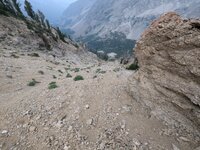
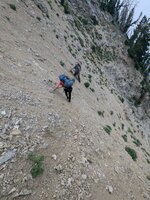
2 years ago I did the Pioneer Mountain traverse, we did 32 miles in less than 48 hours, lowest elevation on that trip was about 7k with our highest elevation around 11,200.

Rucking and walking is my only cardio. I do lift Monday, Tuesday, Thursday and Friday with Sunday my only day off.

Here is some of the shit we went up and down on the traverse trip.
 

Attachments

  • PXL_20240728_144416572.jpg
    PXL_20240728_144416572.jpg
    608.5 KB · Views: 7
  • PXL_20240728_144413747.jpg
    PXL_20240728_144413747.jpg
    673.8 KB · Views: 6
I'm a 50 year old rucker. I ruck Wednesday and Saturday. Wednesday is my light but gas ruck day. 40 lbs at 13-13:30 miles for 5-7 miles.

Saturday is heavier and slower. Currently 50 pounds at 15 minute miles, usually 4-6 miles.

I have a mortons neuroma on my left foot and it determines my milage, some days it's not to bad, other days it's like stepping on a tack every time my left foot plants.

2 years ago I did the Pioneer Mountain traverse, we did 32 miles in less than 48 hours, lowest elevation on that trip was about 7k with our highest elevation around 11,200.

Rucking and walking is my only cardio. I do lift Monday, Tuesday, Thursday and Friday with Sunday my only day off.

Here is some of the shit we went up and down on the traverse trip.

Have you ever considered taking the stairs? I think would really push you over the top.

I say that tongue in cheek. Epic stuff!


Sent from my iPhone using Tapatalk
 
None of the factors you mentioned are the limiting factor to anyone in the mountains. Sucking wind, cramping, delayed recovery, elevated HR etc. ruin hunts, not stabilizer muscles. A dude that is strong can handle hiking downhill just fine.

You need a higher vo2 max and mitochondrial density, those are quantifiable adaptations that translate directly to the mountains, and can be trained with great specificity on a stair climber.

This all goes back to your original comment that stairs dont mimic the mountains

Is there evidence showing that a stair master is as effective or nearly as effective as actual, fixed stairs?

I asking because I prefer stairs or bleachers at my local middle school stadium vs the stair master at the gym across the street.

But, when it’s hot out, sometimes the gym and a/c is where I end up.


Sent from my iPhone using Tapatalk
 
Back
Top