Questions for Form and other "small caliber for big game" folks

There is a guy in Australia (and a few others) that do testing for Hammer, and it varies a little bullet to bullet, but at least with petal shedding monos, velocity (and rpm) both significantly add to internal damage, both to permanent and temporary wound channel. They note several “steps”, from lower and minimum impacts, to normal fast to say 2800-3k, then a big jump in destruction as speeds go up from there. Varies by bullet some. I recall some necropsy photos from impacts in the 3500+ range that were far more damage than anyone hunting meat probably wants.


Sent from my iPhone using Tapatalk
I forgot about the RPM component but yeah I recall seeing that too.


For some reason, I missed that entire thread the entire couple of years I've been active on here. Don't know why/how. But just read it front to back, and it's absolutely excellent. I've seen small bits and pieces of the content in various other replies and posts you've made, but not all in one place like this. Frankly, I'm not sure there's much at all anyone asks you about small caliber/match bullets - including some questions from me - that wasn't answered in very deep, patient detail in that thread.

That thread's the Easy Button for questions on match bullets, and small caliber. Honestly, it should be basic reading for someone before they ask you questions on match bullets. The depth of detail and nuance between calibers and specific bullets, and all the reasoning and data behind it, was exquisite. Combined with the photos of the .223 success thread, anything else is just repeating what's in these two threads.
 
For some reason, I missed that entire thread the entire couple of years I've been active on here. Don't know why/how. But just read it front to back, and it's absolutely excellent. I've seen small bits and pieces of the content in various other replies and posts you've made, but not all in one place like this. Frankly, I'm not sure there's much at all anyone asks you about small caliber/match bullets - including some questions from me - that wasn't answered in very deep, patient detail in that thread.

That thread's the Easy Button for questions on match bullets, and small caliber. Honestly, it should be basic reading for someone before they ask you questions on match bullets. The depth of detail and nuance between calibers and specific bullets, and all the reasoning and data behind it, was exquisite. Combined with the photos of the .223 success thread, anything else is just repeating what's in these two threads.

Holy Cow,
Agree.

https://rokslide.com/forums/threads/why-match-target-bullets-for-hunting.203770/

Form, your posts in that thread are the best explanation of the issues I have seen and should be published as a book. Or at the least they should be pinned and included as a primer for anyone going through the painful process of questioning the last 100 years of bullet and caliber "best practices."

As for my previous questions about terminal ballistic performance these specific posts are invaluable:


I will dig into Fackler and Roberts to better understand. Curious as to why they even reference Temporary Cavity when it appears that it has no real affect on terminal ballistic performance. If it tears due to high velocity bullet impact doesn't it just become part of the Permanent Cavity anyway?

So, let us rule out hydrostatic shock or temporary cavity as a meaningful contributor towards fast and ethical killing!

 
Holy Cow,
Agree.

https://rokslide.com/forums/threads/why-match-target-bullets-for-hunting.203770/

Form, your posts in that thread are the best explanation of the issues I have seen and should be published as a book. Or at the least they should be pinned and included as a primer for anyone going through the painful process of questioning the last 100 years of bullet and caliber "best practices."

As for my previous questions about terminal ballistic performance these specific posts are invaluable:


I will dig into Fackler and Roberts to better understand. Curious as to why they even reference Temporary Cavity when it appears that it has no real affect on terminal ballistic performance. If it tears due to high velocity bullet impact doesn't it just become part of the Permanent Cavity anyway?

So, let us rule out hydrostatic shock or temporary cavity as a meaningful contributor towards fast and ethical killing!

The temporary cavity is one of the four main wounding mechanisms. Depending on bullet type and impact velocity, it can have little to no effect- or massive effects.

“Hydrostatic shock” has been disproven in medical studies in conjunction with terminal ballistics testing for the last 30+ years.
 
@Formidilosus I've listened to and read everything I can of yours, most of it multiple times - thank you. I understand your points and in agreement. Here's a couple questions from it all:

1. Copper monos out to 100yds - at their highest velocities, are they still very small wounds or does the max velocity 'guarantee' full expansion and a wound cavity that makes them desirable over a bonded or fragmenting bullet? Are the tiny wound channels you reference at longer ranges or does that include in the woods distances? I know you use them for meat hunts, especially in the open (not woods), and I know the concerns about blood trailing.

2. I chose a 243 for velocity, bullet size, and availability in Alaska after listening to the Exo small caliber podcast. Do you see a benefit or use case for bonded bullets over ELD-X? Many of the bondeds fragment and it seems the ones that dont fragment REALLY upset into very wide mushrooms. What's the thought process in selecting which kind of bullet to use? Or, if the rifles shoot the ELD-X well, just stick with that? Curious to hear your decision process thoughts on bondeds, as I heard you recommend SSTs, etc. I really do not see myself taking very many shots on animals beyond 300 yds, but would like the ability to do so, if needed.

Thanks!
 
@Formidilosus one more:
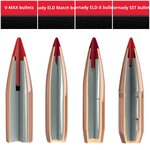
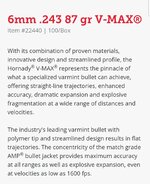
3. I remember you saying SSTs are essentially the same as another Hornady bullet. In the same thought process as question #2, which Hornady bullet do you recommend and why, or, what's the actual differences in the V-Max, ELD-X/M, and SST? I see the jacket thickness, space behind the tip for increased ability to upset, and the SST's crimp below the ogive, so the question is more like why/when pick each of these bullets - V-Max or SST instead of ELD-X/M if I have all three and they all shoot well? For example, the 75gr V-Max has the best velocity and trajectory at 500yds by far, AND Hornady actually says it 'upsets' to 1600fps, as we can assume by the bullet construction compared to the others.
 

Attachments

  • 20241201_203318.jpg
    20241201_203318.jpg
    174.6 KB · Views: 62
  • Screenshot_20241201-203111_Chrome.jpg
    Screenshot_20241201-203111_Chrome.jpg
    224.6 KB · Views: 62
1. Copper monos out to 100yds - at their highest velocities, are they still very small wounds or does the max velocity 'guarantee' full expansion and a wound cavity that makes them desirable over a bonded or fragmenting bullet?
Desirable is subjective to the desires of the user which aren't black and white, your question is flawed. Petal peeling monos, for example, will ALWAYS have a narrowish wound channel, you just maximize it with velocity (edit to add, hitting bone creates more damage but that is the bone fragments enlarging the wound channel not the bullet itself). A narrow (but sufficent) wound channel being labeled "desirable" is not a one size fits all answer.

I have very successfully hunted monos well past 100yds, that is silly short distance limitation out west, but I put that narrower "broadhead like" wound channel through the heart/arterial bundle area and I do not purposely shoot rear lungs.

A user has to decide where they rank things like pass throughs, meat damage, recoil of the cartridge vs distance shot (you can shoot a high BC match bullet further and remain effect than a mono, a mono NEEDS more velocity and tend to have lower BC so you'd have a bigger cartridge to be effective at the same distances), etc.
 
Last edited:
@Formidilosus I've listened to and read everything I can of yours, most of it multiple times - thank you. I understand your points and in agreement. Here's a couple questions from it all:

1. Copper monos out to 100yds - at their highest velocities, are they still very small wounds or does the max velocity 'guarantee' full expansion and a wound cavity that makes them desirable over a bonded or fragmenting bullet?

The expectation for average wound channel width is still 1-1.5”. Sometimes wider, sometimes narrower.

There is nothing about standard mono wound channels that make them more desirable then heavy for caliber fragmenting bullets- unless meat loss is the primary concern.


Are the tiny wound channels you reference at longer ranges or does that include in the woods distances? I know you use them for meat hunts, especially in the open (not woods), and I know the concerns about blood trailing.

Same as above- in general, expect 1” to 1.5” wounds.


2. I chose a 243 for velocity, bullet size, and availability in Alaska after listening to the Exo small caliber podcast. Do you see a benefit or use case for bonded bullets over ELD-X?

No.


Many of the bondeds fragment and it seems the ones that dont fragment REALLY upset into very wide mushrooms. What's the thought process in selecting which kind of bullet to use?

Meat damage primarily


Or, if the rifles shoot the ELD-X well, just stick with that? Curious to hear your decision process thoughts on bondeds, as I heard you recommend SSTs, etc. I really do not see myself taking very many shots on animals beyond 300 yds, but would like the ability to do so, if needed.
Thanks!

For sub 500’ish yards, the Nosler 95gr Ballistic Tip is very hard to top, and is what I would probably choose first for your use case.


@Formidilosus one more:
3. I remember you saying SSTs are essentially the same as another Hornady bullet. In the same thought process as question #2, which Hornady bullet do you recommend and why, or, what's the actual differences in the V-Max, ELD-X/M, and SST? I see the jacket thickness, space behind the tip for increased ability to upset, and the SST's crimp below the ogive, so the question is more like why/when pick each of these bullets - V-Max or SST instead of ELD-X/M if I have all three and they all shoot well? For example, the 75gr V-Max has the best velocity and trajectory at 500yds by far, AND Hornady actually says it 'upsets' to 1600fps, as we can assume by the bullet construction compared to the others.


V-max is a varmint bullet and may not have sufficient penetration on some animals/shots. The SST is in general probably the best killing bullet that Hornady currently makes due to the old too material and more space in the nose- but that varies with each caliber/weight. ELD-X and M’s mostly crossover each other.
 
Formidilosus, is there any reason to choose a 6mm creedmoor over say a 243 Winchester? Really looking hard at either a Sako or Tikka in 243. I reload if that has anything to do with the choice. Thanks for all the info you have shared.
 
Formidilosus, is there any reason to choose a 6mm creedmoor over say a 243 Winchester? Really looking hard at either a Sako or Tikka in 243. I reload if that has anything to do with the choice. Thanks for all the info you have shared.

Factory ammo with high BC bullets, that’s functionally mostly it.
 
Formidilosus, is there any reason to choose a 6mm creedmoor over say a 243 Winchester? Really looking hard at either a Sako or Tikka in 243. I reload if that has anything to do with the choice. Thanks for all the info you have shared.
1. Recoil is a little less in a 243, but not by a lot, which could probablybe mitigated by getting a better stock/chassis on the Tikka and using a suppressor.
2. If shooting 500 and farther on animals, one of the 6mms will offer higher weight/BC bullets to do a better job beyond 500. If hunting in the woods or maybe to 300-400yds, either works just fine.
3. 243 has had better ammo availability, but that seems to be rapidly changing. I honestly should've gotten a 6CM but the 243 is only a placeholder for me until 22CM is an over the counter, less expensive option.
4. 243 is cheaper ammo than a 6mm, but that's a generalized statement.
5. Twist rates vary in 243 but seem pretty standard at 1:8 in the 6s. That means pretty reliable performance from 6s but variable or limiting with 243s from brand to brand. If you go 243, get a Tikka for sure, with their 1:8. Unknown has the heaver 6mm bullets loaded in 243 brass for the 1:8 Tikka 243s, which would be marginal with a 1:9 like on my Ruger. That was a mistake on my part. I learned of Form, small cals for big game, and Rokslide literally right after I bought the Ruger.
 
I just wish there were a good factory supressor ready rifle option for 6mm creed..... pretty slim pickins.
Great point and reminder for me. THIS is actually why i went 243... i found a 243 in stock where i live that fit this bill. Threaded, good 6mms over the counter seem rare still, unless you got $$$$$.
 
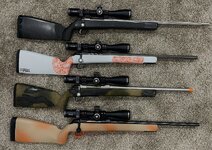
The rifle I mentioned above is what the light grey stock gun is. Factory tikka action and barrel threaded from the factory. It absolutely hammers 95 SST factory ammo as well as 103 ELDX and 108 ELDM hand loads. It now wears a suppressor and is a dream to shoot and carry.

IMG_9175.jpeg
 
Tape the muzzles when in the field. No, I/we do not clean the barrels. Wipe the bolt down, spray brake cleaner and flush the action is needed, relube the bolt and action, move on with life.

No, never disassemble just to check. Degrease, thread lock and torque. Then leave it alone.


There is a LOT of elk, moose, bear, deer, mountain goats, etc., shot in every conceivable position and impact location. Read the every page of the thread from the beginning- it is worth it.


The 243 win is functional identical to the 6cm. The simple answer is the less recoil the better.
To each their own but I will clean as normal and keep my kit and my gear in a high state of readiness.

Fouling a barrel is very different from a dirty barrel. Fouling is a great idea, especially after cleaning. A dirty barrel is full of reasons that affect accuracy and the integrity of the barrel - a really dirty barrel may even affect pressures and bullet seating, not to mention action performance.

Brake Cleaner is a mixture of volatile hydrocarbons VOCs, Toluene, xylene, heptane, benzene, acetone and many others. Its fine in small quantities to strip parts with a breather on and the notion of cleaning down to bare metal would seem to make sense however those chemicals highly toxic and should not come in contact with humans on a regular basis. Breathing it in any large quantity has shown lung and brain toxicity.
 
Back
Top