I have not said it is the most healthy. You on the other hand are acting like running ultras is the same as smoking (a risk factor). Then you site data that shows it is not, but misrepresent that data.
You would have done well to read the summary as well and check your interpretation against the authors. It shows that the authors understand statistical significance and disagree with your interpretation that ignores CIs.
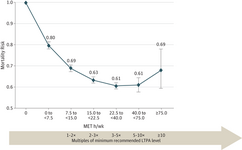
If you read it, then like me, you knew the data in the text you quoted was also presented in a more interpretable format in the graph I posted. It begs the question, why did you choose to extract the format that is more likely to be misinterpreted?
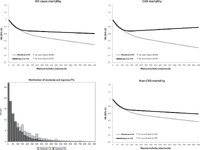
The below is from the more recent study I linked earlier. It has the same issue regarding a small n for the higher activity levels, but the disagreement in the graphs show why confidence intervals matter.
View attachment 1043807
You should be happy with this one, it shows moderate activity trumps vigorous at high volumes. But, it does not show vigorous activity being a risk factor, so does not support your initial assertion.
I addressed the biomarkers in an earlier post, so will not repeat myself beyond pointing out that the levels that worry you are frequently described as clinically insignificant in cardiology.
There are people who are stuck at the text book, then there are people who understand the concepts. Saying that any Hb A1c above 5.6% is always metabolic syndrome or any BMI above 25 is bad is not an art, nor is it good medicine, nor science. You have to be able to interpret basics before claiming a sweeping view of "all the data".
As an aside, I have had this conversation with Mayo Clinic preventative cardiologists and sports cardiologist and their interpretation was closer to mine than yours. It doesn't make mine or theirs correct, but I'm far from being alone in my interpretation, which says I'm not too far out on a limb.