Endurance athletes and Hb A1c

This is based on a couple of recent survey studies of Olympic athletes and didn’t look at other factors like socioeconomic.

Not sure it exactly put the baby to bed.
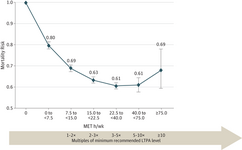
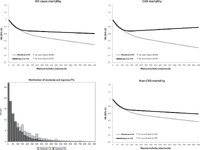
There are other studies, going back to the marathon study in the first half of the 20th century (people have wanted to believe laziness is healthy for a long time). Results were the same back then too, despite the hand ringing of the medical community, running marathons didn't shorten life expectancy.

However, SES doesn't stand up as higher SES confers reduction in mortality from mental illness and neurologic disorders, yet Olympic athletes have no benefit in those areas.
 
There are other studies, going back to the marathon study in the first half of the 20th century (people have wanted to believe laziness is healthy for a long time). Results were the same back then too, despite the hand ringing of the medical community, running marathons didn't shorten life expectancy.

However, SES doesn't stand up as higher SES confers reduction in mortality from mental illness and neurologic disorders, yet Olympic athletes have no benefit in those areas.
The problem I see with the study and results:

Comparing life expectancy alone can be misleading without controlling other factors. Socioeconomics play a big role in life expectancy, and most Olympic athletes are rich.

Also, comparing to the general population is not ideal. There are many benefits athletes have such as ideal body weight that could offer benefit to LES, while the extended aerobic exercise could be negative.

A better study would be endurance athlete vs non endurance athletes, or moderate exercisers. The Olympic study did that a little, and there was some data trending toward moderate exercisers living longer than the endurance athletes.

My bottom line thought.

Being an ultra marathoner is better/healthier than being an overweight slob. That’s a low bar.

I’m not convinced it’s healthier than being a moderate exerciser who mixes 30-45 min of strength and cardio training 4-5 days a week. I think your hgb A1c data is pointing towards this same finding.
 
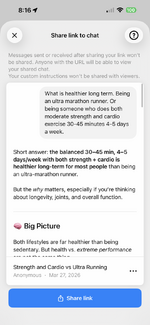
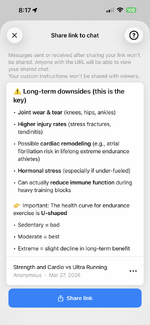
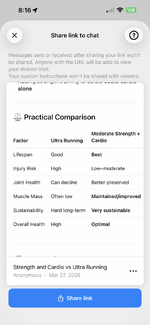
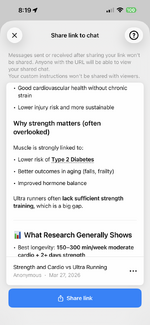
After writing that I asked ChatGPT and it agreed with my assessment.

Of note it picks up on the increased life expectancy of moderate vs extreme. It also picks up on the potential diabetes risk of ultra endurance.
IMG_7878.pngIMG_7879.pngIMG_7877.png
IMG_7880.png
 
The problem I see with the study and results:

Comparing life expectancy alone can be misleading without controlling other factors. Socioeconomics play a big role in life expectancy, and most Olympic athletes are rich.

Also, comparing to the general population is not ideal. There are many benefits athletes have such as ideal body weight that could offer benefit to LES, while the extended aerobic exercise could be negative.

A better study would be endurance athlete vs non endurance athletes, or moderate exercisers. The Olympic study did that a little, and there was some data trending toward moderate exercisers living longer than the endurance athletes.

My bottom line thought.

Being an ultra marathoner is better/healthier than being an overweight slob. That’s a low bar.

I’m not convinced it’s healthier than being a moderate exerciser who mixes 30-45 min of strength and cardio training 4-5 days a week. I think your hgb A1c data is pointing towards this same finding.

I think there almost always exists a tipping point where one is sacrificing health for performance. Its generally easy to use examples of competitive strong men, often pushing 500 lbs in competition shape or NFL lineman who are extremely strong, athletic and genetically gifted but may very well be sacrificing some amount of longetivity due to the inherent size requirements of their sport. On the flip side, people often assume endurance athletes to be extremely healthy because they tend to be thin and get lots of conditioning training (ie cardio = good, more cardio = better), but the same thing also applies at the opposing end of the spectrum. Over specialization in performance doesn't necessarily equate to good general health.
 
I think there almost always exists a tipping point where one is sacrificing health for performance. Its generally easy to use examples of competitive strong men, often pushing 500 lbs in competition shape or NFL lineman who are extremely strong, athletic and genetically gifted but may very well be sacrificing some amount of longetivity due to the inherent size requirements of their sport. On the flip side, people often assume endurance athletes to be extremely healthy because they tend to be thin and get lots of conditioning training (ie cardio = good, more cardio = better), but the same thing also applies at the opposing end of the spectrum. Over specialization in performance doesn't necessarily equate to good general health.
Amen.
 
Socioeconomics play a big role in life expectancy, and most Olympic athletes are rich.
Wrong. Most Olympic athletes are not ritch, the get payed very little for competing and go into normal jobs when done. Most olympians are not winning gold and are not getting high paying sponsorships.
 
Wrong. Most Olympic athletes are not ritch, the get payed very little for competing and go into normal jobs when done. Most olympians are not winning gold and are not getting high paying sponsorships.
Ha

Most come from rich families. Swimming. Tennis. Gymnastics. Every winter sport. Most come from rich families.

You didn’t ask a question. You stated something you wanted backed up because it is the lifestyle you have chosen. Lots have chimed in that you’re not looking at the data objectively.

Your a1c should not be explained off because you run long distances. Neither should your weight above the line for normal. You’re not special. Those numbers are still warning signs on the dashboard.
 
Ha

Most come from rich families. Swimming. Tennis. Gymnastics. Every winter sport. Most come from rich families.
Ask Chat GPT, it says most are financially strained and the majority don't have long term wealth after the Olympics. AI is slop, but seeing as you go to the slop bucket, you should be fine with a slop bucket answer. I will not spam the slide with screen shots, but I did attach two just for you (as the slop bucket is known to be inconsistent).

You didn’t ask a question. You stated something you wanted backed up because it is the lifestyle you have chosen. Lots have chimed in that you’re not looking at the data objectively.
I did not ask a question. I would not come to Rokslide for health information any more than a master plumber would for plumbing information. I was sharing information to help others and I stated as much.

Your a1c should not be explained off because you run long distances. Neither should your weight above the line for normal. You’re not special. Those numbers are still warning signs on the dashboard.
Specificity of Hb A1c for prediabetes is around 60-80%. Any good clinician will not hang their hat on that if it doesn't fit the picture and will seek further testing.

Did you know, you can have prediabetes at Hb A1c below the 5.6% cut point? Testing choices are about compromise between specificity, sensitivity, and practicality. Population level trade offs are tailored for the mean and not the tails.

BMI is widely acknowledged to have flaws within the medical community. Saying a high BMI is bad when reliably assessed fat mass is in the healthy range is laughable. It is equally laughable to call a healthy weight BMI good when fat mass is well above the healthy range. Again, mean vs tails.

Good clinicians know the mean, and they also know they will see people in the tails and care is individualized.

Put differently, just like a good hunter knows when it is time to pull out the glass and take a closer look at the "rock" or "snow patch", a good clinician knows when it is time to look closer.
 

Attachments

  • Screenshot_20260327_075026_Chrome.jpg
    Screenshot_20260327_075026_Chrome.jpg
    102.3 KB · Views: 0
  • Screenshot_20260327_075103_Chrome.jpg
    Screenshot_20260327_075103_Chrome.jpg
    96.9 KB · Views: 0
Back
Top