Endurance athletes and Hb A1c

This is based on a couple of recent survey studies of Olympic athletes and didn’t look at other factors like socioeconomic.

Not sure it exactly put the baby to bed.
There are other studies, going back to the marathon study in the first half of the 20th century (people have wanted to believe laziness is healthy for a long time). Results were the same back then too, despite the hand ringing of the medical community, running marathons didn't shorten life expectancy.

However, SES doesn't stand up as higher SES confers reduction in mortality from mental illness and neurologic disorders, yet Olympic athletes have no benefit in those areas.
 
There are other studies, going back to the marathon study in the first half of the 20th century (people have wanted to believe laziness is healthy for a long time). Results were the same back then too, despite the hand ringing of the medical community, running marathons didn't shorten life expectancy.

However, SES doesn't stand up as higher SES confers reduction in mortality from mental illness and neurologic disorders, yet Olympic athletes have no benefit in those areas.
The problem I see with the study and results:

Comparing life expectancy alone can be misleading without controlling other factors. Socioeconomics play a big role in life expectancy, and most Olympic athletes are rich.

Also, comparing to the general population is not ideal. There are many benefits athletes have such as ideal body weight that could offer benefit to LES, while the extended aerobic exercise could be negative.

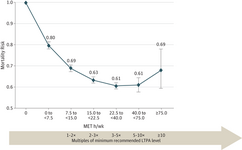
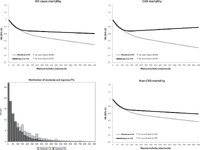
A better study would be endurance athlete vs non endurance athletes, or moderate exercisers. The Olympic study did that a little, and there was some data trending toward moderate exercisers living longer than the endurance athletes.

My bottom line thought.

Being an ultra marathoner is better/healthier than being an overweight slob. That’s a low bar.

I’m not convinced it’s healthier than being a moderate exerciser who mixes 30-45 min of strength and cardio training 4-5 days a week. I think your hgb A1c data is pointing towards this same finding.
 
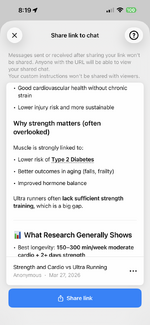
After writing that I asked ChatGPT and it agreed with my assessment.

Of note it picks up on the increased life expectancy of moderate vs extreme. It also picks up on the potential diabetes risk of ultra endurance.
IMG_7878.pngIMG_7879.pngIMG_7877.png
IMG_7880.png
 
The problem I see with the study and results:

Comparing life expectancy alone can be misleading without controlling other factors. Socioeconomics play a big role in life expectancy, and most Olympic athletes are rich.

Also, comparing to the general population is not ideal. There are many benefits athletes have such as ideal body weight that could offer benefit to LES, while the extended aerobic exercise could be negative.

A better study would be endurance athlete vs non endurance athletes, or moderate exercisers. The Olympic study did that a little, and there was some data trending toward moderate exercisers living longer than the endurance athletes.

My bottom line thought.

Being an ultra marathoner is better/healthier than being an overweight slob. That’s a low bar.

I’m not convinced it’s healthier than being a moderate exerciser who mixes 30-45 min of strength and cardio training 4-5 days a week. I think your hgb A1c data is pointing towards this same finding.

I think there almost always exists a tipping point where one is sacrificing health for performance. Its generally easy to use examples of competitive strong men, often pushing 500 lbs in competition shape or NFL lineman who are extremely strong, athletic and genetically gifted but may very well be sacrificing some amount of longetivity due to the inherent size requirements of their sport. On the flip side, people often assume endurance athletes to be extremely healthy because they tend to be thin and get lots of conditioning training (ie cardio = good, more cardio = better), but the same thing also applies at the opposing end of the spectrum. Over specialization in performance doesn't necessarily equate to good general health.
 
I think there almost always exists a tipping point where one is sacrificing health for performance. Its generally easy to use examples of competitive strong men, often pushing 500 lbs in competition shape or NFL lineman who are extremely strong, athletic and genetically gifted but may very well be sacrificing some amount of longetivity due to the inherent size requirements of their sport. On the flip side, people often assume endurance athletes to be extremely healthy because they tend to be thin and get lots of conditioning training (ie cardio = good, more cardio = better), but the same thing also applies at the opposing end of the spectrum. Over specialization in performance doesn't necessarily equate to good general health.
Amen.
 
Back
Top