Endurance athletes and Hb A1c

This is based on a couple of recent survey studies of Olympic athletes and didn’t look at other factors like socioeconomic.

Not sure it exactly put the baby to bed.
There are other studies, going back to the marathon study in the first half of the 20th century (people have wanted to believe laziness is healthy for a long time). Results were the same back then too, despite the hand ringing of the medical community, running marathons didn't shorten life expectancy.

However, SES doesn't stand up as higher SES confers reduction in mortality from mental illness and neurologic disorders, yet Olympic athletes have no benefit in those areas.
 
There are other studies, going back to the marathon study in the first half of the 20th century (people have wanted to believe laziness is healthy for a long time). Results were the same back then too, despite the hand ringing of the medical community, running marathons didn't shorten life expectancy.

However, SES doesn't stand up as higher SES confers reduction in mortality from mental illness and neurologic disorders, yet Olympic athletes have no benefit in those areas.
The problem I see with the study and results:

Comparing life expectancy alone can be misleading without controlling other factors. Socioeconomics play a big role in life expectancy, and most Olympic athletes are rich.

Also, comparing to the general population is not ideal. There are many benefits athletes have such as ideal body weight that could offer benefit to LES, while the extended aerobic exercise could be negative.

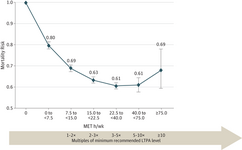
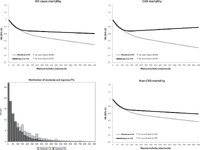
A better study would be endurance athlete vs non endurance athletes, or moderate exercisers. The Olympic study did that a little, and there was some data trending toward moderate exercisers living longer than the endurance athletes.

My bottom line thought.

Being an ultra marathoner is better/healthier than being an overweight slob. That’s a low bar.

I’m not convinced it’s healthier than being a moderate exerciser who mixes 30-45 min of strength and cardio training 4-5 days a week. I think your hgb A1c data is pointing towards this same finding.
 
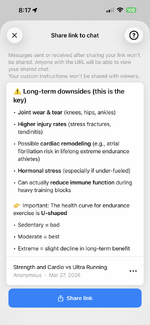
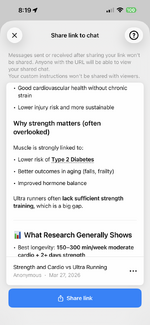
After writing that I asked ChatGPT and it agreed with my assessment.

Of note it picks up on the increased life expectancy of moderate vs extreme. It also picks up on the potential diabetes risk of ultra endurance.
IMG_7878.pngIMG_7879.pngIMG_7877.png
IMG_7880.png
 
The problem I see with the study and results:

Comparing life expectancy alone can be misleading without controlling other factors. Socioeconomics play a big role in life expectancy, and most Olympic athletes are rich.

Also, comparing to the general population is not ideal. There are many benefits athletes have such as ideal body weight that could offer benefit to LES, while the extended aerobic exercise could be negative.

A better study would be endurance athlete vs non endurance athletes, or moderate exercisers. The Olympic study did that a little, and there was some data trending toward moderate exercisers living longer than the endurance athletes.

My bottom line thought.

Being an ultra marathoner is better/healthier than being an overweight slob. That’s a low bar.

I’m not convinced it’s healthier than being a moderate exerciser who mixes 30-45 min of strength and cardio training 4-5 days a week. I think your hgb A1c data is pointing towards this same finding.

I think there almost always exists a tipping point where one is sacrificing health for performance. Its generally easy to use examples of competitive strong men, often pushing 500 lbs in competition shape or NFL lineman who are extremely strong, athletic and genetically gifted but may very well be sacrificing some amount of longetivity due to the inherent size requirements of their sport. On the flip side, people often assume endurance athletes to be extremely healthy because they tend to be thin and get lots of conditioning training (ie cardio = good, more cardio = better), but the same thing also applies at the opposing end of the spectrum. Over specialization in performance doesn't necessarily equate to good general health.
 
I think there almost always exists a tipping point where one is sacrificing health for performance. Its generally easy to use examples of competitive strong men, often pushing 500 lbs in competition shape or NFL lineman who are extremely strong, athletic and genetically gifted but may very well be sacrificing some amount of longetivity due to the inherent size requirements of their sport. On the flip side, people often assume endurance athletes to be extremely healthy because they tend to be thin and get lots of conditioning training (ie cardio = good, more cardio = better), but the same thing also applies at the opposing end of the spectrum. Over specialization in performance doesn't necessarily equate to good general health.
Amen.
 
Socioeconomics play a big role in life expectancy, and most Olympic athletes are rich.
Wrong. Most Olympic athletes are not ritch, the get payed very little for competing and go into normal jobs when done. Most olympians are not winning gold and are not getting high paying sponsorships.
 
Wrong. Most Olympic athletes are not ritch, the get payed very little for competing and go into normal jobs when done. Most olympians are not winning gold and are not getting high paying sponsorships.
Ha

Most come from rich families. Swimming. Tennis. Gymnastics. Every winter sport. Most come from rich families.

You didn’t ask a question. You stated something you wanted backed up because it is the lifestyle you have chosen. Lots have chimed in that you’re not looking at the data objectively.

Your a1c should not be explained off because you run long distances. Neither should your weight above the line for normal. You’re not special. Those numbers are still warning signs on the dashboard.
 
Ha

Most come from rich families. Swimming. Tennis. Gymnastics. Every winter sport. Most come from rich families.
Ask Chat GPT, it says most are financially strained and the majority don't have long term wealth after the Olympics. AI is slop, but seeing as you go to the slop bucket, you should be fine with a slop bucket answer. I will not spam the slide with screen shots, but I did attach two just for you (as the slop bucket is known to be inconsistent).

You didn’t ask a question. You stated something you wanted backed up because it is the lifestyle you have chosen. Lots have chimed in that you’re not looking at the data objectively.
I did not ask a question. I would not come to Rokslide for health information any more than a master plumber would for plumbing information. I was sharing information to help others and I stated as much.

Your a1c should not be explained off because you run long distances. Neither should your weight above the line for normal. You’re not special. Those numbers are still warning signs on the dashboard.
Specificity of Hb A1c for prediabetes is around 60-80%. Any good clinician will not hang their hat on that if it doesn't fit the picture and will seek further testing.

Did you know, you can have prediabetes at Hb A1c below the 5.6% cut point? Testing choices are about compromise between specificity, sensitivity, and practicality. Population level trade offs are tailored for the mean and not the tails.

BMI is widely acknowledged to have flaws within the medical community. Saying a high BMI is bad when reliably assessed fat mass is in the healthy range is laughable. It is equally laughable to call a healthy weight BMI good when fat mass is well above the healthy range. Again, mean vs tails.

Good clinicians know the mean, and they also know they will see people in the tails and care is individualized.

Put differently, just like a good hunter knows when it is time to pull out the glass and take a closer look at the "rock" or "snow patch", a good clinician knows when it is time to look closer.
 

Attachments

  • Screenshot_20260327_075026_Chrome.jpg
    Screenshot_20260327_075026_Chrome.jpg
    102.3 KB · Views: 0
  • Screenshot_20260327_075103_Chrome.jpg
    Screenshot_20260327_075103_Chrome.jpg
    96.9 KB · Views: 0
Thanks for posting this; I had to go through the last couple of years of metabolic tests to see where I sit. It appears mine is below the threshold for pre-diabetes. Guessing thats probably why it hasn't been brought up.

Completely unrelated, but my BMI usually show me overweight—I had a DEXA scan done it shows not.

My creatine levels almost always show me slightly above the normal range (I take a daily dose of 5mg) that causes them some concern. What I do now is when I'm due for my annual metabolic panel, I quit taking creatine for a week before hand and it lands in the normal range.

Again probably not directly related, but blood taken from elite ultra runners after a race typically show a lot of "bad" markers. While I have the highest respect for these athletes, I don't think that can be overly good for a person race after race, year after year.
 
Thanks for posting this; I had to go through the last couple of years of metabolic tests to see where I sit. It appears mine is below the threshold for pre-diabetes. Guessing thats probably why it hasn't been brought up.

Completely unrelated, but my BMI usually show me overweight—I had a DEXA scan done it shows not.

My creatine levels almost always show me slightly above the normal range (I take a daily dose of 5mg) that causes them some concern. What I do now is when I'm due for my annual metabolic panel, I quit taking creatine for a week before hand and it lands in the normal range.

Ideally the patient is treated and decisions are not made to treat the medical team (which is what you are describing). The problem is reasoning takes lots of energy and most providers are over worked as it is. Some patients bringing up excellent points, and some have so much BS that they are literally hurting themselves with bad information.

Again probably not directly related, but blood taken from elite ultra runners after a race typically show a lot of "bad" markers. While I have the highest respect for these athletes, I don't think that can be overly good for a person race after race, year after year.

There is a huge difference between saying something is bad, and saying something is not the best. I make no argument that long course endurance is best, only that it is not bad. I've even said training loads past 300 minutes a week isn't something to be done for health reasons.

You have to be careful interpreting markers of risk outside of a validated context.

Blood pressure (to use an example that is unlikely to be controversial), in a healthy person BP goes up during activity. Knowing that high blood pressure is bad and damages every organ in the body, one could argue that anything other than slow walking is unhealthy. That would be wrong with no exception that doesn't involve reaching far into the tails of the distribution for a zebra**.

We know that high intensity training increases cortisol, should anything faster that a 13 minute mile be avoided?

Creatine kinase (a marker of skeletal muscle injury) levels go up after weight lifting, but is all weight training causing long term muscle damage? There is a huge continuum between 1 pound curls and an ICU stay for rabdo and the range of that continuum depends on the individual.

Trying to read significance into a small increase in cardiac troponin (a marker of heart muscle injury and likely one of the markers you are thinking of) in the context of no heart attack (and no amyloidosis or HCM or microvasculature dysfunction or chronic ischemia, Etc) is only making educated guesses. The same holds for NT-proBNP and ck-MB. The levels of increase we are talking about are well below the levels associated with the acute illness's for which they are signs of badness.

You could read these markers as a sign of long term injury, or you could read it as like the muscle damage associated with proper weight lifting and a marker of training. Biomechanical systems adapt and get stronger in response to stress. All training is intentionally causing damage to provoke an adaptive response.
The catch here is at what point is the recovery response overwhelmed. We know from athletic training for muscle/joints/connective tissue this varies by individual and training history. The use of PEDs really complicates the assessment of if just being strong in itself is bad, or if it is the lifestyles of professional weight lifters that is bad. Being physically larger is likely bad past a certain point regardless of muscle vs fat mass as taller people tend to have lower life expectancy. If a person not using PEDs and not training to the point of acute injury can push themselves over the line to obviously worse health than the general population is not a topic I have researched much. I suspect the answer is no.

Adding in unhealthy behaviors to gain performance is not the same as adding more training. An endurance athlete who restricts calories to drop below healthy body fat level and improve in competition is not making a healthy choice. Yet, even with the higher prevalence of such choices in elite athletes, from altra marathoners to olympians to Tour de France riders data show increased life expectancy, usually solidly in the upper end of gains from that appear possible from exercise. Team sports like soccer and baseball have mixed data with some studies showing an associated with decreased life expectancy. Yet I have never heard anyone advise against participating in these.

Before the 1960s medical opinion was that a person would die if they ran much further than a marathon, then some SAS guys decided to see if Herodotus might not have telling an impossible tall tail when he said a runner was sent 135 miles from Athens to Sparta, and they didn't die.


**To explain the zebra reference, if you hear hoof beats in Montana, you think horses. It could be a zebra that escaped, but that is not a reasonable place to start.
 
Again probably not directly related, but blood taken from elite ultra runners after a race typically show a lot of "bad" markers. While I have the highest respect for these athletes, I don't think that can be overly good for a person race after race, year after year.
I've followed these findings with interest. As I understand it, it's relatively confirmed that the bad markers--which point to muscle damage, gut leaking, and similar things--tend to go away quickly and there's reason to believe the healing process get you back to at least as good, or perhaps better, as before.

But I would also agree that, as a matter of common sense, there has to be some upper limit regarding how many times you can truly push yourself over 50 or 100 miles. Lots of stress there!

The BMI one is interesting. I'm always in the "healthy" range, but close to the top. I've started getting DEXA scans, which confirm that is not of concern (16%ish body fat). But man, it's tough to get actual doctors to talk about things like this - in my experience, it's almost always an NP or MD that provides the canned recommendations, whether "numbers are good, keep it up" or "numbers are good, watch the BMI," without really digging in.

Thanks to all for the perspective.
 
Back
Top