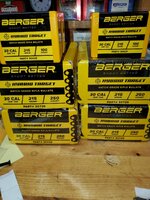
Once again you show your impeccable taste!#4 without hesitation. That’s what that scope was made for.
That very scope is on my ‘next-scope-to-buy’ list. As soon as I get the requisite spousal approval, that is.

Follow along with the video below to see how to install our site as a web app on your home screen.
Note: This feature may not be available in some browsers.
Once again you show your impeccable taste!#4 without hesitation. That’s what that scope was made for.

I would like to hear of the losses using this combination also. As many times as this bullet has been used successfully, there have to be some wounded/missed outcomes.Though my passion was bowhunting elk (until the imported wolves wiped out my favorite hunting area Grrrrr) I was firmly in the "big gun for big game" camp.
7mm WBY mag, 300 Win Mag. I've taken a few (6 or 7?) bull elk with the 7. Never missed or wounded any with that gun, however ranges probably never exceeded 200 yards or so. Went on a DIY hunt in AK for moose and caribou with the 300 Win Mag. Got both, also not over that 200 yard range. A couple years ago I had the opportunity to hunt late season cow elk. Used the 300 Win Mag, unsuppressed. I wounded and lost one. About 350-400 yards; don't recall exactly but I ranged it. Then I missed a standing broadside shot at 190 , prone, unhurried, solid rest, witnessed by a friend (just to make it more humiliating ). Tag left unfilled. Last winter I wounded one at around 350-375 and lost it. Then I killed a cow around 350 and a calf about the same. My wounding events and the clean miss probably would have ended up being kills except for the fact I could not tell which elk I'd shot at due to recoil, the fact that (in my limited experience) elk of either sex can appear as though nothing happened even though mortally wounded and the group milling as they usually do so I had no follow-up shot. There was plenty of time for multiple shots each time as they stood and looked for a while.
Of course, I'm not proud of this but those are the bare facts. I doubt I'm such a rare bird.
Of all the almost 4000 pages of this thread here's a question that hasn't been asked: Those who've shot at elk or moose with the 223 and 77 grTMK's, how many have been (assumed) missed and lost, wounded and lost VS hit and retrieved? I pose the same question to the big gun/big game crowd also.
My guess is the ratio of wounded and lost VS taken is (much) greater for the big gun crowd.
I could be wrong.
I thought I was once but I was only mistaken.
With more precise shooting along with easier follow up shots and an optimized bullet, not necessarily but possibly so. Certainly more elk have been shot at with larger calibers by more hunters, why are other large caliber shooters silent, especially the ones who have stated they'd never use a 223 for elk?I would like to hear of the losses using this combination also. As many times as this bullet has been used successfully, there have to be some wounded/missed outcomes.
The large caliber shooters are likely silent because they would A. have to admit that recoil does actually affect their shooting and B. would further prove the point that a less hard hitting caliber would actually be a better choice.With more precise shooting along with easier follow up shots and an optimized bullet, not necessarily but possibly so. Certainly more elk have been shot at with larger calibers by more hunters, why are other large caliber shooters silent, especially the ones who have stated they'd never use a 223 for elk?

I think it's very telling, towards this point, that those of us who endorse & use the .223 over large, magnum chamberings, are buying projectiles & reloading components by the thousand. Hundreds at least.Just my uneducated opinion but most of the people posting in this thread are likely shooting their 223s more than people shoot the magnums. More practice shooting results in less lost game.

I think it's very telling, towards this point, that those of us who endorse & use the .223 over large, magnum chamberings, are buying projectiles & reloading components by the thousand. Hundreds at least.
When was the last time you heard of a hunter buying 180gr .30 call bullets in multiples of 500?
![Shō[t]gun](https://forumdata.rokslide.com/file/forumdata/data/avatars/m/73/73016.jpg?1702506841)
They're not silent, they're absent. This thread hasn't been kind to opposing opinions. Not every person who is skeptical about 77grTMK for mature bull elk is a Fudd. It keeps getting brought up because the thread is flooded with deer, pigs, and antelope lethality which should surprise nobody. Cow elk don't seem to enjoy getting hit either. Mature bulls on the other hand have been sparse. There have certainly been lost animals with the combination, just as there has been with any other bullet ever produced. Even if some people opened up with stories about how they lost an animal with seemingly good shot placement, it doesn't detract from the success stories because it's not really a scientific process with percentages and equal variables. There are also thousands of 223 kills not uploaded to this thread every year. Quite a few people have responded with the real answer here: that their practice makes them a better killer, and that is a much better control over variables than simply sizing up powder and bullet weight alone.Certainly more elk have been shot at with larger calibers by more hunters, why are other large caliber shooters silent, especially the ones who have stated they'd never use a 223 for elk?
Well not 180's but 215'sI think it's very telling, towards this point, that those of us who endorse & use the .223 over large, magnum chamberings, are buying projectiles & reloading components by the thousand. Hundreds at least.
When was the last time you heard of a hunter buying 180gr .30 call bullets in multiples of 500?

I know a guy as well who has a lot of 205 EH and 215s as well. He's definitely the exception, though.Well not 180's but 215's
I know a guy as well who has a lot of 205 EH and 215s as well. He's definitely the exception, though.
Most of the people I talk to about the 223 for big game that can't wrap their minds around it also can't wrap their minds around shooting 500 rounds a year.
Wow!A guy I became friends with 27 years ago only hunted with a 22/250 and 55 gr soft point factory ammo. He killed a mature bull every year and various other big game animals. He told me back then the key was low recoil and placing your bullet through the middle of the lungs.

 ). I don't think you can go wrong with any of them. Rifle was a crappy tikka factory CTR and the AAC seemed to have a bit more pop.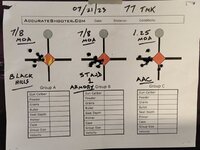
Wow!
I'm reading Alaska's Wolf Man and he said the 220 Swift was the most emphatic killer of any cartridge he used. Also said he wouldn't use it on grizzlies but that was with 1920's light bullets.
As soon as I get my cone where I want it, then I'll make my zero adjustments. But you're close.0.2R


As soon as I get my cone where I want it, then I'll make my zero adjustments. But you're close.
Randy
Yup that's correct, an old mate told me that at the time scopes were becoming more commonplace and the 222s low recoil meant that neck and headshots were easy.Someone can correct me if I'm wrong, but I believe the .222 Rem used to be a very popular cartridge for deer culling in NZ.

Please forgive my ignorance, but what does 0.2R mean in this context?0.2R