UL fuel efficient cook system

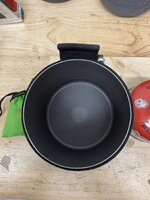
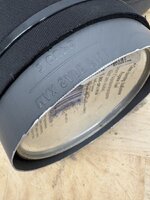
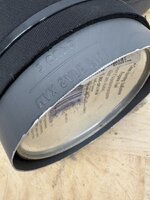
Do you have any pictures of that edge? I have a few skills but making clean cuts with tin snips is not one of them haha. How much weight did you cut out by shortening it?
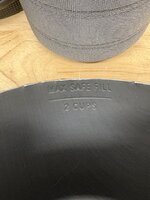
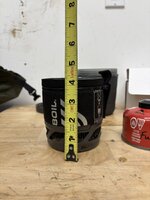
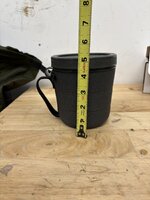
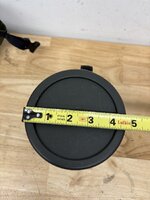
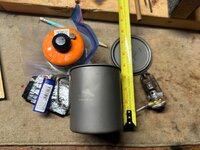
Here are a few more pics. The edge doesn’t come out pristine, but a little light file work removes all sharp edges. I’m not sure the exact weight savings in shortening the pot, but it allowed it to all fit inside the Mug and still have enough volume to boil for one person meals.
1771630115469-jpeg.1025034


1771630198194.jpeg
1771630227800.jpeg
1771630271722.jpeg
1771630313847.jpeg
1771630531341.jpeg
 

Attachments

  • 1771630080174.jpeg
    1771630080174.jpeg
    299.4 KB · Views: 18
  • 1771630115469.jpeg
    1771630115469.jpeg
    299.4 KB · Views: 114
A pot worth looking at is the Fire Maple "Ramen Pot". 1L capacity even though it is listed at 800ml. Wider base than the G3, has cutouts for both a three-prong support and a four prong support on the heat exchanger bottom. Lid won't sit flush with a 230g canister (110g is an easy fit with the stove too) however efficiency with the wider bottom and heat exchanger looks to be really good. I use a Soto Windmaster and much less than full power easily boils a half quart of water with a package of ramen in well under 2 minutes at my house at 7200' elevation. 1:47 to be more exact.

A few things I've noticed in the journey to arrive at a system that ticks the boxes for me...

1) Why manufacturers don't make a recessed burner head, such as a the Soto Windmaster and a few other highly rated stoves, is beyond me. More designs than not are so exposed as to be criminal. Without a windscreen they couldn't make Jiffy Pop in a slight breeze for a birthday party on a picnic table in the park surrounded by 8 kids blocking the wind (some creative license in that, however I hope the general point is understood).

2) The distance a pot sits above the burner head with respect to the pot support design, varies widely. With that, narrow pots short or tall, HX or not, need to be throttled back more than wider pots to avoid the flame going up around the sides which knocks off efficiency.

3) Empty canisters need to be packed out. 110g canisters weigh about 100g each for the canister, a single 230g is about 130g-140g empty. 10 G more fuel on average with 60g-70g less canister weight that I'm packing out, works for me. And if I don't use the remaining amount of the 230 g canister, then it's a wash with less waste to throw in the trash when I return.

EDIT: 4) Manufacturer boil times are typically from full power runs. Efficient fuel usage (grams/boil) from a lower BTU burner (some jetboil burners for example) can be had with more powerful burners such as the Soto Windmaster or MSR Pocket Rocket Deluxe by throttling back. BTU's are BTU's. With apples to apples pots, and burners adjusted to the same approximate output, most lightweight canister stoves boil and use fuel about the same.

EDIT: 5) Stoves of pressure regulator design do much better as the canister gets lower on capacity and of course as the outside temperature drops.

I'll be the first to admit just like my car, I have no desire to run it down to the end of a tank and finish on fumes, or come up short of my destination. I'll carry a bit of extra fuel above and beyond what I need and use it up on the trip for a rainy day, a few more cups of coffee, simmer up some back strap in the bottom of the pan if I tag out early and not worry about fuel to cook meals after hard days of packing out. Ymmv.
 
A pot worth looking at is the Fire Maple "Ramen Pot". 1L capacity even though it is listed at 800ml. Wider base than the G3, has cutouts for both a three-prong support and a four prong support on the heat exchanger bottom. Lid won't sit flush with a 230g canister (110g is an easy fit with the stove too) however efficiency with the wider bottom and heat exchanger looks to be really good. I use a Soto windmaster and much less than full power easily boils a half quart of water with a package of ramen in well under 2 minutes at my house at 7200' elevation. 1:47 to be more exact.

A few things I've noticed in the journey to arrive at a system that ticks the boxes for me...

1) Why manufacturers don't make a recessed burner head, such as a the Soto Windmaster and a few other highly rated stoves, is beyond me. More designs than not are so exposed as to be criminal. Without a windscreen they couldn't make Jiffy Pop in a slight breeze for a birthday party on a picnic table in the park surrounded by 8 kids blocking the wind (some creative license in that, however I hope the general point is understood)

2) The distance a pot sits above the burner head with respect to the pot support design, varies widely. With that, narrow pots short or tall, HX or not, need to be throttled back to avoid the flame going up around the sides which knocks off efficiency.

3) Empty canisters need to be packed out. 110g canisters weigh about 100g each for the canister, a single 230g is about 130g empty. 10 G more fuel on average with 70 G less canister weight that I'm packing out, works for me. And if I don't use the remaining amount of the 230 g canister, then it's a wash with less waste to throw in the trash when I return.

I'll be the first to admit just like my car, I have no desire to run it down to the end of a tank and finish on fumes, or come up short of my destination. I'll carry a bit of extra fuel above and beyond what I need and use it up on the trip for a rainy day, a few more cups of coffee, simmer up some back strap in the bottom of the pan if I tag out early and not worry about fuel to cook meals after hard days of packing out. Ymmv.

Interesting. I’m running the original Petrel/fire maple pot, jetboil zip cozy and lid with pocket rocket delux.

Do you know if the ramen pot lines up with a cozy cover that is readily available? I can see the wider base making a big difference. My normal pot has been awesome
 
Interesting. I’m running the original Petrel/fire maple pot, jetboil zip cozy and lid with pocket rocket delux.

Do you know if the ramen pot lines up with a cozy cover that is readily available? I can see the wider base making a big difference. My normal pot has been awesome
As you probably have looked, Fire Maple doesn't have one and I don't know of other generic ones to fit the width of the pot.
 
A pot worth looking at is the Fire Maple "Ramen Pot". 1L capacity even though it is listed at 800ml. Wider base than the G3, has cutouts for both a three-prong support and a four prong support on the heat exchanger bottom. Lid won't sit flush with a 230g canister (110g is an easy fit with the stove too) however efficiency with the wider bottom and heat exchanger looks to be really good. I use a Soto Windmaster and much less than full power easily boils a half quart of water with a package of ramen in well under 2 minutes at my house at 7200' elevation. 1:47 to be more exact.

A few things I've noticed in the journey to arrive at a system that ticks the boxes for me...

1) Why manufacturers don't make a recessed burner head, such as a the Soto Windmaster and a few other highly rated stoves, is beyond me. More designs than not are so exposed as to be criminal. Without a windscreen they couldn't make Jiffy Pop in a slight breeze for a birthday party on a picnic table in the park surrounded by 8 kids blocking the wind (some creative license in that, however I hope the general point is understood).

2) The distance a pot sits above the burner head with respect to the pot support design, varies widely. With that, narrow pots short or tall, HX or not, need to be throttled back more than wider pots to avoid the flame going up around the sides which knocks off efficiency.

3) Empty canisters need to be packed out. 110g canisters weigh about 100g each for the canister, a single 230g is about 130g-140g empty. 10 G more fuel on average with 60g-70g less canister weight that I'm packing out, works for me. And if I don't use the remaining amount of the 230 g canister, then it's a wash with less waste to throw in the trash when I return.

EDIT: 4) Manufacturer boil times are typically from full power runs. Efficient fuel usage (grams/boil) from a lower BTU burner (some jetboil burners for example) can be had with more powerful burners such as the Soto Windmaster or MSR Pocket Rocket Deluxe by throttling back. BTU's are BTU's. With apples to apples pots, and burners adjusted to the same approximate output, most lightweight canister stoves boil and use fuel about the same.

EDIT: 5) Stoves of pressure regulator design do much better as the canister gets lower on capacity and of course as the outside temperature drops.

I'll be the first to admit just like my car, I have no desire to run it down to the end of a tank and finish on fumes, or come up short of my destination. I'll carry a bit of extra fuel above and beyond what I need and use it up on the trip for a rainy day, a few more cups of coffee, simmer up some back strap in the bottom of the pan if I tag out early and not worry about fuel to cook meals after hard days of packing out. Ymmv.
Good timing ... I only recently purchased the Firemaple Ramen Pot and was going to post about it.

My short take: I think it provides a useful alternative to the Petrel G2 and G3 in terms of the wide base and volume.

However, in my (very) brief testing, it did not balance well at all on the Soto Windmaster three-prong support - it simply wanted to tip towards the handle side. Could have been something I was doing wrong - we were in a hurry - but I did try to center it a few times and no go. Was lucky I had a four-prong support with me as well, which worked fine.

Some of the reviews on their site spoke about it being hard to remove from the support. I did find I needed to jiggle it to get it on and off. Not something you'd want to do with it full of hot water, so worth experimenting with more.

Overall, would be interesting to see some comparisons of the Ramen Pot with the Jetboil Stash pot (which, as noted earlier in this thread, can be purchased from Jetboil as 'relacement' parts). Some of the tests I linked to a year ago were suggesting that was the most efficient HX pot available (at that time, at least).
 
Nice input, thanks for sharing. My experience is only with the four prong support.

One of the main benefits to me is the width of the ramen pot. More efficient heating with the wider HX base and easier to eat out of by far than the tall skinny pots.

Personally, the three prong support is a pinhead at just under 4" in diameter. The four prong support is closer to 6" in diameter. The stability and versatility of the four is where it's at in my book. The three prong support is for users that need or want to count every gram and probably won't be using a liter size pot on that type of excursion, in my estimation. In any case a taller skinny 1 L pot would be a better option with the three prong support. In fact, it's been suggested that a liter be the largest pot to consider with the three prong head.

I picked the ramen pot because it had slots for the four flex as I had said in my previous post and I agree that it works well.
 
Back
Top