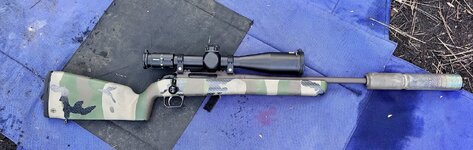
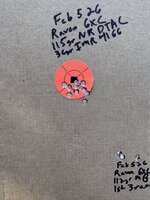
Shot my first 1 day NRL with the minox yesterday.
Optics and reticle were great. I was able to watch trace my own on many shots at the practice range.
But I had some inconsistencies that I couldnt pin point.
Gun. Tikka ctr in KRG xray. 140 gr berger hybrids. H4350. Generally boringly consistent with my athlon scope.
During the week, went to an indoor range, and got a pretty solid zero at ~55-60 degrees temp, allegedly 100 yards, i did not confirm. Then did a 7 mil tracking test at 100, followed by a return to zero. Dialed 7 mils up and hit 24.5" above aim, should be 25.2" (and thats measuring the outside of the upper most bullet hole of the 2 shots, so it may be closer to 24.2" to the center of the cone of fire). Kept that info in my back pocket. Returned to zero and hit the edge of my aiming mark.
At the warmup range I was consistently 0.3-0.4 mils low at distance. I shouldve sent more rounds to confirm zero, but did not. it was also 20 degrees out. That load should be about 2750-2760 fps. But I chrono'd it at 2730.
I went ahead and adjusted the SSF in the kestrel to the scope tracking error, and lowered the velocity. And the math aligned with what I was seeing.
After a few stages I really noticed that I was missing just over the targets. Adjusted the velocity back up to 2750 in the kestrel. Yet continued to miss just high. Did not adjust the ssf back to normal.
For the record, shot a 58 out of 80, winner shot a 76, 70 medaled. All other aspects of my performance were good (only timed out once, and only didnt find 1 target), except the data/scope question mark and hitting high frequently on the 450-600 yard targets. Remove the vertical misses and im in the medals i think.
So anyways...ive got a big question mark on my system right now. There are some things I should've done better, like bring a rangefinder to the indoor range, and confirm zero more throughly at the match (maybe a zero shift in the system due to cold?). I could've just had some calculation errors, the electronics didnt necessarily like the cold either. My ranging felt pretty solid and most targets had a berm just in front of them. Or maybe the load really had that much of a change from 20 degrees to 50.
But the scope is a variable i need to understand better.
Could use some insights on how you guys would go about testing it.
Im thinking I do a tracking test at the indoor range again. Maybe shoot zero, Dial and shoot 1,2,3,4,5,6,7,rtz, and repeat (or something to that effect).... And build a full plot of the tracking.
Posting an update...
Played with the scope for a few hours. Still some questions....
TLDR: seems to track appropriately. But *might* have slipped/skipped adjustment during the nrl and moved zero up 1/2". During this test it *seems* to have shifted back to perfect.
Same ammo from the initial zero and the nrl. 140 hybrids. Remembered my br4 this time and it was 98 yards (at a different shooting range then my initial zero, forgot my RF at the indoor range).
Started with a tracking test.
Aimed at top of the black post. 1 shot each at 0,1,2,3,4,5 mils. Then repeat for 3 shots. (Green circles)
Probably did it in 20 minutes. So barrel was getting a little toasty.
0 Group was 1/2" high.

First two shots from each group lined up great. On the third pass At 2 3 and 4 mils it dropped low (single holes circled orange). But at 5 it was close. Those groups at 2,3, and 4 are the largest that gun has ever shot.
Range went cold. Possible sources of uncertainty. Barrel was getting pretty warm (i was pausing intermittently, but still...). I was shooting off of a wiebad bag, And i didnt notice that the mdt triple pull Had started to click out. Probably halfway out on the first leg each side.
Came back and repeated the test going straight from 0 to 6 mils. Zero now hit the post. 6 mils up seems to be accurately adjusted. (Orange groups). measured everything at home and its tracking within the margins of the groups. And the 0 to 6 is almost spot on.
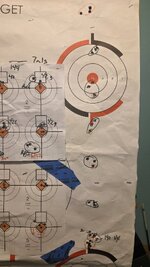
Went to the ocw target and shot 2 hybrids. Pretty much dead on zero.
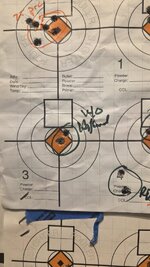
Ok....did my scope skip some clicks? Or is it slipping? Not sure.
Range cold. Let it cool off.
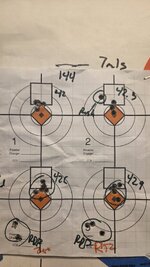
Shot some load dev. 144 gr lrht's. Shot lights out. (The one flyer at 42.3 was me rushing to get some shots off just for chrono data, forgot my chrono, and some old timer let me borrow his but range was about to go cold).
Range cold.
Down to my last few 140 gr rdfs that I need to empty out.
Shot 2 for zero at the #4. Moved right to the #5, Dialed 10ish mils up, back down to 0 and shot. Repeated 3 times. Seems good. (Pic above).
Tried a 0 to 6 mils test with the rdfs. Seems pretty spot on except for one that dropped way low at 6 mils. No explanation there.
Conclusions....
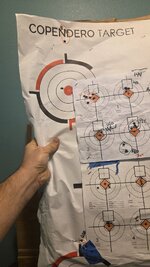
My zero was .5" high initially. That may explain my high misses at the nrl.
But during the test it sure *seems* like something settled or shifted and brought the zero back to perfect (where it was before the nrl). My initial tracking concerns at the indoor range are likely due to the target not being at 100, and me not ranging it. If it was at 98 yards that would explain my perceived tracking errors.
The 144s shoot good

Uncertainties....
definitely ran it a bit hot
ckyepod unclicked on me unnoticed during the berger hybrid tracking test
barrel has ~2000 rounds on it, mostly in NRL context or prep. And maybe 750ish berger hybrids and I havent touched that load so maybe its shooting out or out of tune?
My electronics at the NRL may have just been really wonky due to the cold weather and negative DA and it being the first time i used them this year.
Im going to check/tighten the turret screws. And check the action screws. Load up a bunch of ammo and go to the next NRL. If it seems wonky on the practice range I'll use my 25 prc instead.