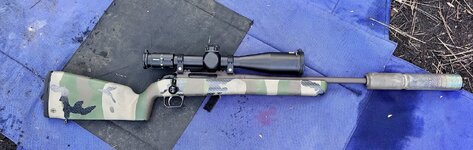
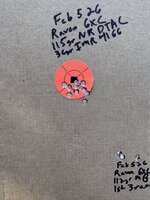
Q&A for Minox ZP5 5-25x56mm THLR scope

My issue wasn’t the diopter. It was the parallax functioning in the opposite direction as labeled, and the optic being unable to focus/resolve any image at a given distance across the magnification range.
 
During the week, went to an indoor range, and got a pretty solid zero at ~55-60 degrees temp, allegedly 100 yards, i did not confirm. Then did a 7 mil tracking test at 100, followed by a return to zero. Dialed 7 mils up and hit 24.5" above aim, should be 25.2" (and thats measuring the outside of the upper most bullet hole of the 2 shots, so it may be closer to 24.2" to the center of the cone of fire). Kept that info in my back pocket. Returned to zero and hit the edge of my aiming mark.


At the warmup range I was consistently 0.3-0.4 mils low at distance. I should've sent more rounds to confirm zero, but did not.


But the scope is a variable i need to understand better.

Could use some insights on how you guys would go about testing it.

Im thinking I do a tracking test at the indoor range again. Maybe shoot zero, Dial and shoot 1,2,3,4,5,6,7,rtz, and repeat (or something to that effect).... And build a full plot of the tracking.
I always test every new scope that comes through the door for tracking, RTZ, adjustment increments, and adjustment range on an optical grid collimator (i.e., Bushnell magnetic boresighter), which allows me to confirm the scope's function before introduction additional variables such as rifle precision and recoil. One important reason to use the optical collimator that attaches to the barrel or scope, is to couple any movement of the rifle with the grid. If a guy had a vise at the range, he could accomplish the same thing and verify function with a TT board while keeping the rifle immobile.

Once I know the scope functions correctly on the optical collimator, I'll do a live-fire TTT to make sure the scope still works correctly when recoil is introduced.
 
I always test every new scope that comes through the door for tracking, RTZ, adjustment increments, and adjustment range on an optical grid collimator (i.e., Bushnell magnetic boresighter), which allows me to confirm the scope's function before introduction additional variables such as rifle precision and recoil. One important reason to use the optical collimator that attaches to the barrel or scope, is to couple any movement of the rifle with the grid. If a guy had a vise at the range, he could accomplish the same thing and verify function with a TT board while keeping the rifle immobile.

Once I know the scope functions correctly on the optical collimator, I'll do a live-fire TTT to make sure the scope still works correctly when recoil is introduced.
Seems like way too much work. Mount it, shoot 10 shots, dial 10 mils, shoot 10 shots, tape measure. Oh and look at that, you now have a zeroed gun.
 
  • Like
Reactions: G&W
Dont mind the vertical offset. The target was on the indoor ranges track system. It ended up crooked at 100. The reticle showed vertical was ok and the scope is aligned properly. (Also have a sg pulse pro the outputs to the 0.1 degree, so i was level)


I think everything you reported gets explained away if the original zero was .3-.4 mils low.
 
I think everything you reported gets explained away if the original zero was .3-.4 mils low.
No it doesnt.

Because if my zero is .3-.4 mils low then it means the scope doesnt hold zero. (Or my barrel is toast, which isn't out of the realm of possibility, but i wouldn't expect it to go from perfect zero to immediately .3 low the next shot).

My zero was established with 13 rounds on that paper. Plus the 2 at 7 mil up.

Started at location 4, shot 3 that hit high left. Switched to #5, first shot high left, down 2 over 2 and fired 2 more that hit on the dot. Location #2, 3 on the money. Location #1, 3 are hidden under the tape measure and are perfect. Dialed up 7 and shot 2. RTZ and hit the right edge of the mark i was aiming at. Not a single indication of being .3 low. (The sighter, location 3, and all other marks on that paper were different rifles). Compile all of those into one group with the same POA, and correct the 2 down and 2 over and the entire 13 shots are sub .75" and roughly a bullet hole right.


Im confident in that zero.

Im gonna mount it on my AR and wring it out with cheap ammo. If its looking ok, then slap it back on the tikka and repeat a more condensed test.
 
Do you have photos of your set up in use?
The method does either depend on you verifying the subtension of the grid squres, or the assumption that the reticle has correctly labeled subtensions (which can be verified on a paper grid at a confirmed distance).

Align the magnetic boresighter with the reticle, and dial the parallax correction setting to infinity:

49404116111_d7dfd252de_b.jpg


Place a reticle mark on a grid line, dial the elevation turret to the next reticle mark. Confirm the angular adjustment dialed, versus the expected amount based on the reticle subtension.

49404116016_cc1c1796f0_b.jpg


Continue doing that until you run out of grid and/or reticle lines, or until you reach the end of the erector adjustment range. If the reticle walks left or right, you have a canted reticle relative to the erector. Dial back and forth and confirm exact RTZ. Confirm that the erector actually moves the reticle at the extremes of its range, and verify total adjustment range. Repeat for windage adjustments.
 
The method does either depend on you verifying the subtension of the grid squres, or the assumption that the reticle has correctly labeled subtensions (which can be verified on a paper grid at a confirmed distance).

Align the magnetic boresighter with the reticle, and dial the parallax correction setting to infinity:

49404116111_d7dfd252de_b.jpg


Place a reticle mark on a grid line, dial the elevation turret to the next reticle mark. Confirm the angular adjustment dialed, versus the expected amount based on the reticle subtension.

49404116016_cc1c1796f0_b.jpg


Continue doing that until you run out of grid and/or reticle lines, or until you reach the end of the erector adjustment range. If the reticle walks left or right, you have a canted reticle relative to the erector. Dial back and forth and confirm exact RTZ. Confirm that the erector actually moves the reticle at the extremes of its range, and verify total adjustment range. Repeat for windage adjustments.

This is interesting to me. I have different tools (700 yard range) at my disposal. My process is to use 20 round zero (10 round zeros have failed me by 0.1 mil in the past). Check impact on 10” plates at 200/300/450/700. If I’m failing to hit at 700 I’ll do a waterline test at 600 and true up data.

I could see where I might be covering up for imperfect scope adjustments (with trueing), but counter argument would be I only care about having data that works with that particular rifle system.

I don’t shoot much beyond 700, so it makes me curious which method (or both) holds up at extreme distance.
 
This is interesting to me. I have different tools (700 yard range) at my disposal. My process is to use 20 round zero (10 round zeros have failed me by 0.1 mil in the past). Check impact on 10” plates at 200/300/450/700. If I’m failing to hit at 700 I’ll do a waterline test at 600 and true up data.

I could see where I might be covering up for imperfect scope adjustments (with trueing), but counter argument would be I only care about having data that works with that particular rifle system.

I don’t shoot much beyond 700, so it makes me curious which method (or both) holds up at extreme distance.
Sounds like the data he's collecting is more scientific slash quality control?

The 35 rounds or so in you'll be minimum to zero and true would theoretically happen anyway after the collimator phase.

I'm soaking in those thoughts of danger space and the utility of the Zp5. Mines on the way back to Germany, btw.

My max range here is 840 and I shot it with a 3-9x42 last week.

My rifles are maxed out on lethality 660-750 depending on the length of the barrel or size of the case. My big stuff is 300 Fury and 6.5 PRC with no current interest in jumping into the next class up.
 
Sounds like the data he's collecting is more scientific slash quality control?

The 35 rounds or so in you'll be minimum to zero and true would theoretically happen anyway after the collimator phase.
Correct. The idea is to separate variables and see how the scope functions before introducing other confounding variables, like recoil and rifle/load dispersion.
 
good to hear Form.

I don’t know if this applies to anybody else, but I haven’t received anything from Minox or Blaser USA, not even a confirmation of receipt, even though it’s been delivered over a week ago.

@EuroOptic
 
good to hear Form.

I don’t know if this applies to anybody else, but I haven’t received anything from Minox or Blaser USA, not even a confirmation of receipt, even though it’s been delivered over a week ago.

@EuroOptic

Crickets here, but mine arrived Tuesday.

The person I spoke to there before I shipped mine said that they send stuff to Germany 1x per week and service would be expedited since it was a problem with a new/unused product.
 
good to hear Form.

I don’t know if this applies to anybody else, but I haven’t received anything from Minox or Blaser USA, not even a confirmation of receipt, even though it’s been delivered over a week ago.

@EuroOptic
I'm at DSC in Atlanta right now, but i'll check in on these tuesday when im back at the mothership
 
Shot my first 1 day NRL with the minox yesterday.

Optics and reticle were great. I was able to watch trace my own on many shots at the practice range.

But I had some inconsistencies that I couldnt pin point.

Gun. Tikka ctr in KRG xray. 140 gr berger hybrids. H4350. Generally boringly consistent with my athlon scope.

During the week, went to an indoor range, and got a pretty solid zero at ~55-60 degrees temp, allegedly 100 yards, i did not confirm. Then did a 7 mil tracking test at 100, followed by a return to zero. Dialed 7 mils up and hit 24.5" above aim, should be 25.2" (and thats measuring the outside of the upper most bullet hole of the 2 shots, so it may be closer to 24.2" to the center of the cone of fire). Kept that info in my back pocket. Returned to zero and hit the edge of my aiming mark.


At the warmup range I was consistently 0.3-0.4 mils low at distance. I shouldve sent more rounds to confirm zero, but did not. it was also 20 degrees out. That load should be about 2750-2760 fps. But I chrono'd it at 2730.

I went ahead and adjusted the SSF in the kestrel to the scope tracking error, and lowered the velocity. And the math aligned with what I was seeing.

After a few stages I really noticed that I was missing just over the targets. Adjusted the velocity back up to 2750 in the kestrel. Yet continued to miss just high. Did not adjust the ssf back to normal.

For the record, shot a 58 out of 80, winner shot a 76, 70 medaled. All other aspects of my performance were good (only timed out once, and only didnt find 1 target), except the data/scope question mark and hitting high frequently on the 450-600 yard targets. Remove the vertical misses and im in the medals i think.

So anyways...ive got a big question mark on my system right now. There are some things I should've done better, like bring a rangefinder to the indoor range, and confirm zero more throughly at the match (maybe a zero shift in the system due to cold?). I could've just had some calculation errors, the electronics didnt necessarily like the cold either. My ranging felt pretty solid and most targets had a berm just in front of them. Or maybe the load really had that much of a change from 20 degrees to 50.

But the scope is a variable i need to understand better.

Could use some insights on how you guys would go about testing it.

Im thinking I do a tracking test at the indoor range again. Maybe shoot zero, Dial and shoot 1,2,3,4,5,6,7,rtz, and repeat (or something to that effect).... And build a full plot of the tracking.
Posting an update...

Played with the scope for a few hours. Still some questions....

TLDR: seems to track appropriately. But *might* have slipped/skipped adjustment during the nrl and moved zero up 1/2". During this test it *seems* to have shifted back to perfect.

Same ammo from the initial zero and the nrl. 140 hybrids. Remembered my br4 this time and it was 98 yards (at a different shooting range then my initial zero, forgot my RF at the indoor range).

Started with a tracking test.

Aimed at top of the black post. 1 shot each at 0,1,2,3,4,5 mils. Then repeat for 3 shots. (Green circles)

Probably did it in 20 minutes. So barrel was getting a little toasty.

0 Group was 1/2" high. 🤔

First two shots from each group lined up great. On the third pass At 2 3 and 4 mils it dropped low (single holes circled orange). But at 5 it was close. Those groups at 2,3, and 4 are the largest that gun has ever shot.

Range went cold. Possible sources of uncertainty. Barrel was getting pretty warm (i was pausing intermittently, but still...). I was shooting off of a wiebad bag, And i didnt notice that the mdt triple pull Had started to click out. Probably halfway out on the first leg each side.


Came back and repeated the test going straight from 0 to 6 mils. Zero now hit the post. 6 mils up seems to be accurately adjusted. (Orange groups). measured everything at home and its tracking within the margins of the groups. And the 0 to 6 is almost spot on.
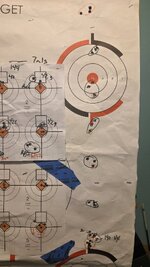
20260209_233908.jpg

Went to the ocw target and shot 2 hybrids. Pretty much dead on zero.
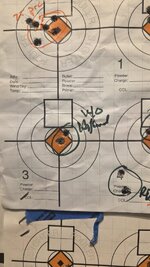
20260209_233918.jpg

Ok....did my scope skip some clicks? Or is it slipping? Not sure.

Range cold. Let it cool off.

Shot some load dev. 144 gr lrht's. Shot lights out. (The one flyer at 42.3 was me rushing to get some shots off just for chrono data, forgot my chrono, and some old timer let me borrow his but range was about to go cold).
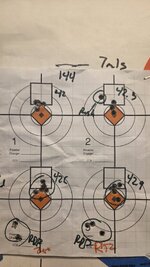
20260209_234030.jpg

Range cold.

Down to my last few 140 gr rdfs that I need to empty out.

Shot 2 for zero at the #4. Moved right to the #5, Dialed 10ish mils up, back down to 0 and shot. Repeated 3 times. Seems good. (Pic above).

Tried a 0 to 6 mils test with the rdfs. Seems pretty spot on except for one that dropped way low at 6 mils. No explanation there.
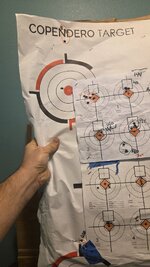
20260209_234023.jpg

Conclusions....

My zero was .5" high initially. That may explain my high misses at the nrl.

But during the test it sure *seems* like something settled or shifted and brought the zero back to perfect (where it was before the nrl). My initial tracking concerns at the indoor range are likely due to the target not being at 100, and me not ranging it. If it was at 98 yards that would explain my perceived tracking errors.

The 144s shoot good 👀

Uncertainties....

definitely ran it a bit hot

ckyepod unclicked on me unnoticed during the berger hybrid tracking test

barrel has ~2000 rounds on it, mostly in NRL context or prep. And maybe 750ish berger hybrids and I havent touched that load so maybe its shooting out or out of tune? 🤔

My electronics at the NRL may have just been really wonky due to the cold weather and negative DA and it being the first time i used them this year.

Im going to check/tighten the turret screws. And check the action screws. Load up a bunch of ammo and go to the next NRL. If it seems wonky on the practice range I'll use my 25 prc instead.

 
Back
Top