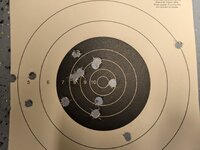
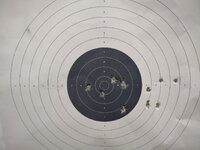
These are from the other day. For the PRB guys, what do they look like?
View attachment 986691
From my and common knowledge would say they're ok but the damaged/cut parts could potentially be detrimental to accuracy.
I have not seen a single person, anywhere, that has said it doesn't matter if patches are cut/damaged after shooting.
I haven't tested it in a controlled enough manner myself to say for sure, but I did have a gun that cut patches due to rough/raised burrs on the edges of the lands from crap machining. After fixing that, the accuracy seemed better. Prior to fixing it I'd get occasional fliers way out of the rest of the group. Like something obviously wrong ... Not cherry picking and 3rd groups.
I would like to see a controlled test though. I think to a degree it makes sense. If there is gas leakage around the patch or unequal friction between patch and bore on one side from damage, I would think that could cause big variation in pressure, etc.
I was thinking about this. Does the latch need to be perfectly centered? Or does it just need to cover the ball so that it is contained?
From all I've been able to find, people seem to agree it doesn't matter as long as all sides are covered. I believe there have been tests to determine if it matters.... Even if the sprue being up/down/off center matters, and those said it doesn't. But I can't remember who tested this and don't have a link.
Shot a few rounds with the borrowed rifle late this afternoon. Light wa slow, and it was hard to center the bull, but…
There is definitely a tight spot in front of the breach, going to give it a good scrubbing tonight.
With that, this thing really wants the bore swabbed between shots. 1, it gets very hard to seat the patch and ball past that “ring” if you don’t swab the shots go haywire consistently.
View attachment 988898
Three different things going on here.
These were shot intermixed- blue are all slit swabbed between shots. Yellow is one dry swab between shots, red is no swabbed between shots. I shot a couple shots swabbing (blue), then didn’t swab (red), then swab again (blue). Then, dry swab (yellow), then swab- (blue). Etc.
Not swabbing between shots consistently has the shot going 4-6” high.
View attachment 988899
Made a sight adjustment up, swabbed the barrel, and fired one at 100 yards kneeling against a tree for grits and shins- barley clipped.
View attachment 988900
A few things:
Tight spot in breech after shooting- swiss has the potential to cause a worse fouling ring in the bottom, for whatever reason. I usually use schuetzen which is dirty as all hell in my gun (but does not make a hard ring) and tried swiss this year. After a couple shots, yes there's a crazy hard ring in the bottom and all other who've experienced this agree that when that hard ring forms your accuracy goes to crap... I think it probably changes pressure if it doesn't damage the patch. I have experienced the issue. I do not know how to prevent it other than swabbing it out.
Shots being lower on clean bore - yes a clean bore produces lower MV and I guess lower pressure. I have noticed this with mine with certain loads. With a super tight combo in my two guns it seems to not make as much difference between clean/fouled bore. This is where having a tight enough patch/ball combo and a good lube helps. If it's tight enough, and the patch is moist enough, it will basically wipe the bore each time you load and give the same bore condition each time. I do this because taking the time to swab drives me nuts.
Patches- the prelubed are handy, but using a super tight weave and very strong material supposedly works best for accuracy. There are none of this quality that are prelubed that I know of. Using tighter weave that is stronger material means no gas blow by, which is supposedly beneficial to accuracy. Idaholewis has shown it a couple times in his videos. He'll use precut patches that are thin, but he will double patch... Put a patch over the powder below the patched ball which protects the integrity of the patch on the ball. I haven't tested this myself because I went straight to loading the tightest load I could from the get go. However, I have seen accuracy degrade with damage patches or completely blown patches.
Look into minute men patching. Tightest and toughest stuff I've found. Wash regular cycle, rinse twice, dry medium. Cut strips and then cut at the muzzle using spit for lube to make it easy.
https://www.theminute-menpatches.com/ try the 0.018 and 0.020.
Could also find some tight weave duck canvas that measures 0.018-0.020 with calipers when squeezed really hard with one hand. Same thing. Wash and dry.
Here's a large round count group at 100 with a 54 Hawken . 90gr 2f swiss. Wind was gusting so I was trying to hold for that. Without the wind, I can typically put them all in the black. My flintlock is a different story. As soon as I can see out of my right eye again I'll get out and shoot some more large count groups.