Without giving it a ton of thought (so maybe I'm running off the rails), we have four things going on:
1.A. – Rifle System (rifle, ammo, mounts, optic, etc.)
1.B. – Shooter’s fundamentals
2. Cartridge Efficiency
3. Shooter’s Wind Reading Abilities
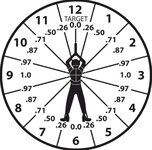
#1 - I think we can simply combine 1.A. and 1.B for this discussion. This can also really easily be quantified in a short amount of time. Although the Kraft drill is not the end all be all, it is pretty well established, and there’s no real reason to reinvent the wheel in my opinion. Not to mention, there’s no arbitrary target sizes, no arbitrary gear requirements/restrictions, no arbitrary time requirement (although the stress drill is somewhat arbitrary). Use the gear you've got that you'll use in the field. Pretty simple.
Round count is another thing the Kraft has going for it. Although not really statistically significant, 12 independent build & breaks starts showing how consistent/inconsistent you are as a shooter, which will likely overshadow 1.A anyways. Even if shooting standing is not something you normally would do, overall the drill exposes your inconsistencies. Again, this can be done in a couple minutes in a single range trip.
#2 – Generally, there is an inversely proportionate relationship between shootability and the cartridge’s efficiency. For example, a large 30 cal magnum shooting 215 Berger at 3,050 fps is about a 10MPH gun where I live, and a 223 shooting 77TMKs at 2600 fps is going to be about a 4MPH gun. At 600 yards (for example) someone that could only read the wind to within 4 MPH (a novice) using the 30 cal magnum example would have the same probability of hitting a target as someone that could read wind to about 1.5 MPH (elite wind caller) with a 223 (assuming Item #1 was equal). This is why cartridge selection should be considered IMO.
#3 – Shooter’s wind reading abilities is very important, but this will be very hard to quantifiably measure the shooter's accuracy & consistency. Especially if you do not have a baseline established for #1.A & #1.B. Not to mention, people aren't "learning the wind" by practicing shooting at distance. After the first 1, 2, or 3 rounds, you should have the wind pretty well figured out. You'd then have to sit around and wait for a significant change in the wind to learn anything more. I think most people exaggerate how "switchy" the wind is where they shoot (or flat out blame the wind for their own shortcomings). And, as already mentioned, people are generally pretty familiar with the wind in their normal shooting spots. So, shooting in the wind at distance at your normal spot is not a good indicator of your MER anyways.
I tend to like the short range (100 yards) paper idea for an internet challenge. Short ranges are going to be more accessible to more shooters, which has a bigger potential to get more involvement, and ultimately help develop/encourage more shooters.
Although we will not be able to easily quantify the shooters ability to call wind (speed & direction), in order to normalize, we could assume +/- 4MPH, which should be doable for most to establish Max(ish) Effective Range. Direction is another matter. If we can assume that shooters can call wind within 30 degrees, we would need to conservatively double the wind calling budget to 8 MPH. Of course, some will be better and some will be worse.
Assuming a 12” vital zone, and using the quick wind method for mils,
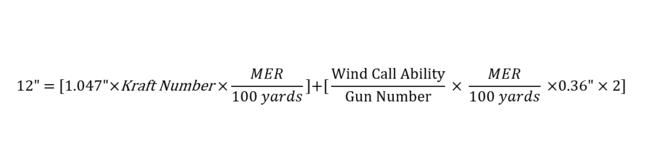
If we are to simply use a 4 MPH & 30 degree wind calling ability to normalize & hopefully be conservative, then we get

If you have a 4 (inch) Kraft Number (meaning accuracy, not precision), and you’re shooting the above 30 cal mag example (10 MPH gun), then:
MER = 251 yards
If you have a 4 (inch) Kraft number (meaning accuracy, not precision) and you're using the 223 example (a 4 MPH gun), then:
MER = 213 yards
If someone wants to say that they only ever shoot prone, then maybe just use the 12-shot build & break “standard” for all prone shots. Just to run out the example, let’s say the accuracy level (not precision) is 1-MOA for all 12 shots, at close range, with the 30 cal magnum example, then
MER = 739 yards
For the 223 example shooting from the prone and having a 1-MOA, 12-shot accuracy, then
MER = 482 yards
For the internet challenge, and I'm just spitballing, it could be a two-step submittal:
1) shoot the close range 12-shot group and calculate your MER
2) confirm hits at your calculated MER distance (or as close as possible, preferably closer if you can't get to the exact MER)



