.223 for bear, mountain goat, deer, elk, and moose.

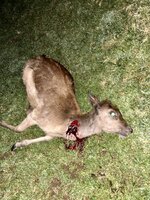
It worked great, blasted through a vertebrae and made about a one inch exit. I wouldn't hesitate to do it if you have a chance. It makes for a nice clean carcass and no meat loss.
Yeah, that’s why I like shooting them there, blood shot stays pretty isolated in the neck, and pretty much wound cavity only damage. Probably because it shuts them down and blood stops flowing filling up membrane and whatever causing a mess

Have always preferred shooting deer in the neck when applicable
 
Thanks, I’ll call that good enough for me. Crazy what that little projectile is capable of

Yep. It’s what happens when a bullet is specifically designed and tested to maximize the wound channel for 14 inches of penetration, with a nose design that consistently allows good upset very low impact velocity.
 
Ah do what? You need to read the entire thread- every post.

Weight retention has about zero to due with killing…. Well, actually inversely proportional. If you hit bone, TMK cause a lot of damage.

No no, not speaking about killing. I'm talking specifically about how much meat is ruined by the round fragmenting.
 
A lot if you hit anything but ribs. Again, if you read this thread in its entirety, that is written about and shown in hundreds of pictures of animals.
@Formidilosus, I hear constantly about the "saving meat" argument. What I never hear about is the effect of stress on meat quality. This is well documented in the agricultural meat processing world. An animal that experiences high levels of stress before death ( being shot and running for even a few dozen yards) will yield ALL of the meat being of poorer quality. It has to do with pH, enzymes, glycogen , and calpains. Tons of open source data on this if someone cares to look. Point is there is definitely an argument to be made for sacrificing say 20% more meat to a bullet that kills rapidly vs compromising 100% of the meat to a bullet that has a smaller permanent wound cavity ( less bloodshot) but resulted in the animal running full out, adrenaline fueled, max stress, bleeding out over 100 yards.
 
I'm starting this thread over to be thorough and so far in the 23 pages I've yet to hear an example of a 100y runner. I can't say I'm noticing any difference in reported bang-flops vs runners compared to other hunters shooting other cartridges, and the ranges of runners vary regardless of cartridge. I'd be very curious if you could cite something validating use of one cartridge versus another for purposes of harvesting stress-free meat.
 
I'm starting this thread over to be thorough and so far in the 23 pages I've yet to hear an example of a 100y runner. I can't say I'm noticing any difference in reported bang-flops vs runners compared to other hunters shooting other cartridges, and the ranges of runners vary regardless of cartridge. I'd be very curious if you could cite something validating use of one cartridge versus another for purposes of harvesting stress-free meat.

We killed 5 deer this past weekend, 3 with 22 cal and 2 with 6.5 cm. All with TMK’s, 77 gr in the 22 cals and 130 gr in the 6.5.

The 3 killed with 22 cals, 2 with a 223 and 1 with 22 cm, went 100 yards for the 3.

The 2 killed with the 6.5 cm went 300 yards for the 2. 1 was a great shot and went 75 yards the other was not and went maybe 225-250 yards.


Sent from my iPhone using Tapatalk
 
We killed 5 deer this past weekend, 3 with 22 cal and 2 with 6.5 cm. All with TMK’s, 77 gr in the 22 cals and 130 gr in the 6.5.

The 3 killed with 22 cals, 2 with a 223 and 1 with 22 cm, went 100 yards for the 3.

The 2 killed with the 6.5 cm went 300 yards for the 2. 1 was a great shot and went 75 yards the other was not and went maybe 225-250 yards.


Sent from my iPhone using Tapatalk

The 3 shot with the 22 cals ran a combined 100y? That sounds about on part with the other runners I'm seeing referenced in the thread. Prior to post 552 nobody had reported a runner of 100y+, and that post was on a big hog that ran 120 (on a 90y shot, 77gr tmk from a 16" bbl). Interesting that the the 6.5cm shots were longer runners even with the great shot. Do the larger tmk's just not do as efficient work as the smaller ones? Good info regardless, thank you for sharing!

I did myself a disservice skimming the topic while at work versus reading it (arguments and all) thoroughly while at home. There are quite a few good details I've missed about this bullet specifically and about others. Seeing a fella use the same 75gr Gold Dots my work issues for patrol rifles out of an 11.5" AR on deer and realizing how much older that round is, and then seeing some of the references to mini-14's and moose, clearly this little round has been a good killer for a lot longer than I/we might've thought. As much as I want an excuse to get a new rifle, I'm really having a hard time justifying it vs just slapping a nice scope on this new 16" upper, unpacking this fresh delivery of Black Hills 77gr TMK's, and rolling with that.

Coffee, paperwork, gym, and back to reading.
 
The 3 shot with the 22 cals ran a combined 100y? That sounds about on part with the other runners I'm seeing referenced in the thread. Prior to post 552 nobody had reported a runner of 100y+, and that post was on a big hog that ran 120 (on a 90y shot, 77gr tmk from a 16" bbl). Interesting that the the 6.5cm shots were longer runners even with the great shot. Do the larger tmk's just not do as efficient work as the smaller ones? Good info regardless, thank you for sharing!

Yes a combined 100 yards. Deer 1 with the 223 went about 50, deer 2 with the 223 went about 30 and the last with the 22 cm went about 20, maybe 30.

The second deer with the 6.5 was not a good shot, low and back, and I can confidently say with another bullet like a Barnes or typical “hunting” bullet we would not have found the deer. Damage was impressive. The first deer shot with the 6.5 took out heart and lungs and still went about 75 yards. Left a blood trail a blind guy could follow. I posted a few pics in the 6.5 thread if your interested in looking.

The biggest difference I saw between the 2 guns was we didn’t have any exits with the 22 cal deer and did on both of the 6.5 deer. All shots were less then 150 yards so the higher velocity attributed to that I’m guessing.


Sent from my iPhone using Tapatalk
 
77TMK 230 yards. Didn't exit, this is the entry. Any good hunting bullet would have worked.
The advantage that the 77TMK brings for these shots is a good BC to minimise wind upset and scary accurate.
On the matter of the grail SWFA 6x, which I don't understand - it would be quite a compromise for me in precision compared to my 3-15 (happens to be a Tract) or any good similar 'scope.
 

Attachments

  • FullSizeRender 9.jpeg
    FullSizeRender 9.jpeg
    677.1 KB · Views: 115
77TMK 230 yards. Didn't exit, this is the entry. Any good hunting bullet would have worked.
The advantage that the 77TMK brings for these shots is a good BC to minimise wind upset and scary accurate.
On the matter of the grail SWFA 6x, which I don't understand - it would be quite a compromise for me in precision compared to my 3-15 (happens to be a Tract) or any good similar 'scope.

Nice shooting. I'm reminded that I need to also be studying the different good strike zones and make sure I'm proficient at those at different angles and ranges before I go out for my first hunt.

Regarding optics... in keeping with my realization that this new upper (intended for work) might also be great for hunting, if setting up for work then I have some optics restrictions to consider that preclude the RSS meta. If not a red dot, it must be a true lpvo (no fixed- or medium-power variables) and from a very small list of manufacturers. It's looking like a Credo 1-6 SFP is going to be my best bet with that limitation. Seems to have a well-behaved 6x so functionally shouldn't be too different from the recommended fixed 6x anyway. Time to see if it's gone through the Rokslide ringer.
 
Nice shooting. I'm reminded that I need to also be studying the different good strike zones and make sure I'm proficient at those at different angles and ranges before I go out for my first hunt.

Regarding optics... in keeping with my realization that this new upper (intended for work) might also be great for hunting, if setting up for work then I have some optics restrictions to consider that preclude the RSS meta. If not a red dot, it must be a true lpvo (no fixed- or medium-power variables) and from a very small list of manufacturers. It's looking like a Credo 1-6 SFP is going to be my best bet with that limitation. Seems to have a well-behaved 6x so functionally shouldn't be too different from the recommended fixed 6x anyway. Time to see if it's gone through the Rokslide ringer.
If you can use a 1-8, both nightforce and trijicon make ones that can dial. The 1-6 accupoint has illumination and doesn’t need batteries if that makes a difference to you.
 
On the matter of the grail SWFA 6x, which I don't understand - it would be quite a compromise for me in precision compared to my 3-15 (happens to be a Tract) or any good similar 'scope.

I'm betting 6X is more than enough to hit an 8" kill zone inside of 300 yards, so precision is not an issue. And unlike the Tract, the SWFA won't move 3 MOA after a simple drop test. The "grail" here is based on a $200 scope that outperforms scopes that literally cost 10-20 times more. And the 6X is used because at most realistic hunting distances even 6X is overkill.

Thread 'Tract Toric Ultra HD 3-15x50mm Field Eval' https://rokslide.com/forums/threads/tract-toric-ultra-hd-3-15x50mm-field-eval.287271/
 
There's a youtuber I've watched for a long time (C_does, if anyone cares) that primarily reviews scopes and had a great discussion with a couple other guntubers on the over-reliance of big zoom over practice and learning dope / reticles properly. He contended that for most shooters in most situations, 6x is on the upper end of what they would need even for hunting and most would be well served by a better-made / more durable 4x or 6x than fancier 8x and higher power fixed or variables. I know he hunts but I don't know how much or how far; he's a NYer and lives up in the NE but I don't know what kind of ranges he has encountered while hunting or doing precision rifle matches but it sounds like 400-600 are well within his usual practice ranges.

I can't comment on how much magnification is "needed" (I'm a pistol guy with minimal rifle experience only now getting into rifles seriously for work and hunting purposes), but based on some of the more loved optics here and elsewhere, I think he makes a damn fine point about how good some of the lower powered scopes are in real world use compared to higher powered or newer versions. It seems like these comparatively lower powered scopes are often more durable, have better clarity, are a little lighter, etc. than newer more complex scopes.

For me, the 1-6 is a good way to satisfy work's policy requirements, with a vetted (maybe not here?) scope, from a good manufacturer, that has a good usable 6x I can quickly switch to. Having a substantial discount via ExpertVoice is also a big factor.
 
Last edited:
@Formidilosus, I hear constantly about the "saving meat" argument. What I never hear about is the effect of stress on meat quality. This is well documented in the agricultural meat processing world. An animal that experiences high levels of stress before death ( being shot and running for even a few dozen yards) will yield ALL of the meat being of poorer quality. It has to do with pH, enzymes, glycogen , and calpains. Tons of open source data on this if someone cares to look. Point is there is definitely an argument to be made for sacrificing say 20% more meat to a bullet that kills rapidly vs compromising 100% of the meat to a bullet that has a smaller permanent wound cavity ( less bloodshot) but resulted in the animal running full out, adrenaline fueled, max stress, bleeding out over 100 yards.

I disagree with your thesis. Absent a CNS hit, just about every animal is going to run until the brain runs out of oxygen. Usually more than a few dozen yards. In my experience poor care in the field makes the difference in meat quality.


P
 
I disagree with your thesis. Absent a CNS hit, just about every animal is going to run until the brain runs out of oxygen. Usually more than a few dozen yards. In my experience poor care in the field makes the difference in meat quality.


P
Yup I agree. And it seems like some animals have a much stronger will to live than others. I shot a meat sow at 70 yards with a 30-06 180 Magtip. Perfect broadside and destroyed the hear and lungs. Huge blood cloud witnessed by my guide and the pig still ran for over a hundred yards. After we processed the pig the guide said he'd never believe it unless he saw it. When I saw the sow take off I racked another round in to shoot it again but the guide stopped me "she's dead she just doesn't know it". When the sow almost crested the hill my guide said get ready to stop her lol.
 
Back
Top