
Shooting up and down at an angle also changes the recoil movement of the rifle, making shots land higher if recoil is not managed. The mass of the rifle is also at an angle to the body in many situations. When the gun is tipped muzzle up, the recoil impulse is in different proportion to gravity and angles, and the rifle jumps more.Smart to do cold bore. Angle has messed with me recently. Every range is flat. Shooting up or down 15-20degrees changes the range vs LOS. Would save time to practice with changing angles because seems chances pop up at the most inconvenient of times and it’s just seconds to get a shot.

Navigation
Install the app
How to install the app on iOS
Follow along with the video below to see how to install our site as a web app on your home screen.
Note: This feature may not be available in some browsers.
More options
Style variation
You are using an out of date browser. It may not display this or other websites correctly.
You should upgrade or use an alternative browser.
You should upgrade or use an alternative browser.
How are you training for long range?
- Thread starter WKR
- Start date
OP
OP

WKR
WKR
- Joined
- Jun 14, 2019
- Messages
- 2,229
I'm shooting my 25 creedmoor with the 133 bergers, which is a 6mph gun with that load.Kudos for the work and effort. Keep at it. You are doing a lot of good stuff already.
Get a bigger target, paint vital size, and be brutally honest with yourself. You can’t learn without feedback.
A 6 mph wind?
You didn’t say what cartridge, but my 6.5 creed is 14.4 inches of drift with a full value 6 mph wind at 750.
If we assume the wind died to 3 mph, and you held for 14.4”, then you get drift of 7” off your point of aim. Assume your gun is an moa gun, then you are stacking errors that take you out of the vitals st 750.
If your position is not built well enough, you are adding more error.
650 to 750 is a big jump in drop and wind. Wind at 640 is 10 inches.
You have to know the ballistics and develop the skills to shoot long range in the field.
And, it’s why I usually limit my long range hunting shots to early morning and late evening when the wind dies down. In virtually no wind situations I have high confidence.
Which I think is why sometimes I miss that little target at 750. Its for all intents and purposes a 1 moa target and I'm shooting a 1 moa load, so with any kind of shooter error or bad wind call is going to be a miss.
I'm going to take a bigger ipsc target out there today and swap them out.

TaperPin
WKR
- Joined
- Jul 12, 2023
- Messages
- 6,317
Good points, I’m also at a disadvantage when in unfamiliar territory. I had to chuckle when over by Grand Junction in a little valley covered with giant sagebrush - the stuff looked just like our sage, but double in size, made everything seem half the distance, and it was worse than if I had never seen sage before.I CANNOT reliably estimate to within 50 yards at 300-400 when I travel to the west.
- Banned
- #24

Loo.wii
WKR
- Joined
- Sep 23, 2022
- Messages
- 790
Do you have a trainer rifle in something cheaper than your hunting caliber?I have an upcoming hunt where I expect there to be opportunities at long range. So I have been implementing a self imposed cold bore challenge everyday, once I become comfortable at the set distance I move the target back and resume the daily cold bore shot.
This week, starting Sunday, im at 750. Yesterday I go out and hit the cold bore and a follow up just for good measure, today....whiffed on the cold bore and a follow up, Yesterday was a consistent 5mph wind that was easier to call then today with a 6mph that was variable and I over compensated both times I shot.
I wonder though if my target is to small? Its a 8×12 ipsc, which actually is a good size representation of a deers vitals but at 750, if I miss its hard sometimes to see which side of the plate I'm on and what to correct. Should I step up to a bigger plate and paint a kill zone size aiming point ?
Anyhow, I'd like to hear some recommendations on what more I should implement into the training regiment and also what some of you guys do to train for upcoming hunts.
I am training field positions too, but keep that 600 and in. The cold bore stuff is if I get an opportunity where I can be prone or fully supported

mxgsfmdpx
WKR
- Joined
- Oct 22, 2019
- Messages
- 8,781
You are going to find that your shot to shot discrepancy has far less to do with wind, and everything to do with shooting ability, I think you know this already. Make a horizontal hold or dial correction and then miss "the other way", is what you are likely going to see in most cases out there by yourself, and with someone being more towards the novice side of wind calling...
Unless you are REALLY good at reading wind and making a true long range rifle shot wind call (think along the lines of not just holding up a Kestrel at your gun) you will just be fighting yourself on corrections. A good spotter sitting next to you with real time feedback, with you already having the next one racked and ready for the correction is really the only way; otherwise it takes too long and the wind has changed and your chasing your tail.
Unless you are REALLY good at reading wind and making a true long range rifle shot wind call (think along the lines of not just holding up a Kestrel at your gun) you will just be fighting yourself on corrections. A good spotter sitting next to you with real time feedback, with you already having the next one racked and ready for the correction is really the only way; otherwise it takes too long and the wind has changed and your chasing your tail.
I have some very embarrassing stories about wildly misjudging the size of something upon showing up in an area and not being accustomed to the scale. Couple years ago I spotted a herd of antelope in an opening in the sage just below a grassy slope. The mirage was pretty bad and I could only see them through the sage, so all I could see was a few splotches of the buff color, a little white, and some occasional movement. it was a very low-point unit with a zillion tags, and we hadnt found a single goat on public, so we hiked a mile around to stay out of view, hiked along the other side of the hill, and crawled up over the rounded top to avoid being skylighted. pricked my unit several times with cactus spines, ate some dust, scraped my knees and elbows, but finally crept into a little wash 200 yards from their location. Peering over the crest of the slope thru my bino's I looked for the herd goat...and saw a colony of very antelopey-colored prairie dogs. Definitely got my scale wrong on that one.Good points, I’m also at a disadvantage when in unfamiliar territory. I had to chuckle when over by Grand Junction in a little valley covered with giant sagebrush - the stuff looked just like our sage, but double in size, made everything seem half the distance, and it was worse than if I had never seen sage before.

750 is a long way. 8” is an admirable target size. And, just a little error makes a big difference.I'm shooting my 25 creedmoor with the 133 bergers, which is a 6mph gun with that load.
Which I think is why sometimes I miss that little target at 750. Its for all intents and purposes a 1 moa target and I'm shooting a 1 moa load, so with any kind of shooter error or bad wind call is going to be a miss.
I'm going to take a bigger ipsc target out there today and swap them out.
Fortunately, if you practice on that, you’ll know your skill and load. Then, on game animals you get a little wider target for the most part.
If you can, add in some practical training. I go in the desert and take a hike with my pack and practice cold bore shots and building positions shooting rocks.
Poser
WKR
I'm not a "long range hunter" by any stretch, but I'll reinforce the suggestion that shooting on a flat range with the intention of hunting mountains is not preparation.
I spent quite a bit of time shooting at steeper angles this summer after not being able to get properly setup for a steep angle shot last year. I killed an elk this season at 263 yards with a +27 degree shooting angle. Having practiced setting up for steep angles, I was able to set up for such a shot in a matter of seconds without too much thought.
To further complicate matters, shooting across canyons involves complex winds with often 3-4 wind variables at long distances. If you are shooting from a North facing slope that is cold and in the shade to a sunny, South facing slope that is warm and sunny across a canyon with a running creek whipping wind down stream + a prevailing wind, its going to be dramatically different than a flat range. If terrain is steep, setting up a stable shot is also going to be dramatically different as everything wants to slide downhill.
I spent quite a bit of time shooting at steeper angles this summer after not being able to get properly setup for a steep angle shot last year. I killed an elk this season at 263 yards with a +27 degree shooting angle. Having practiced setting up for steep angles, I was able to set up for such a shot in a matter of seconds without too much thought.
To further complicate matters, shooting across canyons involves complex winds with often 3-4 wind variables at long distances. If you are shooting from a North facing slope that is cold and in the shade to a sunny, South facing slope that is warm and sunny across a canyon with a running creek whipping wind down stream + a prevailing wind, its going to be dramatically different than a flat range. If terrain is steep, setting up a stable shot is also going to be dramatically different as everything wants to slide downhill.
I'm not a "long range hunter" by any stretch, but I'll reinforce the suggestion that shooting on a flat range with the intention of hunting mountains is not preparation.
I spent quite a bit of time shooting at steeper angles this summer after not being able to get properly setup for a steep angle shot last year. I killed an elk this season at 263 yards with a +27 degree shooting angle. Having practiced setting up for steep angles, I was able to set up for such a shot in a matter of seconds without too much thought.
To further complicate matters, shooting across canyons involves complex winds with often 3-4 wind variables at long distances. If you are shooting from a North facing slope that is cold and in the shade to a sunny, South facing slope that is warm and sunny across a canyon with a running creek whipping wind down stream + a prevailing wind, its going to be dramatically different than a flat range. If terrain is steep, setting up a stable shot is also going to be dramatically different as everything wants to slide downhill.
What kind of "set up" are you talking for a 263yd shot with a 27degree?
I feel that every single potential shot-setup is going to be different. Angle, shot distance, atmospherics, it's all going to change from shot to shot. Have as much ready as possible at any given time. For me, I have my dope chart stuck in my scope cap, so when I flip my cap up its all right there and I can immediately dial range. Range, dial, pull the trigger. It's both that easy, and that hard! Confidence is key, and with that comes a good amount of practice!
Also, one persons definition of "Long-Range" might be different then the next! I'm not sure what the exact definition of "Long-Range" is in the Rokslide world, but for me anything over 500yds would be "long-range" and anything 300yds and under would be considered a "chip-shot".
Poser
WKR
What kind of "set up" are you talking for a 263yd shot with a 27degree?
In this case, quick stix in the front and a backpack under the rifle butt while kneeling to get the angle.
OP
OP
WKR
WKR
- Joined
- Jun 14, 2019
- Messages
- 2,229
Right, I know I'm not a great wind caller but I would like to be eventually.You are going to find that your shot to shot discrepancy has far less to do with wind, and everything to do with shooting ability, I think you know this already. Make a horizontal hold or dial correction and then miss "the other way", is what you are likely going to see in most cases out there by yourself, and with someone being more towards the novice side of wind calling...
Unless you are REALLY good at reading wind and making a true long range rifle shot wind call (think along the lines of not just holding up a Kestrel at your gun) you will just be fighting yourself on corrections. A good spotter sitting next to you with real time feedback, with you already having the next one racked and ready for the correction is really the only way; otherwise it takes too long and the wind has changed and your chasing your tail.
I dont have someone that is knowledgeable and experienced enough to be a spotter on a regular basis so 90% of my training is going to be solo. Thats why I want to be totally self reliant when it comes to making wind calls and corrections in the field.
Maybe I should focus on training up my lady to be a dedicated spotter

mxgsfmdpx
WKR
- Joined
- Oct 22, 2019
- Messages
- 8,781
Yeah makes it tough, and finding someone who is dedicated or has some experience is tough. If you lived close by I would shoot with ya!Right, I know I'm not a great wind caller but I would like to be eventually.
I dont have someone that is knowledgeable and experienced enough to be a spotter on a regular basis so 90% of my training is going to be solo. Thats why I want to be totally self reliant when it comes to making wind calls and corrections in the field.
Maybe I should focus on training up my lady to be a dedicated spotter
OP
OP
WKR
WKR
- Joined
- Jun 14, 2019
- Messages
- 2,229
Went and swapped steel today and realized I was wrong, the target i had out wasn't even 8 inches it was 6.5, which is sub moa at that distance 
Swapped it out for a bigger more realistic vital size target. Gunna load up and shoot here in a bit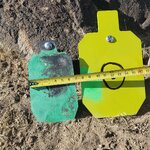
Swapped it out for a bigger more realistic vital size target. Gunna load up and shoot here in a bit
OP
OP
WKR
WKR
- Joined
- Jun 14, 2019
- Messages
- 2,229
Well...that made a world of difference
Impact after impact today...no wind at the shooter but one look at that mirage and I knew there was some hold over necessary. I probably could have gotten away with a tenth looking at the impacts but I held .2
Definitely brought my confidence back up...that little target had me scratching my head and second guessing myself. Lesson learned.
Impact after impact today...no wind at the shooter but one look at that mirage and I knew there was some hold over necessary. I probably could have gotten away with a tenth looking at the impacts but I held .2
Definitely brought my confidence back up...that little target had me scratching my head and second guessing myself. Lesson learned.
Lawnboi
"DADDY"
Regardless of what the internet says, a 1.2moa target at 750 yard is a difficult target.
10” circle is what I would consider vital size target for deer. If I can’t hit that with zero pressure I’m not shooting at something.
Re spotting shots. Spotting shots in the field goes way beyond recoil and seeing maybe some plate rock or splash. Many areas have vegetation, no nice berm behind the animal, snow, ect where spotting shots is hard. Even very accomplished shooters can have a hard time spotting shots in the field. Pinnpointing where you hit can also be different than seeing some splash, processing this information while your trying to get back in target is even tougher.
10” circle is what I would consider vital size target for deer. If I can’t hit that with zero pressure I’m not shooting at something.
Re spotting shots. Spotting shots in the field goes way beyond recoil and seeing maybe some plate rock or splash. Many areas have vegetation, no nice berm behind the animal, snow, ect where spotting shots is hard. Even very accomplished shooters can have a hard time spotting shots in the field. Pinnpointing where you hit can also be different than seeing some splash, processing this information while your trying to get back in target is even tougher.
Do a bunch of jumping jacks and pushups prior to your cold bore shot too. Get that heart rate up and adrenaline pumpingI shoot a ton of long range. Run matches, shoot comps etc.
The biggest piece of advice I offer to hunters is to get off the bench.
The best thing you can do it spend a ton of time working to get into a stable position quickly. That could be off your pack, shooting sticks, tripod etc.
OP
OP
WKR
WKR
- Joined
- Jun 14, 2019
- Messages
- 2,229
Update 10/28/24
4 days of consecutive cold bore impacts at varying degrees of wind strength and direction.
Today was by far the best with a 12 mph 10 o clock wind.
Tomorrow im going to push it back some. I'm thinking 850ish
At this point its purely for skills training because my 25 creed runs out of required impact velocity right around 750 so I won't be taking shots past that for this hunt.
4 days of consecutive cold bore impacts at varying degrees of wind strength and direction.
Today was by far the best with a 12 mph 10 o clock wind.
Tomorrow im going to push it back some. I'm thinking 850ish
At this point its purely for skills training because my 25 creed runs out of required impact velocity right around 750 so I won't be taking shots past that for this hunt.
Southern Lights
WKR
For most hunting rifles working perfectly, with great shooting, the best ammo, in the most stable position, and with no wind is going to be about 1 MOA. So for the 750 yard shot discussed, you are giving up 7.5" in variation just in the cone of fire from perfect shooting with a perfect rifle and perfect ammo. That leaves extremely little room for error.
My main practice is an 8" kill zone assumption. I shoot and practice on a 8" plate backing up further and further until I'm no long consistent in field conditions (wind, shooting of pack, seated, etc.). That is my max range for that position.
My main practice is an 8" kill zone assumption. I shoot and practice on a 8" plate backing up further and further until I'm no long consistent in field conditions (wind, shooting of pack, seated, etc.). That is my max range for that position.
Last edited:
Lawnboi
"DADDY"
Add wind. A 6mph rifle at 750 yards…. 1mph of wind is changing poi more than .1mil. It takes no time for your cone of fire to get quite a bit bigger.For most hunting rifles working perfectly, with great shooting, the best ammo, in the most stable position, and with no wind is going to be about 1 MOA. So for the 750 yard shot discussed, you are giving up 7.5" in variation just in the cone of fire from perfect shooting with a perfect rifle and perfect ammo. That leaves extremely little room for error.
My main practice is an 8" kill zone assumption. I shoot and practice on a 8" plate backing up further and further until I'm no long consistent in field conditions (wind, shooting of pack, seated, etc.). That is my max range for that position.
IMO once you hit the point where your mph makes 1mph make .1 mils things become a lot more difficult
Southern Lights
WKR
Add wind. A 6mph rifle at 750 yards…. 1mph of wind is changing poi more than .1mil. It takes no time for your cone of fire to get quite a bit bigger.
IMO once you hit the point where your mph makes 1mph make .1 mils things become a lot more difficult
There is a lot to go wrong for sure. One thing with shooting on plates is it downplays the significance of a miss. I have seen many times someone walk a shot onto a plate, then after taking five shots to get on it, hit it another five+ times and think everything is fine. They forgot about the five shots it took to get there.
Shot 1 - Off the plate to the left = Complete miss of animal and it starts running. All your range dope is now off.
Shot 2 - A little off the plate left, but low = You clipped the front leg of the animal or underside of chest. It runs off and dies.
Shot 3 - Over correct and now hit far right as wind shifted and low = You shot it in the rear leg. Ran off and died.
Shot 4 - Off the plate to the right but almost hit. = You gut shot it. Ran off an died.
Shot 5 - Great windage, but shot just high over the plate = You clipped the spine. It dropped stunned, then got up to run and died.
Shot 6-10 - My rifle is on and I would have killed the animal.
So really in this kind of practice your first shot is the only one that matters. If you can't put it on a target after setting up under time pressure, I think it's very misleading what will happen when the pressure is on.
One of the most valuable things I do for LR hunting is shoot in comps where the targets are life-size targets. The kill zones are steel, but the rest of the target is rubber conveyor belt. If you hit it rings. If you miss you hear the thud. It keeps things in perspective about reality of taking long range shots because a miss is obviously bad. A plate standing alone misses this important part of what the miss means when it actually happens on an animal.
Similar threads


- Replies
- 104
- Views
- 14K


Featured Video
Latest Articles
- Knowledge From Storms: Surviving and Thriving in the Backcountry with John Barklow
- DIY Wyoming Pronghorn Hunt
- Unlock Precision Shooting: Master Your Hunting Game with Competitive Insights
- Topo Topper Rincon Review
- Tony Trietch on Big Mule Deer, Desert Bulls & Western Hunting Evolution
- The Right to Hunt & Fish Colorado (and North America)
- Mastering New Zealand’s Mountain Hunts: Challenges and Rewards
- Iron Will Turkey Broadhead Review
- Nevada Mule Deer & The Trade-Offs in Wildlife Management
- Spartan SpringBok Bipod Review