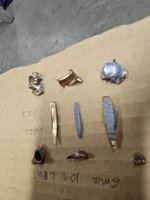
Notice the 2 front ~1/3 of the bullet (middle of pic) tore off with unopened tips recovered from gel.

Follow along with the video below to see how to install our site as a web app on your home screen.
Note: This feature may not be available in some browsers.
Notice the 2 front ~1/3 of the bullet (middle of pic) tore off with unopened tips recovered from gel.
The mushroom in the pic (like the one in your hand) was connected to one of the tips in the pic.What about the other two and mine that was recovered from an elk? Tumbling is always possible but far from the rule.
You're not wrong. I've seen evidence of tumbling too but to firmly state that they all tumble vs expand is not accurate.The mushroom in the pic (like the one in your hand) was connected to one of the tips in the pic.
I would agree with that.You're not wrong. I've seen evidence of tumbling too but to firmly state that they all tumble vs expand is not accurate.

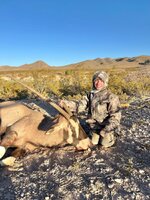
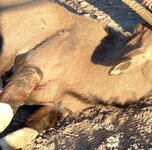
How do you know it did not tumble?My daughter shot a New Mexico oryx last March with a 156 Berger out of a 6.5 prc. The shot was at 50 yards and very hard quartering away. The Berger preformed perfectly. There was some tiny shrapnel piece exits on the front of the shoulder. There was
No tumbling with this one.
How do you know it did not tumble?
How do you know it did not tumble?
I don't intend to be argumentive but what if the yaw/tumble is what caused the bullet to open/fragment?The tiny exits from fragments lead me to believe it didn’t tumble but fragmented. I also couldn’t find the bullet.
I don't intend to be argumentive but what if the yaw/tumble is what caused the bullet to open/fragment?
As long as it works does it matter what opens the jacket?

What’s the lowest impact velocity you have with the 108 EH?


That was not my experience with 156 EOL out of my 264 Win Mag AI or 144 LRHTs out of my wife’s 6.5x47I have had a multitude of Berger failures, they simply do not open on thin skinned game like pronghorn when shooting double lung. Hit the shoulder and they explode. A happy medium would be much preferred. I for one do not promote using them as hunting bullets. I will stick with ELD's and Hammers for all future hunting uses.