It you want to know what your BS is doing after a long run you could wear a glucose monitor. Idk if people realize how much “sugar” a person’s body kicks out on its own when exercising, all of which is normal.
Being type one I wear a glucose monitor and after a run I can expect my BS to rise, up to an hour afterwards. This is pretty common for me.
I’ve had high, pre diabetic range, A1c levels for the last couple of years and they kept inching up slowly. I was very miffed by this as I was eating reasonably healthy and super active all of the time. I quit drinking entirely and that didn’t seem to make any difference over the course of 12 months.
Finally, I switched to 90% keto diet for 3 months + started supplementing Chromium, Alpha Lapoic Acid and Berberine and my levels dropped back into normal range within that 3 month window.
Alpha lipoic acid and chromium lowered my A1C as well. Mine started creeping up even though I have been eating real clean, exercising about 5-6 hrs a week, as well as walking several miles a day at work. I hadnt drank alcohol for 10 years when mine started going up.
I tried berberine for several months and it did not work for me.
IMO, 19-20% bodyfat and endurance "athlete" aren't compatible. I think this could be addressed and see what happens.
Edit: You could maybe convince me that a swimmer athlete would benefit from higher bodyfat due to buoyancy. But 19% for a true athlete is still pretty high, unless you are in a strength/power sport.
It you want to know what your BS is doing after a long run you could wear a glucose monitor. Idk if people realize how much “sugar” a person’s body kicks out on its own when exercising, all of which is normal.
Being type one I wear a glucose monitor and after a run I can expect my BS to rise, up to an hour afterwards. This is pretty common for me.
I thought about that, but no one can tell you what it means. It can yield a lot of assumptions, but those are carried over from the diabetic population. Over interpretation of tests without data creates real problems. I found an article discussing a competitive cyclists who used CGM and his tracing looks like a poorly controlled diabetic.
Similarly, given we know exercise is beneficial for diabetics, if someone told you to stop running because of that glucose bump, you would know they are focused on the wrong thing.
IMO, 19-20% bodyfat and endurance "athlete" aren't compatible. I think this could be addressed and see what happens.
Edit: You could maybe convince me that a swimmer athlete would benefit from higher bodyfat due to buoyancy. But 19% for a true athlete is still pretty high, unless you are in a strength/power sport.
Fine, replace the word athlete with exerciser. Having grown up calling kids playing softball athletes, I didn't realize I needed to have podium finishes to use the title. My apologies for offending Section 147.54.467.2 of the Word Police Code.
As a middle aged guy who is working hard (10-12 ish+ hours a week in workouts) to be in/ stay in shape, I often find these conversations fascinating. I'm not an athlete, heck I'm below average at being average. I'm just trying to be a better elk hunter and able to move outdoors and in life as I want.
Those who have lives dedicated to strictly being athletes (as a career) , have a little different context in life I don't necessarily relate to daily.
But for those who are training hard for events they compete in, but still living every day lives too, family/ careers/hobbies I have to wonder at the every day cumulative stress levels and impacts on all bood/bio markers and where that enters this conversation. Then you apply that to individuals and it almost gets in the weeds or minutiae.
Age and associated metabolic changes, training schedules, work/ family/personal stress points, lack of relaxation/rest/recovery, compressed sleep schedules to get it all in, all equals compounding stress (physical/ emotional/psychological/spiritual) that I can't help but think influence all of these markers that have been discussed.
At least that's my experience the last 2 years.
I sometimes think that while the general knowledge of what does or doesn't move blood/bio markers becomes a cookie cutter/general approach because humans like systems/ equations.
But when stress (especially high levels of stress not necessarily derived from physical exertion) enters the picture, it can quickly muddy the waters. At the same time, it seems that must be part of these conversations, in my opinion. Especially for those of us average joes.
I might have missed it, but i haven't seen that mentioned yet and wondered if it had a place in these thoughts/ this thread?
As a middle aged guy who is working hard (10-12 ish+ hours a week in workouts) to be in/ stay in shape, I often find these conversations fascinating. I'm not an athlete, heck I'm below average at being average. I'm just trying to be a better elk hunter and able to move outdoors and in life as I want.
Those who have lives dedicated to strictly being athletes (as a career) , have a little different context in life I don't necessarily relate to daily.
But for those who are training hard for events they compete in, but still living every day lives too, family/ careers/hobbies I have to wonder at the every day cumulative stress levels and impacts on all bood/bio markers and where that enters this conversation. Then you apply that to individuals and it almost gets in the weeds or minutiae.
Age and associated metabolic changes, training schedules, work/ family/personal stress points, lack of relaxation/rest/recovery, compressed sleep schedules to get it all in, all equals compounding stress (physical/ emotional/psychological/spiritual) that I can't help but think influence all of these markers that have been discussed.
At least that's my experience the last 2 years.
I sometimes think that while the general knowledge of what does or doesn't move blood/bio markers becomes a cookie cutter/general approach because humans like systems/ equations.
But when stress (especially high levels of stress not necessarily derived from physical exertion) enters the picture, it can quickly muddy the waters. At the same time, it seems that must be part of these conversations, in my opinion. Especially for those of us average joes.
I might have missed it, but i haven't seen that mentioned yet and wondered if it had a place in these thoughts/ this thread?
External load certainly plays into everything, even for pro athletes. If you have signs of over training, it is time to back down the load. Most of the time we cannot do much to lower external load (family obligations, work), so training load has to go. Not usually an issue if just exercising.
Training too hard (relative to the person, just like lifting heavy is relative to the person when talking training) is detrimental to short term performance. Is it bad long term? Probably depends on lots of factors. But, without data to the contrary, hurting yourself today is unlikely to be beneficial tomorrow, and thus should be avoided.
With data that shows benefits, we redefine it as something other than hurting yourself. At the extreme, think of physical therapy after surgery. On the more practical level for most of us, is that soreness after a session injury or discomfort? Sometimes it takes lots of knowledge to know. No one gets to the point of rupturing a tendon without lots of subtle warning signs, many times those are ignored as just being part of the discomfort that comes with improvement. On the other side, no one sees much improvement if every time things get uncomfortable they stop for fear of injury.
The problem with biomarkers is they are not black and white, they must be interpreted in context and the further one gets from the validated context, the higher the risk that we don't know how to interpret them correctly.
Scott Johnson, in explaining why he doesn't rely on HRV to train people (
we cannot call them athletes, because we have established the I'm not an athlete in this thread and I've paid for coaching from his team. I'm still waiting to hear back from the word police on if I must change all past uses of the word 'athlete' to say 'person' but the the Vogons are slow as usual.
) tells a story were HRV data said the person was in poor condition and shouldn't train that day, this was after a taper and she proceeded to run one of her best races ever. HRV does not know if you are over trained or just pumped and ready; biomarkers don't know the context. So the question becomes, do we know the marker well enough to interpret it in the context at hand.
Fine, replace the word athlete with exerciser. Having grown up calling kids playing softball athletes, I didn't realize I needed to have podium finishes to use the title. My apologies for offending Section 147.54.467.2 of the Word Police Code.
Valid point based on how this thread has gone. While not a perfect answer to the charge, I submit the following in response:
I am on a statin even though every calculator says I'm low risk. The reason is that while high amounts of activity are profoundly protective when compared to say only 50 minutes/wk, the level I do is still associated with increased coronary plaque (not just coronary calcium, but follow on CTA studies confirmed plaque burden) and the current data suggests my cardiovascular disease mortality risk is closer to that of someone who does about 100 minutes/wk (but all cause mortality risk is still lower than someone who does less).
I avoided bringing this up because past experience shows statins are controversial on RS and don't feel like arguing the point again and my primary interest was sharing other ways to evaluate for poor glucose management to confirm or disconfirm a mildly elevated A1c, which is a different topic.
I will repeat what I said earlier, don't push past 300 min/wk of vigorous activity for health benefits. And broadening the topic, address risk factors that fit the data and the clinical picture, if the picture isn't clear and the intervention might be problematic, seek clarifying testing.
We know recreational running is associated with a significantly reduced risk of knee replacement compared to the general population, but professional running has a moderately higher risk when compared to the general population. So, anyone who is pushing there ability should take measures to protect their knees. I do that, but based on some responses in this thread, perhaps I should just consider myself a recreational runner and stop wasting my time.
In the medical literature I actually fit the typical definition of a "masters athlete", if you want to get technical.
However, generalizability is a valid concern, it depends on the individual population of the study, not the word used. A football lineman is a different type of physically active person than a middle long distance running person, and how different is a middle long distance running person who places mid pack in a non-competitive field compared to a long long distance running person who podiums in a competitive field? (Sorry for the awkward construction, don't want to offend by using the term athlete incorrectly and you haven't provided a definition yet.)
@omicron1792 I decided to try and change my question to see if I found information that lead me to a different conclusion.
This study lends support to your position. While higher level activity remains protective it is less protective than moderate level for people with prediabetes developing type 2. https://pmc.ncbi.nlm.nih.gov/articles/PMC11406853/
Given fasting glucose was used to make the diagnosis of prediabetes there is room to question how it applies to someone with normal fasting glucose and elevated A1c. It does, however, make a lack of metabolic syndrome much less reassuring than I thought.
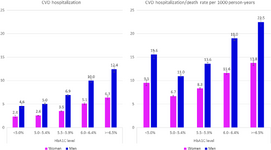
This is also rather interesting, particularly when looking at the right hand graph. I never would have considered a A1c below 5.0 to be more risky than a Prediabetic A1c between 5.6 and 6.0. The right hand graft is CVD hospitalizations and all cause mortality (not CVD mortality, which was not clear to me from the graph). Could be due to genetic factors, such as hemoglobin variants being the actual marker of risk. https://www.ahajournals.org/doi/10.1161/JAHA.123.031095
It reminds me of HDL, where once you pass 100 the level is a risk factor and not good, despite indicating lower risk below that point.
Valid point based on how this thread has gone. While not a perfect answer to the charge, I submit the following in response:
I am on a statin even though every calculator says I'm low risk. The reason is that while high amounts of activity are profoundly protective when compared to say only 50 minutes/wk, the level I do is still associated with increased coronary plaque (not just coronary calcium, but follow on CTA studies confirmed plaque burden) and the current data suggests my cardiovascular disease mortality risk is closer to that of someone who does about 100 minutes/wk (but all cause mortality risk is still lower than someone who does less).
I avoided bringing this up because past experience shows statins are controversial on RS and don't feel like arguing the point again and my primary interest was sharing other ways to evaluate for poor glucose management to confirm or disconfirm a mildly elevated A1c, which is a different topic.
I will repeat what I said earlier, don't push past 300 min/wk of vigorous activity for health benefits. And broadening the topic, address risk factors that fit the data and the clinical picture, if the picture isn't clear and the intervention might be problematic, seek clarifying testing.
We know recreational running is associated with a significantly reduced risk of knee replacement compared to the general population, but professional running has a moderately higher risk when compared to the general population. So, anyone who is pushing there ability should take measures to protect their knees. I do that, but based on some responses in this thread, perhaps I should just consider myself a recreational runner and stop wasting my time.
As for the A1C i personally would be overly concerned about it if its staying the same yr to yr. if its been or is going up yr to yr I would be looking closely what I am eating.
I to have an A1C that goes from 5.6 to 5.7 and back my doctor is not real concerned.
It does seem if you see someone other than I doc now days you tend to get treat acording to what ever The practices SOP or standing orders are for the office.
This is about where I fall looking at all the data. High level is protective, just less so than moderate exercise.
My hypothesis is the exercise itself is still protective, but the high level creates some negative effects that start to drag it back down toward the mean.
This is all pretty interesting to me. I am an “endurance athlete” - as in non professional dude that just likes to get out and see what I might be capable of.
A few years back my A1c was in the upper half of the normal range and I was trying to be healthier and wanted to lower it. I started drinking way less, eating way fewer carbs, but also got into doing some fasted training (which I don’t do anymore). Interestingly in a few months of that my A1c went up to 5.7 And I was like WTF? I switched away from fasted training and for some other reasons started eating some more carbs again and it went back down. I suspect I had up-regulated my gluconeogenesis from the fasted exercise - which interestingly always felt very good - even on long duration strenuous hikes. That and/or increased cortisol from the stress of being unfed maybe. Either way, I could find basically nothing about this as it seems in general blood sugar levels haven’t been studied too much in non diabetic groups.
I also wore some CGMs for a few months off and on around then. My fasting blood sugar was always good and my insulin resistance was low. However the cgms always seemed to calibrate to the high side for me and would read higher than my drawn fasting blood sugar - so the averages on those were high but seemed to indicate I could deal with carbs well. I didn’t do a glucose tolerance test. As an aside - if I had a beer while wearing the cgm it would dramatically lower my blood sugar even if paired with eating carbs. Not that I am advocating for drinking - just interesting.
Anyway now mine has been steady in the upper part of the normal range for the last couple years. I would prefer it be a bit lower.
Carb periodization and timing around training is important (before/during/after), but can be difficult on big days to nail this without needing to consume a lot later in the day. I'm taking in tons of carbs and have an hba1c of 5.3/5.4 which I keep an eye on with the balance of trying to consume enough, but not over eat, while making sure the timing makes sense. I'd like to lower it if possible. It's a tricky balance.
Just getting in some light movement (i.e. walk) after eating a carb heavy meal can help with the insulin response, as well as pairing with fat/proteins as someone else mentioned. The diet for big training isn't perfectly healthy or "ideal" for longevity, but is better than sitting around on the couch and can be managed by paying attention to timing of macros.
Same boat here. 34yo. ~15% Body Fat. Fasted Insulin of 2.7uIU/mL & Glucose at 85.0mg/dL. MyHbA1c is at 5.6%. Looking at my Garmin I hit ~5 hours of zone 1-3 training and ~1 hour in zones 4&5 so not exactly an elite athlete.
If you're eating clean, training hard, and your insulin & glucose look good - wouldn't worry about it too much. I like to get down to 10-12ish% body fat for hunting season just to "ultralight" myself. Just find that level of body fat is not enjoyable to hold for the rest of the year (Takes a super clean diet & extra running for me to get there)
Same boat here. 34yo. ~15% Body Fat. Fasted Insulin of 2.7uIU/mL & Glucose at 85.0mg/dL. MyHbA1c is at 5.6%. Looking at my Garmin I hit ~5 hours of zone 1-3 training and ~1 hour in zones 4&5 so not exactly an elite athlete.
If you're eating clean, training hard, and your insulin & glucose look good - wouldn't worry about it too much. I like to get down to 10-12ish% body fat for hunting season just to "ultralight" myself. Just find that level of body fat is not enjoyable to hold for the rest of the year (Takes a super clean diet & extra running for me to get there)
Key Point - If your below biomarkers are:
- Fasted Glucose 85-90
- Triglyceride to hdl ratio < 2 (Athletes are often less than 1 which is where I fall at .67)
- Low Insulin (Don't recall this video calling out a range)
Then your a1c is not a concern in this context. They discuss the mechanism of why a1c can be raised for athletes as well. It has to do with red blood cell life



 , which would put me closer to 16-17%