Choupique
WKR
- Joined
- Oct 2, 2022
- Messages
- 1,395
That’s monos my man
I thought that was the chief issue with regular hollow point match bullets?

Follow along with the video below to see how to install our site as a web app on your home screen.
Note: This feature may not be available in some browsers.
That’s monos my man
Yes, it is.I thought that was the chief issue with regular hollow point match bullets?
If you do decide to hunt with it, I can recommend the 75 ELDM.And while I put together a tack driver of a 22 Arc this year, because the ballistics look so great on paper, I have yet to hunt with it.


If you do decide to hunt with it, I can recommend the 75 ELDM.
I’m my experience they run about 40 yards.
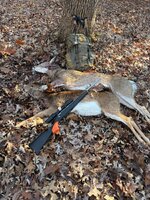
View attachment 975865

One of the rifles in my rotation is a 308 pushing a 110 gr. CX at 3190 fps. That bullet being designed for the 300 Blackout will not pencil. Some mono's nowadays open quite quickly.That’s monos my man
The other issue is the hpbt bullets tend not to penetrate in a straight line.I thought that was the chief issue with regular hollow point match bullets?
just as a data point - years ago I found a wounded fawn and finished it off and skinned it out to figure out why it died.Good point. Lung shooting deer would probably work with that too, but probably not with the best recovery rate, I imagine.

If you do decide to hunt with it, I can recommend the 75 ELDM.
I’m my experience they run about 40 yards.
View attachment 975865
What’s the sample size?

Spin a suppressor on that rifle and it’s really going to blow your mind. I couldn’t be happier, deer aren’t stirred up, ears aren’t ringing, I can hear and see the impact in the scope.#3 and 4 for the year with the 223 Tikka and factory 73 ELDM. Probably nothing that useful in the way of data. Sub-100 yards so both neck shots and DRT with very large holes. Really happy with the 223 so far, it's just enjoyable to shoot.
Sorry if it's been answered but the search function was no help...
Do 88 gr ELDMs give more reliable exits on black bears (or deer similar size since our bears are sub 350 lbs 99% of the time). Yes I know the 77 TMK kills well but the pattern I see makes me think we'd have minimal blood trails. Fine if the bear dies within 40 yards where you can hear it drop. Not so great if it's a sub optimal hit and they go farther. Yes I know practicing a lot balances that out... I'm taking kids hunting and they don't always have the steadiest nervous 40 yards from a bear no matter how much practice they have (and they aren't my kids so I can't necessarily have them do the kind of practice a lot of folks here get).
So I want a blood trail if possible. If 88s work I might load a batch. If not, we'll keep using the suppressed 308 or 6.5 Grendal.
Do you have any other info on this bullet how closely it’s related to the 88 and 80 eldm, along with the 77tmk?
Curious why you would go down this road when the 88 eldm is available.
I just don't want to admit that but I think I need to move on from 88's in my new 22 Creed. Tried 4350, Retumbo and H1000. Was going for N565 next but I guess I'll just load up some 80's and 77 TMK's.
My thoughts are to stick with H1000 to get better case fill and potentially extend barrel life with the cooler powder vs H4350...
The only thing I questioned was the minimal damage on neck shot. Has anyone else seen similar performance from the 75 ELDM?
Didn't realize that was the case. I know the 77 TMKs are the most consistent, but putting them aside if one were looking for a higher bc, would the 80 ELD-M be the most consistent, over the 88?

The 106/108/109 ELD don’t seem to reliably exit so I don’t know why 88s would. Hell 175 (7mm) and 200 gr eldx don’t either in my small sample size.Sorry if it's been answered but the search function was no help...
Do 88 gr ELDMs give more reliable exits on black bears (or deer similar size since our bears are sub 350 lbs 99% of the time). Yes I know the 77 TMK kills well but the pattern I see makes me think we'd have minimal blood trails. Fine if the bear dies within 40 yards where you can hear it drop. Not so great if it's a sub optimal hit and they go farther. Yes I know practicing a lot balances that out... I'm taking kids hunting and they don't always have the steadiest nervous 40 yards from a bear no matter how much practice they have (and they aren't my kids so I can't necessarily have them do the kind of practice a lot of folks here get).
So I want a blood trail if possible. If 88s work I might load a batch. If not, we'll keep using the suppressed 308 or 6.5 Grendal.