Do you understand what migratory mule deer are?
I do. Mule deer are considered migratory by wildlife biologists if they make distinct, seasonal movements between summer and winter ranges, with distances ranging from less than 10 miles (referencing some herds in Oregon) to over 150 miles (referencing some herds in Wyoming).
All of the mule deer herds I've hunted in California, Utah, and Colorado fit that academic definition of a migratory mule deer herd.
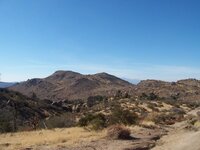
Do I think the mule deer that use the ground in the photo I posted are different then your mule deer? Yes, the fact that they are migrating and dont live where I am hunting them makes the situation infinitely different than hunting resident mule deer.
The herd that uses the terrain in my photo is a migratory mule deer herd, having distinct summer and winter ranges. The center of the summer range is 17.5 miles from the center of the winter range and there's a difference of 3,000' in elevation between them. When on the winter range, the herd doesn't "live" within the frame of my photo any two consecutive days in a row. It does a 64 mile round trip that takes an average of 21 days to complete as it covers an average distance of 3 miles per day. The other migratory herds I've hunted in California, Utah, and Colorado use winter range in a similar way.
You would apparently have us believe that your migratory herd is on some kind of 100 mile non-stop trip and can't be re-connected with because of this. Mule deer biologists from your own state of Wyoming would say that it isn't.
Spring migration takes mule deer 3 to 28 days to complete, with 15 days being the average across populations throughout mule deer country. Fall migration takes 3 to 38 days with a 17 day average across populations throughout mule deer country. According to your Wyoming Game and Fish Department, herds having summer range inside Yellowstone National Park and winter range around Cody take an average of 38 days to get from summer range to winter range, making their seasonal migration among the longest in mule deer country.
While bucks can travel up to 10 miles in a day and does and fawns up to 9, the average daily mileage for migratory mule deer throughout mule deer country is 3 miles. According to your own Wyoming Game and Fish department, that behavior applies to the migratory herds that have their summer range in Yellowstone National Park, as well. Those "three miles" are generally bracketed by "stopover areas" that migratory mule deer will linger in for 1 to 3 days before moving on with the next leg of their journey. Mule deer typically cover relatively short daily distances during migration and spend up to 95% of their total transit time lingering in stopover habitat as an instinctive energy conservation mechanism.
Studies conducted by state wildlife agencies in Oregon, Utah, California, Idaho, and Wyoming have concluded that a mule deer herd will spend about 25 days in "stopover habitat" out of a 38-day migration trip.
If your herd is one that winters around Cody, the findings of those studies apply to it as much as long-distance migrating herds in other states.
You want me to go into Yellowstone park to pattern deer where I cant hunt them?
No. I wanted to offer a counter-point to statements of yours like these:
I repeatedly see a lot of guys on here saying the same. 300 yards and in, just get closer ect. I thought that way for a while too until I realized if I dont learn to shoot farther and get proficient dialing, I am not going to kill anything very often. The terain in NW Wyoming just doesnt allow it. You could wind up close to an animal, but more often than not, you wont.
But if you think you are going to consistently kill migratory animals at 300 and in, your being dishonest or you just dont get it.
Hunting migratory mule deer, there is no catching up to them when they are moving,
If I am "clueless" for rejecting the veracity of the statements above, so are the majority of wildlife biologists studying migratory mule deer in multiple states.
According the THEM, your herd spends about 25 days out of a 38-day migration essentially going nowhere, and is only going to move an average of 3 miles per day between "stopover habitat" where it will linger from 1 to 3 days before embarking on the next leg of its migratory journey. Statistically speaking, when your herd breezes through your drainage, it isn't likely to travel more than three sections on a topo map before it stops.
Mule deer are renowned for their engagement in crepuscular activity and thus equally renowned for spending most of their mid-day hours and some of their night-time hours bedded down. Their status as "resident" or "in transit" or "on seasonal range" doesn't change that.
All mule deer, whether engaged in seasonal migration or not, sleep an average of about 4.5 to 5 hours in a 24 hour period, That sleep is spread out over multiple sessions, whether they're migratory, or not. As temps drop, all mule deer exhibit a strong propensity to do their bedding on south-facing slopes, whether they're migratory, or not, and they do that because south-facing slopes receive the first and most intense sunlight, aiding in melting snow and keeping the ground drier and softer.
You would have us believe that there are no primary or secondary bedding areas within 3 miles of the drainage in your photo, even though the body of research conducted by wildlife management agencies in multiple states, including Wyoming, doesn't support that notion
Mule deer can travel up to 3 miles for water, but all mule deer, migratory or not, need to consume a half-gallon of water for every 100 pounds of body weight per day and thus no mule deer, whether resident or migratory, likes to be more than 1.5 miles away from standing water at any time.
"Mule deer exhibit remarkable fidelity to seasonal ranges and migration routes" (Sawyer etal 2019, Wheat and Whittaker 2023). According to all three, that "remarkable fidelity" includes the utilization of the same "stopover habitat," year after year, and lingering for about the same amount of time in each stopover area, year after year.
You would have us believe your particular migratory herd doesn't exhibit this commonplace "remarkable fidelity" and it can't be "patterned" in its transit corridor zone because of that.
"Rarely do they deviate from their route, even when encountering disturbance or when alternative routes exist (Wycoff et al. 2018, Sawyer et al.2019)." That lack of deviation includes the stopover habitat.
You apparently want us to believe that your herd exhibits behavior that no other migratory mule deer herd exhibits; that it doesn't travel a relatively short distance between stopover areas that it lingers in for 1 to 3 days, like every other migratory mule deer herd does when in transit between seasonal ranges. You apparently want us to believe that it doesn't have the same renowned fidelity to all aspects of its migration that every other migratory mule deer herd exhibits and that it doesn't have the same needs for standing water sources and bedding areas that every other migratory mule deer herd has.
Migratory mule deer are generally considered
by hunters to be more difficult to "pattern" than resident deer are, but basic mule deer biology doesn't support the idea that "patterning" them is impossible, even in transit corridor zones between seasonal ranges.
In contrast with your opinion on the matter, every one of the wildlife biologists I have spoken to believe that
resident mule deer in high-pressure areas are the most difficult to "pattern" and hunt, with a sudden influx of hunters causing them to interrupt crepuscular activity and become "ghosts" that only move at night, making them more challenging to hunt than any migrating herd engaged in normal crepuscular activity is.
Basic mule deer biology definitely doesn't support the notion that re-connecting with a migrating herd is as impossible as you would have us believe it to be, even if you're hunting a transit zone between seasonal ranges. It says that a migratory herd will spend up to 95% of its transit time not actually going anywhere, and when they are going somewhere, it says that they're moving at an average rate of just 3 miles per day.