
I think the higher intensity is going to give you the opposite effect of zone 2 - It will train your heart rate to spike.Oh totally, more training is going to be better than less. Particularly for endurance.
I'm asking more like: if you know your training is going to be fixed at (say) 5 hours per week, will you have better outcomes from zone 2 work or something at a higher intensity?

Navigation
Install the app
How to install the app on iOS
Follow along with the video below to see how to install our site as a web app on your home screen.
Note: This feature may not be available in some browsers.
More options
Style variation
You are using an out of date browser. It may not display this or other websites correctly.
You should upgrade or use an alternative browser.
You should upgrade or use an alternative browser.
Training for The Uphill Athlete Scott Johnston New Hunting Podcast
- Thread starter Cliff Gray
- Start date

Willie IV
Lil-Rokslider
- Joined
- Mar 6, 2019
- Messages
- 214
How much weekly zone 2 work are you planning to do?
5 to 6 days but at varying degrees of incline, speed and weight. I'm wanting to keep my body from adapting to one routine so I'll change it up. One day is a grind it out day (2-3 hrs) and some days are 0% incline for only 30 minutes. Most days range from 45 - 90 minutes.
mad_angler
WKR
- Joined
- May 10, 2013
- Messages
- 448
I think Scott specifically addressed this when talking with Cliff. He said that leaving zone 2 actually hurts your performance. When you are out of zone 2, you are telling your body to ignore aerobic pathways and focus on anaerobic pathways. That defeats the primary goal of his program.Oh totally, more training is going to be better than less. Particularly for endurance.
I'm asking more like: if you know your training is going to be fixed at (say) 5 hours per week, will you have better outcomes from zone 2 work or something at a higher intensity?
That is my uneducated recollection. Others maybe heard it differently...
Listen to the podcast around 1:29 where this exact question is asked and answered...
Poser
WKR
Oh totally, more training is going to be better than less. Particularly for endurance.
I'm asking more like: if you know your training is going to be fixed at (say) 5 hours per week, will you have better outcomes from zone 2 work or something at a higher intensity?
I would expect that one's fitness would plateau only doing zone 2 training for a handful of hours a week.
The question is if that plateau level of fitness is sufficient for your demands. If you were climbing a Himalayan peak, it most certainly would not be sufficient, but it may be enough for a moderately difficult hunting trip. Of course, if you further divide that 5 hours up with some strength training and, eventually, some muscular endurance, you're not going to be left with much zone 2 training.

kad11
WKR
I understood it the same as you...I think Scott specifically addressed this when talking with Cliff. He said that leaving zone 2 actually hurts your performance. When you are out of zone 2, you are telling your body to ignore aerobic pathways and focus on anaerobic pathways. That defeats the primary goal of his program.
That is my uneducated recollection. Others maybe heard it differently...
If you trust ChatGPT - this sounds accurate to me though...
Great question—and you’re thinking about this exactly the right way.
There is a very real diminishing-returns curve for Zone 2 aerobic training. You don’t need elite-athlete volume to get most of the benefit, especially for hunting.
Below is a practical, evidence-based way to think about it.
 This is the sweet spot for most hunters
Fatigue cost: Low
Injury risk: Low
Great question—and you’re thinking about this exactly the right way.
There is a very real diminishing-returns curve for Zone 2 aerobic training. You don’t need elite-athlete volume to get most of the benefit, especially for hunting.
Below is a practical, evidence-based way to think about it.
The Zone 2 “Return on Investment” Curve
~3–4 hours/week → ~60% of max aerobic base gains
- Big improvements if you’re coming from low/moderate volume
- Better fat oxidation, lower resting HR
- Faster recovery between efforts
~5–6 hours/week → ~75–80% of aerobic base gains
This is the sweet spot for most hunters- Major mitochondrial growth
- Strong capillary density increases
- Noticeable drop in HR at given pace
- Very good endurance carryover to rucking and long days
Fatigue cost: Low
Injury risk: Low
~7–8 hours/week → ~85–90% of gains
- Gains continue, but slower
- Requires better sleep and fueling
- Mostly useful if you’re prepping for very long pack-outs or multi-day hunts
10+ hours/week → Final 5–10%
- Elite endurance territory
- High fatigue, high time cost
- Not necessary unless you’re chasing performance margins
hibernation
WKR
Yeah, that's where I'm struggling a little. Strength training, some mobility and rehab work, shooting the bow regularly, now add in some longer zone 2 work... it adds up fast.Of course, if you further divide that 5 hours up with some strength training and, eventually, some muscular endurance, you're not going to be left with much zone 2 training.

From Scott's article on Aerobic Deficiency Syndrome:For sure endurance is a high volume low intensity - I have a feeling you can probably do like 50% of the training volume to get 80% of the results. It would be interesting to hear his perspective on that.
"Rules of Thumb
The aerobic needle will move very slowly if you do less than 3 hours of aerobic base training per week. Do not expect a noticeable improvement in your aerobic pace in less than six months. If you consistently get in 5-6 hours a week of aerobic base training, you will probably notice an increase in aerobic pace in 3-4 months. Things pick up when you hit 8 hours a week, and we have seen people cure ADS in 2-3 months."

thinhorn_AK
"DADDY"
- Joined
- Jul 2, 2016
- Messages
- 13,769
5-6 hours of zone 2 per week is great but that volume is going to pile up when you add in your strength work and everything else.
kad11
WKR
Roughly accurate? Build strength and aerobic capacity first, then add muscular endurance and HIIT periodically while maintaining foundation?
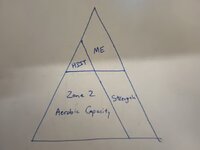

I’ve done their ultra running plans for mountain running. The volume was too high for me. So I just scaled to the duration of my event. Instead of back to back 4 hour runs, a one hour run one day and 3 the next. That sort of thing. Worked great. I maxed at 12 hrs/week for a few weeks, but most were right around 8 hours. Ran 40 miles with 11,000 of vertical and wasn’t sore the next day.
I think the thrust of it is: here’s an ideal program with a proposed set of concepts and workouts. My guess is, if you scale that to meet your training availability, it’ll work really well.
Specifically, I’d guess 5 hrs of zone 2 a week, if maintained as a base for several months, and the ME and strength on top, is going to be great. And if you can do, say, 4 weeks of bumping that to 8 hrs and scale back the strength work to maintenance levels for the 4 weeks, even better.
Substituting high intensity for zone 2 is qualitatively different because it works a different energy system.
Anyway, for what it’s worth, I think folks on the thread are right on. Don’t let the perfect be the enemy of the good - any program with consistent zone 2 aerobic work, strength work, and an ME component will be awesome if you stick with it and progress/periodize in a reasonable way.
I think the thrust of it is: here’s an ideal program with a proposed set of concepts and workouts. My guess is, if you scale that to meet your training availability, it’ll work really well.
Specifically, I’d guess 5 hrs of zone 2 a week, if maintained as a base for several months, and the ME and strength on top, is going to be great. And if you can do, say, 4 weeks of bumping that to 8 hrs and scale back the strength work to maintenance levels for the 4 weeks, even better.
Substituting high intensity for zone 2 is qualitatively different because it works a different energy system.
Anyway, for what it’s worth, I think folks on the thread are right on. Don’t let the perfect be the enemy of the good - any program with consistent zone 2 aerobic work, strength work, and an ME component will be awesome if you stick with it and progress/periodize in a reasonable way.

solostalker
Lil-Rokslider
For those not wanting to go too far off the deep end on this stuff and keep it simple... If you want to increase your stamina in the mountains...
- incorporate extended (at least 1 hour) sessions of Zone 2 work into your routine. The idea is that anything above Zone 2 training (HITT, Running etc.) does not increase aerobic capacity
- if possible keep the work relative to hunting ( weighted hikes or stair master is better than a stationary bike)
you can make this as complicated as you want but for the average guy just simply doing a few Zone 2 sessions a week will make a difference.
- incorporate extended (at least 1 hour) sessions of Zone 2 work into your routine. The idea is that anything above Zone 2 training (HITT, Running etc.) does not increase aerobic capacity
- if possible keep the work relative to hunting ( weighted hikes or stair master is better than a stationary bike)
you can make this as complicated as you want but for the average guy just simply doing a few Zone 2 sessions a week will make a difference.

V2Pnutrition
WKR
Scott, Steve, and every other Z2 proponent have done a great job getting their methodologies to the masses- no doubt about it. I've read, love, and purchased copies of them for our own clients and group.
But, this is far less about there being some magic formula/training zone and more about the sum of the parts: find the right mix of easy, moderate, and hard over time. Assuming that's above what you've already been used to doing- and it sounds like much of this concept is brand new to some of us- and you'll reap a noticeable reward. Sure, more is better, but that might also mean 2-3-4 hours leading into your hunt reaps massive rewards if you've been doing none of this up until now.
A single 8-12 week block may look like this:

You can see where this is WAY above what the usual way.
You can see where it was gradual- not a linear rocket ship up to 2x the volume.
You can see where there were periods of recovery for a week to absorb the volume.
(If you could zero in further) you would see where this is WAY below the "ideal" volume "needed" for Z2 to "work".
Even though not "ideal" (15-20 hours), you can see where practical is still highly effective when above your norm:
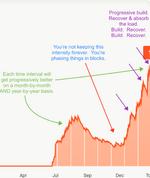
The second year of training like this carried further than my first because there was a base to build from. There are some more thoughts and ideas included in the image and the arrows.
Also, Z2 proponents aren't saying "never do hard, high-intense workouts!" They're saying there is a place, time, and reason to add those, but they're not the thing (as many have been accustomed to believing).
Strength training and recovery as vital parts too as they're the foundation in which ALL this volume rests.
Having a plan is great, but knowing flexibility IN that plan is important too or you end up with diminishing returns from turning the jets on too much.
TLDR: It goes without saying that 20-minutes won't put you in "Zone 2". At the same time, don't let the recommended volume scare you away from trying it at all. Keep the general rule of thumb, challenge your normal dedicated time to fitness (i.e. give a little more time to it than usual), but still make it realistic. Be consistent. You'll reap the reward.
PS: This thread epitomizes when it's worth hiring a coach. A decent understanding of the basics doesn't mean a high degree of confidence and certainty. A good coach will help you navigate your questions and provide explanation in a way that makes you understand it so well that you couldn't NOT buy in. The difference is then have a high degree of confidence what what you're doing will work and that makes the work easier to commit to.
But, this is far less about there being some magic formula/training zone and more about the sum of the parts: find the right mix of easy, moderate, and hard over time. Assuming that's above what you've already been used to doing- and it sounds like much of this concept is brand new to some of us- and you'll reap a noticeable reward. Sure, more is better, but that might also mean 2-3-4 hours leading into your hunt reaps massive rewards if you've been doing none of this up until now.
A single 8-12 week block may look like this:
You can see where this is WAY above what the usual way.
You can see where it was gradual- not a linear rocket ship up to 2x the volume.
You can see where there were periods of recovery for a week to absorb the volume.
(If you could zero in further) you would see where this is WAY below the "ideal" volume "needed" for Z2 to "work".
Even though not "ideal" (15-20 hours), you can see where practical is still highly effective when above your norm:
The second year of training like this carried further than my first because there was a base to build from. There are some more thoughts and ideas included in the image and the arrows.
Also, Z2 proponents aren't saying "never do hard, high-intense workouts!" They're saying there is a place, time, and reason to add those, but they're not the thing (as many have been accustomed to believing).
Strength training and recovery as vital parts too as they're the foundation in which ALL this volume rests.
Having a plan is great, but knowing flexibility IN that plan is important too or you end up with diminishing returns from turning the jets on too much.
TLDR: It goes without saying that 20-minutes won't put you in "Zone 2". At the same time, don't let the recommended volume scare you away from trying it at all. Keep the general rule of thumb, challenge your normal dedicated time to fitness (i.e. give a little more time to it than usual), but still make it realistic. Be consistent. You'll reap the reward.
PS: This thread epitomizes when it's worth hiring a coach. A decent understanding of the basics doesn't mean a high degree of confidence and certainty. A good coach will help you navigate your questions and provide explanation in a way that makes you understand it so well that you couldn't NOT buy in. The difference is then have a high degree of confidence what what you're doing will work and that makes the work easier to commit to.
Attachments

There is unfortunately no substitute for time in endurance.I bought and downloaded the $80 program. Here are my thoughts...
First and foremost, this program will definitely work. If you follow the program, you will extremely ready for a real mountain hunt. Your leg and full body strength will be great and your endurance will also be great.
Other thoughts:
- It is extremely cheap. $80 is basically free
- It is well documented. It has enough descriptions and attachments to guide you through every workout
- It does a nice job including leg, core, and upper body strength
- It does a GREAT job including mountain hunting-specific workouts and acclimation.
But... there is always a but...
I looks quite time consuming. It asks for about 9-12 hours of work each week. Much of that is weighted hiking/climbing for 1-3 hours at a shot. That is why I'm convinced that it would do a great job. If someone spends that much time doing hunting focused exercise, there is no doubt in my mind that you'd be extremely well prepared. But i don't know if I have that much time or desire. It does seem fairly easy to modify a few workouts or drop 1-2 per week to manage your other commitments.
I plan on doing the program as closely as I can but will probably miss at least one workout per week and will probably modify another workout.
Higher intensity actually down regulates the metabolic pathways needed for endurance (he even touches on this in the podcast in this thread). So, you cannot replace volume with intensity. If you don't have the time, the adaptations occur slower and you will not be able to reach the same potential. Above aerobic threshold should account for no more than 10% of weekly volume, less than 5% if someone is aerobically deficit.I'd be real interested to hear Scott Johnston talk about how weekly training volume plays into this style of training. These plans all revolve around tons of zone 2 work, which is great if you can manage it, but how do things change for the person who's doing 3 to 5 hours per week? Is that enough to get meaningful benefits? Or are you better off doing harder workouts, especially since you're not taxing your recovery in the same way as an athlete doing 10 to 20 hours per week?
Around 6 hours of aerobic base training (zone 1 and 2) a week is where things start really improving. And durations of about an hour plus. But, you can see improvement with less.
Doubles (am and pm workouts) start coming into play when volume is really more than is beneficial in a single session (north of 4 hours). So, if you need to log 7 hours you might do 4 in the morning and 3 in the evening. Or, you might hit different types of work, such as intensity or ME work in the morning followed by Z1 or two in the evening with the recovery allowing for better over all quality.

Ironman8
WKR
- Joined
- Aug 15, 2013
- Messages
- 948
General questions for you guys that have been doing Zone 2 training AND have experience in higher intensity training such as Crossfit.
QUESTIONS:
1) Will Zone 2 training do anything to help highly anaerobic work that you'd typically see in a crossfit "WOD"? Or are they totally different pathways and won't necessarily help each other?
2) Can you train Zone 2 with different modalities (walk/run, bike, or rower) to keep the total impact and wear and tear on your body in check and have the same effect as only doing one modality (higher impact walk/hike/run)?
3) Can heavy weightlifting be programmed while increasing Z2 time/mileage?
CONTEXT:
My background is collegiate ball sports where strength and speed was more of a factor than long/slow work...so much so that I have almost NEVER done anything longer than 20-30 minutes of cardio, which generally consisted of intervals or higher intensity runs, and hardly ever more than a few miles. Heavy lifting and Crossfit style workouts have always been the norm. I've been backcountry hunting since 2014 and I think I do pretty well due to the strength and ruck prep I do pre-season, but I definitely get gassed fast and just have to gut it out.
I literally just started my Z2 training this week as I discovered the Evoke programming recently and feel like it may be the missing piece. That said, I still want to maintain (or increase) strength and muscular endurance because I'm also starting to compete in the Tac Games (I know, totally different than a marathon or backcountry hunting). I'm about 17 weeks out from my first competition and the questions above are rolling around in my head because I don't want to risk shifting majority of training to aerobic work and then totally kill the anaerobic side that will be needed for the Tac Games.
QUESTIONS:
1) Will Zone 2 training do anything to help highly anaerobic work that you'd typically see in a crossfit "WOD"? Or are they totally different pathways and won't necessarily help each other?
2) Can you train Zone 2 with different modalities (walk/run, bike, or rower) to keep the total impact and wear and tear on your body in check and have the same effect as only doing one modality (higher impact walk/hike/run)?
3) Can heavy weightlifting be programmed while increasing Z2 time/mileage?
CONTEXT:
My background is collegiate ball sports where strength and speed was more of a factor than long/slow work...so much so that I have almost NEVER done anything longer than 20-30 minutes of cardio, which generally consisted of intervals or higher intensity runs, and hardly ever more than a few miles. Heavy lifting and Crossfit style workouts have always been the norm. I've been backcountry hunting since 2014 and I think I do pretty well due to the strength and ruck prep I do pre-season, but I definitely get gassed fast and just have to gut it out.
I literally just started my Z2 training this week as I discovered the Evoke programming recently and feel like it may be the missing piece. That said, I still want to maintain (or increase) strength and muscular endurance because I'm also starting to compete in the Tac Games (I know, totally different than a marathon or backcountry hunting). I'm about 17 weeks out from my first competition and the questions above are rolling around in my head because I don't want to risk shifting majority of training to aerobic work and then totally kill the anaerobic side that will be needed for the Tac Games.
Short answer: yes, shifting to zone 2 work without maintaining the same level of anaerobic work will hurt your anaerobic work.General questions for you guys that have been doing Zone 2 training AND have experience in higher intensity training such as Crossfit.
QUESTIONS:
1) Will Zone 2 training do anything to help highly anaerobic work that you'd typically see in a crossfit "WOD"? Or are they totally different pathways and won't necessarily help each other?
2) Can you train Zone 2 with different modalities (walk/run, bike, or rower) to keep the total impact and wear and tear on your body in check and have the same effect as only doing one modality (leg powered - walk/hike/run)?
3) Can heavy weightlifting be programmed while increasing Z2 time/mileage?
CONTEXT:
My background is collegiate ball sports where strength and speed was more of a factor than long/slow work...so much so that I have almost NEVER done anything longer than 20-30 minutes of cardio, which generally consisted of intervals or higher intensity runs, and hardly ever more than a few miles. Heavy lifting and Crossfit style workouts have always been the norm. I've been backcountry hunting since 2014 and I think I do pretty well due to the strength and ruck prep I do pre-season, but I definitely get gassed fast and just have to gut it out.
I literally just started my Z2 training this week as I discovered the Evoke programming recently and feel like it may be the missing piece. That said, I still want to maintain (or increase) strength and muscular endurance because I'm also starting to compete in the Tac Games (I know, totally different than a marathon or backcountry hunting). I'm about 17 weeks out from my first competition and the questions above are rolling around in my head because I don't want to risk shifting majority of training to aerobic work and then totally kill the anaerobic side that will be needed for the Tac Games.
Longer term, if you build up zone 2 (aerobic) work and layer anaerobic on top of it, it should improve the anaerobic work, or at least aid performance because your recovery will be much faster.
Shorter term, if you add zone 2 but keep the same anaerobic work…I actually don’t know! Probably highly individual results. Not sure if anyone could tell you with that degree of specificity.
I come to this from boxing. Boxing was highly anaerobic. Adding zone 2 but taking away from the anaerobic work hurt me. Doing a whole offseason of zone 2, and continuing the running while still doing the same volume of anaerobic work, supported he anaerobic work and made me much better. But the overall volume was super high; not really sustainable for more than a month or two.
But: ask Scott! They do a monthly “ask evoke” podcast and cover lots of questions. I think the email is coach @ evoke endurance . com, and the podcast is Evokecast
pattimusprime22
WKR
- Joined
- Sep 3, 2019
- Messages
- 400
I agree with what P Carter said above.
Additionally:
1) Building your aerobic base through zone 2 will help with pretty much anything that lasts longer than a couple minutes.
2) You can do your Zone 2 training through different modalities, but it will never be as beneficial as keeping it specific to your intended goal. If your goal is footborn, weight bearing activity (running, hiking, etc), then swimming or biking will help, but won't be as effective as doing more sport specific zone 2.
3) If you're asking if you can DO both at the same time, sure. If you're asking if you can progress in both at the same time, then I gotta give you the classic "it depends." If you can recover from both, then you could probably get better at both concurrently. If your a very advanced level weightlifter, then additional running volume could limit how much training you would need to do to progress in weightlifting.
Additionally:
1) Building your aerobic base through zone 2 will help with pretty much anything that lasts longer than a couple minutes.
2) You can do your Zone 2 training through different modalities, but it will never be as beneficial as keeping it specific to your intended goal. If your goal is footborn, weight bearing activity (running, hiking, etc), then swimming or biking will help, but won't be as effective as doing more sport specific zone 2.
3) If you're asking if you can DO both at the same time, sure. If you're asking if you can progress in both at the same time, then I gotta give you the classic "it depends." If you can recover from both, then you could probably get better at both concurrently. If your a very advanced level weightlifter, then additional running volume could limit how much training you would need to do to progress in weightlifting.
Poser
WKR
Yes. Many of the higher/highest level Crossfit athletes/coaches have caught on to this and are adopting zone 2 building blocks. You still won't see it at your neighborhood Crossfit box because it doesn't fit the format, though.General questions for you guys that have been doing Zone 2 training AND have experience in higher intensity training such as Crossfit.
QUESTIONS:
1) Will Zone 2 training do anything to help highly anaerobic work that you'd typically see in a crossfit "WOD"? Or are they totally different pathways and won't necessarily help each other?
You need to spend the majority of your training doing the thing you are training to do. For a hunter, this is hiking. At a minimum, you need to do it under your own body weight with a lot of your time spent on an incline. Because biking and rowing are seated, they are less than optimal. Better than nothing, but should only be a minimal part of your zone 2 conditioning.2) Can you train Zone 2 with different modalities (walk/run, bike, or rower) to keep the total impact and wear and tear on your body in check and have the same effect as only doing one modality (higher impact walk/hike/run)?
3) Can heavy weightlifting be programmed while increasing Z2 time/mileage?
Yes. Strength progression will be slower, perhaps much slower, even painfully slower at times, but it can be done. You have to temper your expectations when compared to aggressive strength programs. You can, however, get a jump on strength progression during the off season with the mindset that you may very well stall or get weaker once your conditioning volume increases to a certain point. The more training volume you add, the more you'll have to manage your strength training volume. This will become more critical at around 35 years old, again mid to late 40s and yet again around 55-60+ with potential significant adjustments for volume and recovery at each threshold. Genetics, training history, nutrition, recovery management will all play roles in this.
If you really want to compete in the Crossfit games, cool (That's so 2014, but you do you). If you want to excel at endurance, you should immediately suspend all Crossfit once the games are completed and dedicate your focus to endurance supported by strength training. Do that through hunting season and then switch back to Crossfit games prep for an offseason activity. Doing both will invariably end up being a disaster. Guaranteed.
Ironman8
WKR
- Joined
- Aug 15, 2013
- Messages
- 948
Short answer: yes, shifting to zone 2 work without maintaining the same level of anaerobic work will hurt your anaerobic work.
Longer term, if you build up zone 2 (aerobic) work and layer anaerobic on top of it, it should improve the anaerobic work, or at least aid performance because your recovery will be much faster.
Shorter term, if you add zone 2 but keep the same anaerobic work…I actually don’t know! Probably highly individual results. Not sure if anyone could tell you with that degree of specificity.
I come to this from boxing. Boxing was highly anaerobic. Adding zone 2 but taking away from the anaerobic work hurt me. Doing a whole offseason of zone 2, and continuing the running while still doing the same volume of anaerobic work, supported he anaerobic work and made me much better. But the overall volume was super high; not really sustainable for more than a month or two.
But: ask Scott! They do a monthly “ask evoke” podcast and cover lots of questions. I think the email is coach @ evoke endurance . com, and the podcast is Evokecast
Thanks, makes sense about the recovery piece and I think I heard Scott say that on a podcast as well.
I'm hoping I can handle enough volume to do both at the same time. Realistically, I'm not doing an marathon, so if I put in 5-6 hours of Z2 training, I'm hoping that's enough to get the adaptation I'm looking for. I can always do as you suggested previously and have a training block that skews a little more to Z2 and then switch it back depending on how close I am to a competition.
I'll definitely look into sending a question in to Scott, I've been listing to alot of the old podcasts, including Q&A.
Ironman8
WKR
- Joined
- Aug 15, 2013
- Messages
- 948
Agree on the modalities, however, in the Tac Games, there is running, rucking, rowing, and bike so I am still training within the right intent. The performance for backcountry hunting is more of a secondary benefit as it's not a "tested" event per se. I will likely periodize and skew to more rucking as the season gets closer though anyway...and hopefully with a much bigger aerobic base to begin with.I agree with what P Carter said above.
Additionally:
1) Building your aerobic base through zone 2 will help with pretty much anything that lasts longer than a couple minutes.
2) You can do your Zone 2 training through different modalities, but it will never be as beneficial as keeping it specific to your intended goal. If your goal is footborn, weight bearing activity (running, hiking, etc), then swimming or biking will help, but won't be as effective as doing more sport specific zone 2.
3) If you're asking if you can DO both at the same time, sure. If you're asking if you can progress in both at the same time, then I gotta give you the classic "it depends." If you can recover from both, then you could probably get better at both concurrently. If your a very advanced level weightlifter, then additional running volume could limit how much training you would need to do to progress in weightlifting.
Similar threads
- Replies
- 2
- Views
- 618

- Replies
- 13
- Views
- 721


- Replies
- 357
- Views
- 39K

- Replies
- 18
- Views
- 2K


Featured Video
Latest Articles
- Tony Trietch on Big Mule Deer, Desert Bulls & Western Hunting Evolution
- The Right to Hunt & Fish Colorado (and North America)
- Mastering New Zealand’s Mountain Hunts: Challenges and Rewards
- Iron Will Turkey Broadhead Review
- Nevada Mule Deer & The Trade-Offs in Wildlife Management
- Spartan SpringBok Bipod Review
- All About Pronghorn & Hunting Big Ones with Chance Marshall
- Bill Vanderheyden Debunks Myths About Long-Distance Accuracy
- What Do Elk Eat? Elk Nutrition, Habitat, and Finding More Elk with Luke Schultz
- Patagonia Nano Air Ultralight Hoody Review