Today I learned I don't know what a 300" bull is

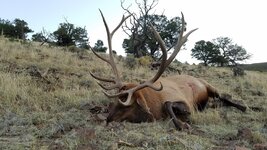
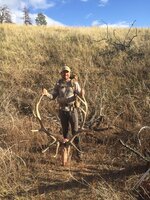
Pictures can be incredibly deceiving. I've got a bull that in one picture looks like he's 340+ and in another he looks like 270. Hes smack dab in the middle of those two numbers. I don't show anyone the second picture, and I just say he's a tick over 300 with a rye smile. I leave it up to there imagination lol

P.S. I'd like to see the score sheet, that bull looks quite a bit bigger than 270" to me...

Creek crossing pics make for excellent size gaining perspective, like long arming a fish

Here I am crossing a massive, raging creek with an elk, straining the very limits of my pansy poles and glacier ready cramp-ons from the treacherous ice covered rocks I just scrambled down. Gotta be what, 28" 4's at least here!! :D

uoqlSon.jpeg
 
Pics can be deceiving, especially when you know how to take them and are short. For example, here's another pic of the bull in my avatar...I'm 6'1" FYI. To me he looks bigger in the below pic than the avatar pic, because I know how tall I am.IMG_3360.jpg
 
Biggest problem with elk is that most units in the west are shooting 4-6 year old bulls. Rare for 360 bulls in that age class.
 
Biggest problem with elk is that most units in the west are shooting 4-6 year old bulls. Rare for 360 bulls in that age class.
360" bulls are rare, period. My goodness people. A 360" bull is an absolute giant that many hunters won't even be lucky enough to lay eyes on in a lifetime of hunting elk.
 
I can eat all I want, won't be a 7 footer to play basketball.

You can maximize with age and food. But you can't make something it isn't.
I think genetics only matter when you are talking about the freaks, the top 0.1% of animals. It's been well shown that access to quality forage, maternal condition (especially in deer) and age are the main determinants of antler size, at least reasonable antler size. Can almost every bull be a 400"+, no, that's freaky. Can every bull get to 320-330" given good nutrition and age, probably. That is definitely still a "BIG" bull, at least to my eyes.
 
I think genetics only matter when you are talking about the freaks, the top 0.1% of animals. It's been well shown that access to quality forage, maternal condition (especially in deer) and age are the main determinants of antler size, at least reasonable antler size. Can almost every bull be a 400"+, no, that's freaky. Can every bull get to 320-330" given good nutrition and age, probably. That is definitely still a "BIG" bull, at least to my eyes.

Yup.

This study is a good mind bender:


Spoiler alert: take animals with 'poor' genetics, give them quality feed for a couple of generations, and boom now you have deer with 'good' genetics. It's not the genes, it's the feed!
 
I think genetics only matter when you are talking about the freaks, the top 0.1% of animals. It's been well shown that access to quality forage, maternal condition (especially in deer) and age are the main determinants of antler size, at least reasonable antler size. Can almost every bull be a 400"+, no, that's freaky. Can every bull get to 320-330" given good nutrition and age, probably. That is definitely still a "BIG" bull, at least to my eyes.

Yeah, I was going to elaborate more. I think most mature bulls are going to be hitting thar 325-340 mark with good conditions. The 360's start to get into probably only the top 20% of genetics, then 400's are more likely 1 or 2 in 100 even have tge potential to get there from the jump.

I think the internet has made a 300" bull more common than it really is. Kinda made it into a benchmark.
 
Spoiler alert: take animals with 'poor' genetics, give them quality feed for a couple of generations, and boom now you have deer with 'good' genetics. It's not the genes, it's the feed!


That's still genes. You are needing a few generations to express it. You can select very quickly, and as conditions change to where some things don't matter as much, like spring conditions for calving, then other factors can be focused on.

Ultimately you still need good feed, winters, moisture, etc. However that can still only carry it so far, however it maximizes what it can do. Without it (feed/body condition), you won't have chit.
 
Nice elk, a lot people are full of crap or have no idea how to measure an elk. 300” is a lot of antler.

265”
View attachment 451318


270”
View attachment 451319


283”
View attachment 451320


308”
View attachment 451321


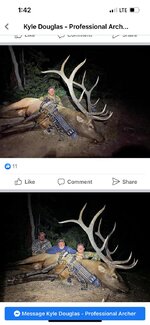
Pictures are deceiving, here are the last 3 bulls all side by side. The biggest bull nets 303”, out of all of those I thought the 280 bull was the biggest prior to the shot. All sitting together you can defiantly see how much larger the 300 bull is that the others.
View attachment 451323

Great post!
 
I mean, he ain't a big dude, smaller than I had first thought.

He is a straight up machine with a bow in his hand tho.
If a guy knew what kind of bow he's shooting and the axle-to-axle length, you could get a SWAG on the main beams. If he's shooting full 32" arrows, add a couple inches on either side and maybe his bow is 37-38" long unless I'm mistaken. So "if" we go with that estimate, maybe that bull has 50" main beams. Also can't really get a good feel for spread, but does't look "extra" wide. Could be 375, who knows, but regardless its an awesome BOAL for vast majority of guys. For comparison only, the bull in my profile had 51, 52, and 37 inside, good mass and grossed 345. Not sure I see 30 more inches here, but it's tough to tell from the angle of this pic.
 
What makes you think that?

Because your quote said a few generations.

That's exactly what genes are. It's not just a straight line down a path. It crosses and you intentionally, lots of times unintentionally select for things.

Take cattle from Texas, they have been down in Texas weather for a few generations now, likely they have lost a lot of ability to cope with northern weather, because you likely inadvertently chose cattle that have lighter coats, they simply won't put on hair like northern varieties. Also gets to be differences in the vascular system. It wasn't anything you selected for, but it happened, likely cause they gained better in the Texas heat than their counterparts. That doesn't even need culling to happen. Higher body Temps will result in lower birthrate, not drastic, but it happens. In reproduction things are constantly changing. So every generation produces changes.
 
Back
Top