The Welfare Cattle Empire That Controls Your Public Lands: article

The Lamar Valley would disagree

Definitely why thousands of people flock to it every year, because its such a shit hole.

There’s plenty of studies show the differences in grazing habits and the ecological benefits.

I get it though, if it’s not a cow eating it, it’s just wasted forage..
 
Can we all at least agree that those fuggin sheep should go first before we worry about cattle?

Don’t have to sell me on it. At least cattle spread out. You keep 1500 sheep concentrated in a group and, in addition to grazing the tundra down to nubs, it’s as if they all conspire to intentionally crap in any available pristine stream.

The local sheep herder in this area is often quoted as saying, “my daddy always said that the high country is for the sheep” in response to any criticism of their impact.
 
Can we all at least agree that those fuggin sheep should go first before we worry about cattle?
My least favorite thing about sheep is dealing with the sheep dogs. Some of them are mean as hell. Nothing worse than hiking and the trail is right in the middle of the flock.
 
Studies also overwhelmingly conclude that grass that is not grazed becomes unpalatable and produces less forage.
Cattle grazing on public land has been reduced all over the west. It has not lead to more game on the public. If anything there is less game now than thirty years ago.
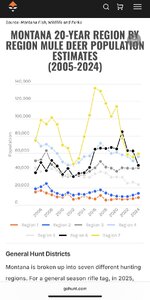
Near me the Custer has cut 10,000 AUMs in the last 30 years. The range has never looked better, the mule deer herd is as bad as I have ever seen it.
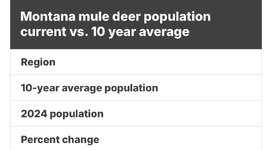
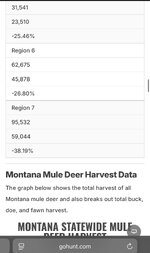
Assuming you’re talking about region 7… I’d have to say correlation doesn’t equal causation. The deer herd in 7 has declined over 38% in the last 10 years. I’m sure that’s not because they’re grazing it less but probably explains why you’re subjectively seeing better habitat with less deer. It’s also supposedly receding from an “artificial high” prior to this 10 year period…
 

Attachments

  • IMG_0308.jpeg
    IMG_0308.jpeg
    202.8 KB · Views: 4
  • IMG_0309.jpeg
    IMG_0309.jpeg
    102.2 KB · Views: 5
  • IMG_0310.jpeg
    IMG_0310.jpeg
    160.1 KB · Views: 5
Here's an idea for you guys. Since there are BLM and NF leases available, why don't some of you apply and lease some of this ground that is not being used at the AMU rate and then you can have your own hunting preserve. You can post no trespassing signs on it and that will solve you hunting problem. Then you can complain when people trespass and shoot all "YOUR" game. Just a thought.
Interesting take, years back in AZ a quail hunting group tried just that. The judge in the case said that it (the land) was for commercial grazing period. He denied their bid even though it was way more than any rancher would pay, go figure!
 
Here's an idea for you guys. Since there are BLM and NF leases available, why don't some of you apply and lease some of this ground that is not being used at the AMU rate and then you can have your own hunting preserve. You can post no trespassing signs on it and that will solve you hunting problem. Then you can complain when people trespass and shoot all "YOUR" game. Just a thought.
Question on this idea. When you get the lease, I always thought you were leasing the resource, not the ground. Is that incorrect?
 
Question on this idea. When you get the lease, I always thought you were leasing the resource, not the ground. Is that incorrect?
Apropos of nothing, it is entirely within the realm of possibility that a group of sportsmen *COULD* pool resources and lease grazing lands simply for the purpose of seeing them not grazed. I don't think anything in the lease says the leaseholder must consume some minimum amount of grass.
We could also privately subsidize - uh, pay - a leaseholder to understock a lease.

Whether that's a worthy conservation strategy, I cannot say; it would undoubtedly vary from lease to lease.
 
Question on this idea. When you get the lease, I always thought you were leasing the resource, not the ground. Is that incorrect?
You are correct. In MOST cases you cannot deny access even if you have cattle actively grazing...There are special circumstances of course.
 
Apropos of nothing, it is entirely within the realm of possibility that a group of sportsmen *COULD* pool resources and lease grazing lands simply for the purpose of seeing them not grazed. I don't think anything in the lease says the leaseholder must consume some minimum amount of grass.
We could also privately subsidize - uh, pay - a leaseholder to understock a lease.

Whether that's a worthy conservation strategy, I cannot say; it would undoubtedly vary from lease to lease.
I think he is more referring to "posting" it? maybe I'm wrong.
 
Apropos of nothing, it is entirely within the realm of possibility that a group of sportsmen *COULD* pool resources and lease grazing lands simply for the purpose of seeing them not grazed. I don't think anything in the lease says the leaseholder must consume some minimum amount of grass.
We could also privately subsidize - uh, pay - a leaseholder to understock a lease.

Whether that's a worthy conservation strategy, I cannot say; it would undoubtedly vary from lease to lease.
To the point about charging hunters for land access, similar to grazing leases…

It doesn’t make sense to charge hunters to access federal land. We’re not eating grass or harvesting trees, extracting minerals etc. We’re not consumptive users of the land, only the animals, which are managed by the state ( in trust) and paid for through the use tax. We’re also paying for habitat conservation, restoration, etc … and not at all subsidized in the way that agriculture is.
 
You are correct. In MOST cases you cannot deny access even if you have cattle actively grazing...There are special circumstances of course.
That’s what I was questioning. I didn’t think that you could keep people off the ground. I know you can do that in some States on State ground but I didn’t think it was possible on Federal.

What are the cases that one can on Federal? Do you know?
 
To the point about charging hunters for land access, similar to grazing leases…

It doesn’t make sense to charge hunters to access federal land. We’re not eating grass or harvesting trees, extracting minerals etc. We’re not consumptive users of the land, only the animals, which are managed by the state ( in trust) and paid for through the use tax. We’re also paying for habitat conservation, restoration, etc … and not at all subsidized in the way that agriculture is.
I don't think your reasoning is correct at all.

Animals ultimately live on and depend on - and are products of - land, and land management, not the state. When we hunt on USFS lands we are harvesting animals that were supported by the land. The state just did a bunch of administrative stuff that animals could get by without, and did for ages before government got into the hunting business. I can assure you, private landowners are capable of managing harvests - see half of Texas - but I'm not even advocating for that. I'm simply advocating that the landowner has the prerogative to set use/access restrictions on their land. And I believe that animals 100% are products of the land itself, just as trees and grass are. Under the NAWMP, populations are managed by the state, but land access is controlled by *owners*.

Further, the premise of free access to federal lands often hinges on the idea that you or I own the land as individuals. That is false. It is held in trust by the fedgov and we only 'own' it in a collective sense. All of us, have a say, in how all of us, get to use it. Neither of us can just go shooting big bulls in YNP on the basis of 'I own this land' - because the rest of us have collectively said 'no' to that. You'll notice that the idea of 'your public lands' is used on marketing materials, but when you nose around long enough to find a fenced-off section of a park, the signs will be more honest and say 'government property - no trespassing'. Make no mistake, they own it; they just let us use it enough to placate us.

In the same way, you could buy a handful of shares in a massive REIT (real estate investment trust) and say 'you' own it, but those shares wouldn't allow you to vote in board elections for the trust and certainly wouldn't grant you the right to use the community pool at an apartment building just because the REIT was invested in that building or the state fire marshal said the pool could safely support more swimmers.

I realize that many people appeal to 'the state owns the wildlife' as justification for free access to hunt federal lands, but it doesn't work that way anywhere else in the world. It's simply not an argument I believe to have merit. I - not the state - control who hunts on my property. The state gets a say in the when and how or how many, but the access itself, is always, in a private property system, at the good pleasure of the landowner, and western civilization depends on such private-property systems. And ultimately, 'public property' is an oxymoronic concept anyway. It's either public (free for all) or it's property (with a bundle of rights reserved for a discrete group who own it). If it's the former the state shouldn't even pretend to manage the wildlife on it. If it's the latter, the owners, or their designees (fed biologists?) should manage access.

Put another way, I think it makes perfect sense to charge money for things people value and as a 'public land owner' (lol) I would prefer to see good stewardship of 'my' lands by asking users to make a good faith effort to respect the value they get from the land - by paying for it.

That could be done by short-term leases or a lottery that capped access. Those details aren't even important to me, honestly, except at the fringes. What would be important is making federal lands places I could go 'get away from it all' without turning hunting into another competitive sport where the winner has to outrun or out-hike or outgun the rest of the players in a free for all.

Also, full disclosure, I'd also do a lottery (or other restrictive) system for crowded parks, for the same reason.

 
Interesting take, years back in AZ a quail hunting group tried just that. The judge in the case said that it (the land) was for commercial grazing period. He denied their bid even though it was way more than any rancher would pay, go figure!
Western Watersheds Project (sorry, just threw up a little in my mouth) frequently submits bids for leases that are opening up. They have won a few IDL leases. I'm not sure how many federal leases they have picked up.
 
Apropos of nothing, it is entirely within the realm of possibility that a group of sportsmen *COULD* pool resources and lease grazing lands simply for the purpose of seeing them not grazed. I don't think anything in the lease says the leaseholder must consume some minimum amount of grass.
We could also privately subsidize - uh, pay - a leaseholder to understock a lease.

Whether that's a worthy conservation strategy, I cannot say; it would undoubtedly vary from lease to lease.
Explicitly cant do that very easily now - and only could for a short time.

 
Put another way, I think it makes perfect sense to charge money for things people value and as a 'public land owner' (lol) I would prefer to see good stewardship of 'my' lands by asking users to make a good faith effort to respect the value they get from the land - by paying for it.

That could be done by short-term leases or a lottery that capped access. Those details aren't even important to me, honestly, except at the fringes. What would be important is making federal lands places I could go 'get away from it all' without turning hunting into another competitive sport where the winner has to outrun or out-hike or outgun the rest of the players in a free for all.

Also, full disclosure, I'd also do a lottery (or other restrictive) system for crowded parks, for the same reason.

I dont disagree with the point you are making full scale but i am opposed to the consequences of implementing it as such if the "Value" we're talking about paying goes beyond let's say resident tag fees (and leaning more towards states like MT who's residents dont pay shit vs say AZ or NV).

The "competitive sport" you're looking to avoid becomes more like "outspend" rather than out-hike or out gun.
 
I dont disagree with the point you are making full scale but i am opposed to the consequences of implementing it as such if the "Value" we're talking about paying goes beyond let's say resident tag fees (and leaning more towards states like MT who's residents dont pay shit vs say AZ or NV).

The "competitive sport" you're looking to avoid becomes more like "outspend" rather than out-hike or out gun.
I do feel the weight of the argument that the con$equence$ would suck. Granted.

Of course, a) that could be avoided with a lottery system where you had to get drew but the actual fee was nominal/easy to swallow, like this:


Or, b) the state could mitgate the expensive permit fees for in-state residents by subsidizing their fees through an agreement with USFS/BLM/whatever where nonresidents paid a hiked fee for the game tag then part of that extra fee is used to subsidize a resident's USFS access permit. Also, State-owned lands could be reserved for state resident use.

Imagine you drew an elk tag to hunt on the famed Hypothetical National Forest in Colorado. There's 200,000 acres and instead of the state allowing 400 hunters to access it, let's say they are willing to issue only up to 100 permits, but the out-of-staters who apply for those permits now have to pay triple the state tag/permit fees. 75% of the fee increase goes to the USFS as an access fee, the other 25% goes to the state of Colorado who then uses it to pay the access fees for the in-state residents who also drew tags.

If it's true that 'most hunters in crowded units are nonresidents' then their high access fees would ~fully subsidize the resident fees. Every 3 out of staters, fund one in-stater. DO I like that as a nonresident? No, but I'm willing to do it if that's what it takes to Make Accessible places Huntable Again.

Would that actually work? Heck, I don't know. I just know I'd like to hunt public land and still have some measure of solitude. I think that until such a thing exists, if ever, I am very likely, once CO moves to the hybrid system, to just focus on applying for hard to draw hunts, and using private acce$$ as Plan B, and remaining easy-draw crowded units as Plan C.

YMMV, a lot.
 
Explicitly cant do that very easily now - and only could for a short time.

I want you to understand that the link you posted is not much more than a 'hit piece' the way it's written.

I'm not saying its wholly factually incorrect. I'm not saying I'm wholly opposed to how it's written or the concerns it conveys (because I am not). But the way it's written is intended to inflame you more than to inform you.

Also, importantly, nothing in that article would necessarily stop a private group from securing a grazing lease then simply not grazing it, or grazing it at some reduced stocking rate. And I must point out that the statistics at the end of the article paint a false dilemma (logical fallacy of the excluded middle) as if 'extractive' uses are necessarily contrary to 'conservation' uses. Not to mention that many people will (intentionally?) conflate 'conservation' with 'preservation'.
 
Back
Top