
Navigation
Install the app
How to install the app on iOS
Follow along with the video below to see how to install our site as a web app on your home screen.
Note: This feature may not be available in some browsers.
More options
Style variation
You are using an out of date browser. It may not display this or other websites correctly.
You should upgrade or use an alternative browser.
You should upgrade or use an alternative browser.
Spotting your shot, most import factors.
- Thread starter Alaska Bowman
- Start date

Not OP but I found this detailed list super helpful thank you!
- butt stock length (shorter so that you can put the rifle on collarbone closer to centerline of body for recoil management)
- grip to trigger/vertical grip (put your finger and hand in neutral position for clean press)
- comb straight or neg (my face doesn't work well with Rokstock unless I have high rings)
- toe more flat than typical (some angle helps with long range adjustment of bag)
- grip size (relaxed hand)
- flatish forend (for resting on bags and not rolling)
- scope height (I prefer higher because it improves the angle your neck has to tilt forward, reducing strain, prone especially. The taller you are the longer your neck is and higher rings should be)
- scope eyebox set up so that prone is at one end of the eye box and standing is on the other end

- Joined
- Oct 22, 2014
- Messages
- 15,238
- butt stock length (shorter so that you can put the rifle on collarbone closer to centerline of body for recoil management)
I’m going to nitpick here (or not nitpick).
This is the worst trend right now in shooting. First, put a gun on your collar bone that actually recoils. Do it with a 12ga. Do it with anything that does more than a PRS 30lb rifle and actually shoot/practice with it from something other than a tripod.
Common rifle/cartridge combinations exceed the requirement to break the average collar bone. Not only that, but repeated recoil on bone is painful- some students at S2H often get sore from 223’s at 200 rounds a day; and I believe we have only had 2 or 3 people out 40+ that have started with 6cm or 6.5cm’s, make it past day 2 before asking to borrow a 223.
This “bring rifle to centerline” was brought up by “tactical” dudes (not competitors first) from the old days of MP5 full auto shooting. This was an attempt to control the up and right movement for RH shooters, that happens during recoil- because almost no one understood how to make a stock that works correctly. They were able to do that because PRS guns have functionally zero movement when fired, and because nearly all shots are from some sort of standing/barricade/tripod position. It is utterly compromised for dynamic field shooting.
This was farther adopted because the common grips on stocks are absolutely atrocious. Fat, with a way too long trigger reach. When you have a bad grip angle, fat grip, and a trigger reach that is over an inch longer than it should be- you need to rotate your wrist counterclockwise and move your finger up to get to the trigger. Now look at what that does to your shoulder position and arm…. THAT is why short LOP has become the thing. As soon as you have to compromise the grip as above, your LOP must by necessity lesson, and combined with the barricaded positions that allow it, and with not having recoil- there is no apparent penalty for it. (This also relates to higher mounted scopes).
Change all of that to how a stock should be designed, and nothing about a long LOP makes shooting a rifle hard- quite the opposite. The farther your hand is from your chest, the better your index finger moves straight to the rear, the less severe angle and hence, strain is on your wrist; and the more your grip helps control recoil.
On top of that, when shooting dynamically, the farther your shooting hand is from your chest, and the farther your offhand is from your shooting hand- the more control you have over the rifle in all axis.
When you design a stock correctly- recoil pad above bore and get a solid cheek weld; then you can use a longer LOP put 90° into the shoulder pocket, and the up and right recoil goes away.
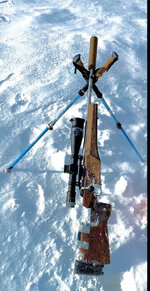
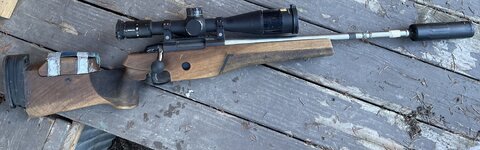
This rifle below has a 14.75” LOP, very short trigger reach of approx 1.5”, and a very well designed grip. Every single person from 12yo girls to 6’6” males that have shot it, have done easily, and almost all have stated it was the best feeling and shooting gun they have ever shot. Hell, there are 4-5 posters on here that after shooting it, went and found one and bought it.
In short: this doesn’t mean that one can’t shoot a short LOP and centerline pad well. It means that the trend of short LOP and recoil pad “centerline” is due to a combination of really poorly designed grips and stocks, a misunderstanding of what is causing sight movement during recoil, and a shooting sphere that promotes it and has no consequence for doing it.
- grip to trigger/vertical grip (put your finger and hand in neutral position for clean press)
Yes.
- comb straight or neg (my face doesn't work well with Rokstock unless I have high rings)
You need longer LOP. The standard LOP for Rokstock should have been at least 14”, but consumers wouldn’t have understood why.
- toe more flat than typical (some angle helps with long range adjustment of bag)
I/we haven’t seen any advantage with an angled toe in timed events side by side with people specifically trying to show that there is; and only a detriment in straight line recoil.
- grip size (relaxed hand)
Yes- narrow and verticle’ish, with a sub 1.7” trigger reach.
- flatish forend (for resting on bags and not rolling)
Yes.
- scope height (I prefer higher because it improves the angle your neck has to tilt forward, reducing strain, prone especially. The taller you are the longer your neck is and higher rings should be)
That is exactly opposite of what your neck must do with higher rings- anyone can experience this right now. Lay prone, straight and neutral (your body straight inline with your target as below).
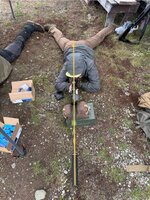
Now, what is less strain on your neck- head relaxed in a normal position looking down to the ground? Or- head pulled way up and looking at the ceiling.
The is the second worst trend is shooting right now. It is driven by just shooting from a standing position of some sort, and the nonsense “heads up improves target awareness” crap from certain people in the tactical community.
1st- as above, it is way more strain on the average persons neck in any position that doesn’t have the torso vertical.
2nd- for most stocks it removes the cheekweld from recoil and control. This is the negative sub component to the “heads up” high mounted scope thing. The cheeckweld offers a pretty substantial effect to recoil control through pressure and friction of the cheek into the stock. This is readily seen with an AR15 and visible laser in rapid fire at close range- remove the face from the gun or only have it touching at “jaw-weld” and the laser bounces all over the place, is very inconsistent and not predictable at all. In contrast, burry the cheek fat into the stock and the laser movement during recoil is cut in half at least, and the movement is extremely consistent and predictable. It’s not even close between them.
3rd- it’s also tangentially related to short LOP. Shorter LOP makes it more difficult for o get enough eye relief for lots of setups, and one way I get your eyebrow back, is to move your head “up”.
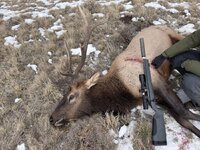
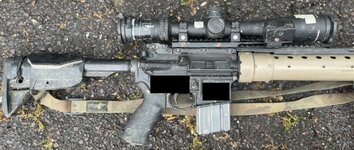
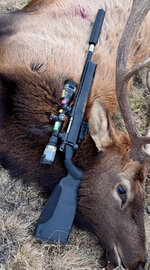
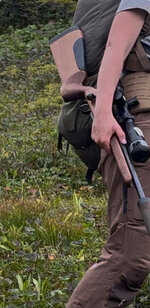
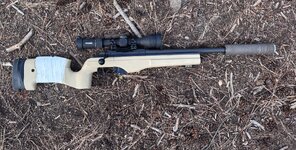
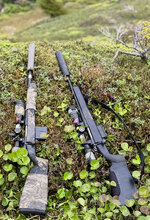
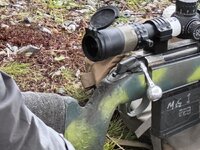
Now a very hard cheekweld and hard comb on the stock can and will cause some effects to the rifle (left reticle movement during recoil, and can a left trend with impacts with the ROKStok for instance). However, look at the picture above of what is on the comb. Look at the rifles below-
- scope eyebox set up so that prone is at one end of the eye box and standing is on the other end
Yes.

RockAndSage
WKR
I’m going to nitpick here (or not nitpick).
This is the worst trend right now in shooting. First, put a gun on your collar bone that actually recoils. Do it with a 12ga. Do it with anything that does more than a PRS 30lb rifle and actually shoot/practice with it from something other than a tripod.
Common rifle/cartridge combinations exceed the requirement to break the average collar bone. Not only that, but repeated recoil on bone is painful- some students at S2H often get sore from 223’s at 200 rounds a day; and I believe we have only had 2 or 3 people out 40+ that have started with 6cm or 6.5cm’s, make it past day 2 before asking to borrow a 223.
This “bring rifle to centerline” was brought up by “tactical” dudes (not competitors first) from the old days of MP5 full auto shooting. This was an attempt to control the up and right movement for RH shooters, that happens during recoil- because almost no one understood how to make a stock that works correctly. They were able to do that because PRS guns have functionally zero movement when fired, and because nearly all shots are from some sort of standing/barricade/tripod position. It is utterly compromised for dynamic field shooting.
This was farther adopted because the common grips on stocks are absolutely atrocious. Fat, with a way too long trigger reach. When you have a bad grip angle, fat grip, and a trigger reach that is over an inch longer than it should be- you need to rotate your wrist counterclockwise and move your finger up to get to the trigger. Now look at what that does to your shoulder position and arm…. THAT is why short LOP has become the thing. As soon as you have to compromise the grip as above, your LOP must by necessity lesson, and combined with the barricaded positions that allow it, and with not having recoil- there is no apparent penalty for it. (This also relates to higher mounted scopes).
Change all of that to how a stock should be designed, and nothing about a long LOP makes shooting a rifle hard- quite the opposite. The farther your hand is from your chest, the better your index finger moves straight to the rear, the less severe angle and hence, strain is on your wrist; and the more your grip helps control recoil.
On top of that, when shooting dynamically, the farther your shooting hand is from your chest, and the farther your offhand is from your shooting hand- the more control you have over the rifle in all axis.
When you design a stock correctly- recoil pad above bore and get a solid cheek weld; then you can use a longer LOP put 90° into the shoulder pocket, and the up and right recoil goes away.
This rifle below has a 14.75” LOP, very short trigger reach of approx 1.5”, and a very well designed grip. Every single person from 12yo girls to 6’6” males that have shot it, have done easily, and almost all have stated it was the best feeling and shooting gun they have ever shot. Hell, there are 4-5 posters on here that after shooting it, went and found one and bought it.
View attachment 979888
View attachment 979889
In short: this doesn’t mean that one can’t shoot a short LOP and centerline pad well. It means that the trend of short LOP and recoil pad “centerline” is due to a combination of really poorly designed grips and stocks, a misunderstanding of what is causing sight movement during recoil, and a shooting sphere that promotes it and has no consequence for doing it.
Yes.
You need longer LOP. The standard LOP for Rokstock should have been at least 14”, but consumers wouldn’t have understood why.
I/we haven’t seen any advantage with an angled toe in timed events side by side with people specifically trying to show that there is; and only a detriment in straight line recoil.
Yes- narrow and verticle’ish, with a sub 1.7” trigger reach.
Yes.
That is exactly opposite of what your neck must do with higher rings- anyone can experience this right now. Lay prone, straight and neutral (your body straight inline with your target as below).
View attachment 979936
Now, what is less strain on your neck- head relaxed in a normal position looking down to the ground? Or- head pulled way up and looking at the ceiling.
The is the second worst trend is shooting right now. It is driven by just shooting from a standing position of some sort, and the nonsense “heads up improves target awareness” crap from certain people in the tactical community.
1st- as above, it is way more strain on the average persons neck in any position that doesn’t have the torso vertical.
2nd- for most stocks it removes the cheekweld from recoil and control. This is the negative sub component to the “heads up” high mounted scope thing. The cheeckweld offers a pretty substantial effect to recoil control through pressure and friction of the cheek into the stock. This is readily seen with an AR15 and visible laser in rapid fire at close range- remove the face from the gun or only have it touching at “jaw-weld” and the laser bounces all over the place, is very inconsistent and not predictable at all. In contrast, burry the cheek fat into the stock and the laser movement during recoil is cut in half at least, and the movement is extremely consistent and predictable. It’s not even close between them.
3rd- it’s also tangentially related to short LOP. Shorter LOP makes it more difficult for o get enough eye relief for lots of setups, and one way I get your eyebrow back, is to move your head “up”.
Now a very hard cheekweld and hard comb on the stock can and will cause some effects to the rifle (left reticle movement during recoil, and can a left trend with impacts with the ROKStok for instance). However, look at the picture above of what is on the comb. Look at the rifles below-
View attachment 979931
View attachment 979917
View attachment 979929
View attachment 979938
View attachment 979932
View attachment 979934
View attachment 979935
Yes.
This was absolutely fascinating, definitely appreciate the level of detail.
In particular, the points you make about cheek-weld - it reminded me quite a bit about grip pressures and inputs on a handgun in managing sight tracking/recoil/trigger control, etc. That really clicked something into place for me in understanding precision rifle a bit better.
Would you mind sharing a primer on cheek weld, and what inputs you're imparting with different points of body contact and platform (ie, shoulder pressure, hand pressures, how hard you're pressing the cheek, pressure into bipod/tripod/bags, etc)?

Good info, @mxgsfmdpx has a longer Rokstock setup now, so I will give it a try.I’m going to nitpick here (or not nitpick).
This is the worst trend right now in shooting. First, put a gun on your collar bone that actually recoils. Do it with a 12ga. Do it with anything that does more than a PRS 30lb rifle and actually shoot/practice with it from something other than a tripod.
Common rifle/cartridge combinations exceed the requirement to break the average collar bone. Not only that, but repeated recoil on bone is painful- some students at S2H often get sore from 223’s at 200 rounds a day; and I believe we have only had 2 or 3 people out 40+ that have started with 6cm or 6.5cm’s, make it past day 2 before asking to borrow a 223.
This “bring rifle to centerline” was brought up by “tactical” dudes (not competitors first) from the old days of MP5 full auto shooting. This was an attempt to control the up and right movement for RH shooters, that happens during recoil- because almost no one understood how to make a stock that works correctly. They were able to do that because PRS guns have functionally zero movement when fired, and because nearly all shots are from some sort of standing/barricade/tripod position. It is utterly compromised for dynamic field shooting.
This was farther adopted because the common grips on stocks are absolutely atrocious. Fat, with a way too long trigger reach. When you have a bad grip angle, fat grip, and a trigger reach that is over an inch longer than it should be- you need to rotate your wrist counterclockwise and move your finger up to get to the trigger. Now look at what that does to your shoulder position and arm…. THAT is why short LOP has become the thing. As soon as you have to compromise the grip as above, your LOP must by necessity lesson, and combined with the barricaded positions that allow it, and with not having recoil- there is no apparent penalty for it. (This also relates to higher mounted scopes).
Change all of that to how a stock should be designed, and nothing about a long LOP makes shooting a rifle hard- quite the opposite. The farther your hand is from your chest, the better your index finger moves straight to the rear, the less severe angle and hence, strain is on your wrist; and the more your grip helps control recoil.
On top of that, when shooting dynamically, the farther your shooting hand is from your chest, and the farther your offhand is from your shooting hand- the more control you have over the rifle in all axis.
When you design a stock correctly- recoil pad above bore and get a solid cheek weld; then you can use a longer LOP put 90° into the shoulder pocket, and the up and right recoil goes away.
This rifle below has a 14.75” LOP, very short trigger reach of approx 1.5”, and a very well designed grip. Every single person from 12yo girls to 6’6” males that have shot it, have done easily, and almost all have stated it was the best feeling and shooting gun they have ever shot. Hell, there are 4-5 posters on here that after shooting it, went and found one and bought it.
View attachment 979888
View attachment 979889
In short: this doesn’t mean that one can’t shoot a short LOP and centerline pad well. It means that the trend of short LOP and recoil pad “centerline” is due to a combination of really poorly designed grips and stocks, a misunderstanding of what is causing sight movement during recoil, and a shooting sphere that promotes it and has no consequence for doing it.
Yes.
You need longer LOP. The standard LOP for Rokstock should have been at least 14”, but consumers wouldn’t have understood why.
I/we haven’t seen any advantage with an angled toe in timed events side by side with people specifically trying to show that there is; and only a detriment in straight line recoil.
Yes- narrow and verticle’ish, with a sub 1.7” trigger reach.
Yes.
That is exactly opposite of what your neck must do with higher rings- anyone can experience this right now. Lay prone, straight and neutral (your body straight inline with your target as below).
View attachment 979936
Now, what is less strain on your neck- head relaxed in a normal position looking down to the ground? Or- head pulled way up and looking at the ceiling.
The is the second worst trend is shooting right now. It is driven by just shooting from a standing position of some sort, and the nonsense “heads up improves target awareness” crap from certain people in the tactical community.
1st- as above, it is way more strain on the average persons neck in any position that doesn’t have the torso vertical.
2nd- for most stocks it removes the cheekweld from recoil and control. This is the negative sub component to the “heads up” high mounted scope thing. The cheeckweld offers a pretty substantial effect to recoil control through pressure and friction of the cheek into the stock. This is readily seen with an AR15 and visible laser in rapid fire at close range- remove the face from the gun or only have it touching at “jaw-weld” and the laser bounces all over the place, is very inconsistent and not predictable at all. In contrast, burry the cheek fat into the stock and the laser movement during recoil is cut in half at least, and the movement is extremely consistent and predictable. It’s not even close between them.
3rd- it’s also tangentially related to short LOP. Shorter LOP makes it more difficult for o get enough eye relief for lots of setups, and one way I get your eyebrow back, is to move your head “up”.
Now a very hard cheekweld and hard comb on the stock can and will cause some effects to the rifle (left reticle movement during recoil, and can a left trend with impacts with the ROKStok for instance). However, look at the picture above of what is on the comb. Look at the rifles below-
View attachment 979931
View attachment 979917
View attachment 979929
View attachment 979938
View attachment 979932
View attachment 979934
View attachment 979935
Yes.
I tried to like it. And, I can see the logic of your explanation. It’s good to hear your input, appreciated.
Yes, on the influences on centerline shooting on collarbone. PRS does bring in lots of nonsense to hunting. I try to avoid and eliminate the nonsense and go with what works for me.
So, I can say it works for me, and has improved shooting for others. It does eliminate the offset recoil and gives more control to spot shots.
The cheek weld I use is more just to index my head with the point my jaw hits. No pressure cause it can move the rifle.
BUT, there can always be better ways.
I do shoot off a tripod a lot here in AZ. Adapting to my preferred technique as stated does require lighter recoiling rifles-part of my list. I will not shoot higher recoiling rifles like that.
I forgot to add that I can shoot 40-50 rounds in a day and not have problems with 6mm and 223 with a decent recoil pad and suppressor in factory Tikka weight plus scope and rifle. I will spend a day shooting a couple hundred rounds and see if that is different.
I don’t shoot shotguns or other heavy stuff on my collar bone. I have shot some suppressed 7 and 6.5 short mag like that. I think a good recoil pad helps. And, there is always a bit more meat on the buttpad. If I lose 50 pounds I may have a different opinion.
I don’t shoot shotguns or other heavy stuff on my collar bone. I have shot some suppressed 7 and 6.5 short mag like that. I think a good recoil pad helps. And, there is always a bit more meat on the buttpad. If I lose 50 pounds I may have a different opinion.

General RE LEE
WKR
- Joined
- Dec 28, 2019
- Messages
- 2,704
Something that may or not been mentioned, but velocity is a factor. It can be easier to spot impact/miss with a 147 grain ELDM going 2550 FPS out of a 6.5 CM vs a 130 grain ELDM going 2850 FPS.

Bobrobheimer
Lil-Rokslider
- Joined
- Oct 2, 2021
- Messages
- 294
This is something I have been wanting to overcome. I’m primarily shooting a 6cm now and even have the rifle super heavy and running a magnus suppression right now so my kid can shoot it. The recoil is extremely mellow, and I am pretty decent at spotting impacts in general even with my 300WSM at least in lower positions. All that said, I haven’t yet been able to get myself not to blink when the shot breaks - even with the very mellow recoil and soft noise of the current 6cm kid gun. In face, even if I’m spotting for a friend shooting unsupressed I find myself blinking at their shots. I’m going to put in a concerted effort on this now and see if I can train the blink out. Any tips other than dry fire practice and a concerted focused effort?Not blinking
- Joined
- Oct 22, 2014
- Messages
- 15,238
This is something I have been wanting to overcome. I’m primarily shooting a 6cm now and even have the rifle super heavy and running a magnus suppression right now so my kid can shoot it. The recoil is extremely mellow, and I am pretty decent at spotting impacts in general even with my 300WSM at least in lower positions. All that said, I haven’t yet been able to get myself not to blink when the shot breaks - even with the very mellow recoil and soft noise of the current 6cm kid gun. In face, even if I’m spotting for a friend shooting unsupressed I find myself blinking at their shots. I’m going to put in a concerted effort on this now and see if I can train the blink out. Any tips other than dry fire practice and a concerted focused effort?
Dry fire will not correct it. Only
Ball and dummy drills will.
Bobrobheimer
Lil-Rokslider
- Joined
- Oct 2, 2021
- Messages
- 294
I will try that.Dry fire will not correct it. Only
Ball and dummy drills will.
Lawnboi
"DADDY"
Just remember a blink is like a half a flinch.This is something I have been wanting to overcome. I’m primarily shooting a 6cm now and even have the rifle super heavy and running a magnus suppression right now so my kid can shoot it. The recoil is extremely mellow, and I am pretty decent at spotting impacts in general even with my 300WSM at least in lower positions. All that said, I haven’t yet been able to get myself not to blink when the shot breaks - even with the very mellow recoil and soft noise of the current 6cm kid gun. In face, even if I’m spotting for a friend shooting unsupressed I find myself blinking at their shots. I’m going to put in a concerted effort on this now and see if I can train the blink out. Any tips other than dry fire practice and a concerted focused effort?
You can start with a rimfire. Shooting steel where you are actually trying to spot exact hit location helps too.

mxgsfmdpx
WKR
- Joined
- Oct 22, 2019
- Messages
- 8,783
17HMR/Mach2/WSM and shooting the centers out of clay pigeons back when I used to get them by the box for free was a fantastic learning tool.Just remember a blink is like a half a flinch.
You can start with a rimfire. Shooting steel where you are actually trying to spot exact hit location helps too.
Then we'd move them up to 32 grainers in 204 Ruger, then up to a 223.
Lawnboi
"DADDY"
I’ll agree 17hmr is an excellent training round for this. Loud enough, fast enough that you have to pay attention.17HMR/Mach2/WSM and shooting the centers out of clay pigeons back when I used to get them by the box for free was a fantastic learning tool.
Then we'd move them up to 32 grainers in 204 Ruger, then up to a 223.
A bit much from a 7.5" barrel, though.17hmr is an excellent training round for this. Loud enough, fast enough that you have to pay attention.
Picking up my .17 HM2 cylinder next week.

solarshooter
WKR
Lots and lots of 22lr helped me identify and train out my flinch and blink. I can shoot higher recoiling rifles much better now (stay eyes open through the shot, spot impacts, trigger control/mechanics), but I also like to come back to the 22 at least once a year and put 500+ rds of focused practice through it to "stay grounded".
Bobrobheimer
Lil-Rokslider
- Joined
- Oct 2, 2021
- Messages
- 294
I don’t believe I flinch - just a quick blink. But it would be nice to get rid of that and sounds like it should be doable.

TaperPin
WKR
- Joined
- Jul 12, 2023
- Messages
- 6,317
Some of us are more likely to blink than others. I’m also naturally a blinker and everyone is different, but I found going back to where you don’t blink and working up from there helps, then it’s repetition to desensitize the natural reaction. A blink, full flinch, or twitch in arms or shoulder are muscles tensing up, so just like learning to relax in a meditation class, we’re learning to relax some muscles while keeping other muscles in different stages of tension to get the shot off. If your face is tense or you begin to squint before the shot, you’re priming yourself for the blink. You probably also struggle with follow through, which is mostly controlled relaxing through recoil. In my 20s the trigger arm would tense up, not the trigger finger or hand, but my arm twitched and took a few years to get over, and luckily never came back.. All that said, I haven’t yet been able to get myself not to blink when the shot breaks - even with the very mellow recoil and soft noise of the current 6cm kid gun.
I don’t blink while shooting shotguns or snap shooting standing up, so standing has become my normal warm up, quick snaps shots at first then shooting for accuracy. Then practice sitting and then the bench or prone.
I also make dummy cartridges for every cartridge that gives me issues and only mix in maybe 20 to 30% live cartridges while on the bench or prone. If your blink is really bad maybe 10% would be as effective. More than anything else, this provides 100% certain feedback if you are blinking or tensing up other muscles. Empty brass doesn’t make a good dummy since powder has a different feel and weight. Steel cut oats, or cat litter can make good powder substitutes.
That’s what works for me.
Bobrobheimer
Lil-Rokslider
- Joined
- Oct 2, 2021
- Messages
- 294
I think I am a blinker. I have taken video of myself and I generally don’t have tension that’s noticeable - I notice that I also blink a fair bit just in general after or before shooting in the videos! But for the closer shots where the time of flight is closer to a tenth second like a blink, it would be great not to!Some of us are more likely to blink than others. I’m also naturally a blinker and everyone is different, but I found going back to where you don’t blink and working up from there helps, then it’s repetition to desensitize the natural reaction. A blink, full flinch, or twitch in arms or shoulder are muscles tensing up, so just like learning to relax in a meditation class, we’re learning to relax some muscles while keeping other muscles in different stages of tension to get the shot off. If your face is tense or you begin to squint before the shot, you’re priming yourself for the blink. You probably also struggle with follow through, which is mostly controlled relaxing through recoil. In my 20s the trigger arm would tense up, not the trigger finger or hand, but my arm twitched and took a few years to get over, and luckily never came back.
I don’t blink while shooting shotguns or snap shooting standing up, so standing has become my normal warm up, quick snaps shots at first then shooting for accuracy. Then practice sitting and then the bench or prone.
I also make dummy cartridges for every cartridge that gives me issues and only mix in maybe 20 to 30% live cartridges while on the bench or prone. If your blink is really bad maybe 10% would be as effective. More than anything else, this provides 100% certain feedback if you are blinking or tensing up other muscles. Empty brass doesn’t make a good dummy since powder has a different feel and weight. Steel cut oats, or cat litter can make good powder substitutes.
That’s what works for me.
I loaded a bullet in a sized and unprimed case after Form’s suggestion but wondered about noticing the difference even if I load blind - the oats is a good idea to mask the weight difference!


My understanding is this is an imperfect trade off. The larger case will need more powder to achieve the same velocity. Not maxing out the load will prolonged barrel life though, but still burning more powder, so unlikely to be equivalent to the smaller case.Separate but related...I'm a bit new to rifle reloading, but I've had something in mind lately that I can't shake, yet haven't dove into much:
What would happen for barrel life and shootability, if you took an overbore cartridge (or any larger cartridge, actually), and just downloaded it for lower pressures but sufficient impact velocity?
Instead of things like AIs and Weatherby casings being used for max velocity...what would happen for barrel life and shootability if you just downloaded for more optimal pressure for the goal?
I know there's issues with powder fill and accuracy, but what about just selecting a good-fill powder for downloaded pressures? Is this even possible?
I debated a 6 gt vs a 6 creed and while Gay Tiger brass got me excited as a sailor, the better availability and being able to push harder from a short barrel won out, but my plan is to back a gr or two down from max loads.
Basically, match the case to what you want. Slower with longer barrel life then 6 GT or 6 ARC. Faster, then 6 NSI. I opted for boring and staying close to my 243.
Similar threads



Featured Video
Latest Articles
- From Big Bucks to Bear Hunts: Catching Up with Jordan Budd
- Mule Deer Days Wildlife Conservation Mashup
- A Hidden Gem: Hunting Washington with Kari Thomas
- Prime Divide Bow Review
- Knowledge From Storms: Surviving and Thriving in the Backcountry with John Barklow
- DIY Wyoming Pronghorn Hunt
- Unlock Precision Shooting: Master Your Hunting Game with Competitive Insights
- Topo Topper Rincon Review
- Tony Trietch on Big Mule Deer, Desert Bulls & Western Hunting Evolution
- The Right to Hunt & Fish Colorado (and North America)