Going on a ten day moose hunt in Alaska in September. Gonna try my best to get a shot with my bow. But if all else fails and only have opportunities with a rifle I will use it. Just wonder would you try for a lung shot or a spine shot and try to drop him??

Navigation
Install the app
How to install the app on iOS
Follow along with the video below to see how to install our site as a web app on your home screen.
Note: This feature may not be available in some browsers.
More options
Style variation
You are using an out of date browser. It may not display this or other websites correctly.
You should upgrade or use an alternative browser.
You should upgrade or use an alternative browser.
Shot placement???
- Thread starter MattP15
- Start date

Kevin Dill
WKR
- Joined
- Aug 26, 2014
- Messages
- 3,158
You'll get a number of different responses I'm sure. If I was the man holding the rifle I would absolutely target the chest (heart & lungs) while avoiding the trickier spine or neck shot. The chest is a BIG target and definitely vital. One or two rounds in and hold fire. The moose is yours. People will disagree but I am absolutely turned off by the practice of pouring many extra rounds into a moving moose (regardless of impact) until it drops. Such is a way to waste a lot of good meat. Every bull I've killed took one measly arrow and died in very short order. Patience and accuracy are your best attributes, while being in a panicky hurry is a way to create a very messy situation.

mxgsfmdpx
WKR
- Joined
- Oct 22, 2019
- Messages
- 8,782
Shoot it in the lungs/heart and wait for it to die. An excellent first shot is so much better than 2 or 3 mediocre shots.

VernAK
WKR
A broadside double lung shot is most desired. If your shot goes a bit high it will usually drop from a shock to CNS spine/hump impact. I'm not sure how final this shot is with an arrow and will leave that to others.
If your shot should go a bit low it will take out the heart /arteries also resulting in quick death.
AS Kevin said, once a good lung shot is made, quit shooting as moose will typically stand there a very short time before collapsing. I have numerous home videos of moose shot through both lungs with rifles as large as 375 H&H and they stand around or walk a few steps before expiring.
Another rifle shot that I hope you never need to do is the pelvic shot. Should you screw up and wound a moose, shoot for the pelvis area near the tail as the moose flees. They will collapse from a broken pelvis and arteries in that area are huge. The last resort for sure!
If your shot should go a bit low it will take out the heart /arteries also resulting in quick death.
AS Kevin said, once a good lung shot is made, quit shooting as moose will typically stand there a very short time before collapsing. I have numerous home videos of moose shot through both lungs with rifles as large as 375 H&H and they stand around or walk a few steps before expiring.
Another rifle shot that I hope you never need to do is the pelvic shot. Should you screw up and wound a moose, shoot for the pelvis area near the tail as the moose flees. They will collapse from a broken pelvis and arteries in that area are huge. The last resort for sure!
Holes through your lungs... doesn't matter how big you are, your not going far.
Don't go for the spine shot with a gun, it's easy to miss high or low. An arrow won't do anything with a spine shot.
Plus backstraps are better then shoulder meat if you loose a a bit of blood shot meat. You might slip between ribs and loose none, but your guaranteed to loose some with a spine shot.
Don't go for the spine shot with a gun, it's easy to miss high or low. An arrow won't do anything with a spine shot.
Plus backstraps are better then shoulder meat if you loose a a bit of blood shot meat. You might slip between ribs and loose none, but your guaranteed to loose some with a spine shot.
Kevin Dill
WKR
- Joined
- Aug 26, 2014
- Messages
- 3,158
Please keep something else in mind: There's a reason the guys in online videos are often blasting multiple shots, and you hear "Hit him again!" over and over. They are trying to capture video of the bull (or other animal) going down after the shot. As Vern stated, a lung-shot moose will often hold ground or only move a short distance before collapsing. I does bother me to see guys make a clean first shot...the bull starts moving around...and then I rounds impacting the shoulder, belly, rump or back.
I met a very successful moose hunter in Whitehorse, Yukon once. He told me his best moose rifle was a .25-06 bolt with a 4-12 on it. When I questioned him on it he said it had exactly the right ballistics for major internal damage in the chest. But his favorite shot of all was to get a very solid rest and hit a stationary bull right at the ear butt. He claimed many of his bulls (and elk too) were taken with that shot. Obviously he was a real marksman and cool when it counted.
I met a very successful moose hunter in Whitehorse, Yukon once. He told me his best moose rifle was a .25-06 bolt with a 4-12 on it. When I questioned him on it he said it had exactly the right ballistics for major internal damage in the chest. But his favorite shot of all was to get a very solid rest and hit a stationary bull right at the ear butt. He claimed many of his bulls (and elk too) were taken with that shot. Obviously he was a real marksman and cool when it counted.
VernAK
WKR
And......he wasn't rushed by others with videos etc. He was hunting more like you archery guys and getting a good shot on an animal that isn't spooked.

kwackkillncrew
WKR
- Joined
- Jun 3, 2020
- Messages
- 933
This year we had a bull walk down the middle of the pond we waited until he stepped up on the high ground 10-15 feet from the water. My buddy shot and sent it through the boiler room. I wait 2 seconds and decided to shoot and clipped just off his shoulder and he dropped. His leg was further back then I thought so that's how i hot the bone. Regardless of probably would have tipped over in 10 or 20 seconds but we didnt want it to tip into the pond. His bullet zipped right through and found mine in between ribs and hide. Lost maybe 4 pounds of meat but was worth it to not let it die in the water.
It's hard sometimes for me to not want to shoot if it doesnt drop right away because I dont want it to run off and create a tracking project or for it to find water nearby
We always go for lungs heart. Mostly because a few inches one way or the other your going to have a good shot. Some shots seem kinda cruel to me just paralyze them then have to walk up and shoot them again. I am not confident in my own shooting to place head shots. All it takes is one movement of their head and you could take off their nose.
Sent from my SM-G892A using Tapatalk
It's hard sometimes for me to not want to shoot if it doesnt drop right away because I dont want it to run off and create a tracking project or for it to find water nearby
We always go for lungs heart. Mostly because a few inches one way or the other your going to have a good shot. Some shots seem kinda cruel to me just paralyze them then have to walk up and shoot them again. I am not confident in my own shooting to place head shots. All it takes is one movement of their head and you could take off their nose.
Sent from my SM-G892A using Tapatalk
Last edited:

Many excellent points shared thus far by helpful people with significant moose hunting experience...
We hunters vary (perhaps greatly) in the accuracy potential of the rifles that each of us bring on the hunt, as well as the amount of practice hours we spend at the range to get to know that rifle and load, and enhance our shooting accuracy with that rifle. We vary in other ways as well, e.g., how far out we are willing to take a first shot, our patience when an animal is in our sights, etc.
All of that is my preface to reiterate what others have shared, i.e., the most likely (definitely largest) kill area on a bull moose is a broad-side shot in the lung/heart area, which I have done a number of times. The bull will die, and it many times dies standing right there not knowing what just happened until it falls over dead...sometimes it runs off and dies. Patiently waiting for a standing broad-side heart/lung shot at a distance you know you can hit reliably is your best/bet shot placement.
That said, I've been head/top of the spine shooting moose for the past ten years, and it works for me. I do that because I've been hunting in a predominately wet area for the past tent years, and I want to anchor that bull on the solid, dry ground where he is standing. I also like calling bulls up close to me (so my shot is most always well within a hundred yards...except last year), and I've used the same rifle for many, many years with the most accurate handloads that I developed. I did have one mishap a few years ago, when I wounded a bull who then ran and jumped into a nearby pond/lake...and died floating out in the middle. The whole thing was my fault because I did not check zero after transport. Fortunately we always have a self-made z-drag system with us, so we were able to get him up onto dry ground, butchered, bagged, and hanging by last light.
Edit: For clarification, when I reference "head/top of the spine" above, I mean shooting the bull in the head or the first few cervical vertebrae of the neck where the base of the skull ends and the neck begins.
We hunters vary (perhaps greatly) in the accuracy potential of the rifles that each of us bring on the hunt, as well as the amount of practice hours we spend at the range to get to know that rifle and load, and enhance our shooting accuracy with that rifle. We vary in other ways as well, e.g., how far out we are willing to take a first shot, our patience when an animal is in our sights, etc.
All of that is my preface to reiterate what others have shared, i.e., the most likely (definitely largest) kill area on a bull moose is a broad-side shot in the lung/heart area, which I have done a number of times. The bull will die, and it many times dies standing right there not knowing what just happened until it falls over dead...sometimes it runs off and dies. Patiently waiting for a standing broad-side heart/lung shot at a distance you know you can hit reliably is your best/bet shot placement.
That said, I've been head/top of the spine shooting moose for the past ten years, and it works for me. I do that because I've been hunting in a predominately wet area for the past tent years, and I want to anchor that bull on the solid, dry ground where he is standing. I also like calling bulls up close to me (so my shot is most always well within a hundred yards...except last year), and I've used the same rifle for many, many years with the most accurate handloads that I developed. I did have one mishap a few years ago, when I wounded a bull who then ran and jumped into a nearby pond/lake...and died floating out in the middle. The whole thing was my fault because I did not check zero after transport. Fortunately we always have a self-made z-drag system with us, so we were able to get him up onto dry ground, butchered, bagged, and hanging by last light.
Edit: For clarification, when I reference "head/top of the spine" above, I mean shooting the bull in the head or the first few cervical vertebrae of the neck where the base of the skull ends and the neck begins.
Last edited:
VernAK
WKR
Good point Doc! I haven't hunted near water for many years so I didn't think to mention the hump/spine shot.
I have seen a couple instances where the bullet tagged the lower protrusions of the spine and the moose dropped at once.. After the shock to the CNS wore off the bulls jumped to their feet and ran off.......here comes that dreaded pelvic shot to get that critter back on the ground. Now we have serious meat loss but have the bull.
In one of those cases, the shooter was jubilant and searching for cameras when the bull ran off.
I have seen a couple instances where the bullet tagged the lower protrusions of the spine and the moose dropped at once.. After the shock to the CNS wore off the bulls jumped to their feet and ran off.......here comes that dreaded pelvic shot to get that critter back on the ground. Now we have serious meat loss but have the bull.
In one of those cases, the shooter was jubilant and searching for cameras when the bull ran off.
Thanks for the response Vern! It helped me realize that I needed to be more specific in my description of "head/top of the spine" shot, so I made an edit to my post clarifying my use of that term.
Thank God spring is coming...it's been a brutal winter up here this year!
Thank God spring is coming...it's been a brutal winter up here this year!
Panhandler80
WKR
Definitely aim for the brain. If that’s not a good option femoral artery. If none of that works shoot all four of his feet off. Finish with knife.
No Saint Thomas
FNG
- Joined
- Mar 15, 2022
- Messages
- 11
I am no expert, but this seems right to me.Definitely aim for the brain. If that’s not a good option femoral artery. If none of that works shoot all four of his feet off. Finish with knife.

Both our Moose were taken with broadside heart/lung shots, my buddies was the same. So sample size of 3, one AK, two WY. Two with a 30-06 & Barnes 180 TTSX and one with 7mm RM & 150 core-lokt.
At the shot, one walked off, the other two stood there. All got well aimed and placed follow up shots into the heart/lung region. Unless there is a CNS hit, they are big enough it took a while for the heart/lung shot to take effect. First shot would have been fatal in all cases, but two were near water…
Not a fan of one shot and admiring my work. If the animal is not down, I will give it another aimed shot, especially if it’s just standing there offering the heart/lung shot again. If it remains standing, it will get a third. One did take 3 standing the whole time, all would have been fatal shots.
At the shot, one walked off, the other two stood there. All got well aimed and placed follow up shots into the heart/lung region. Unless there is a CNS hit, they are big enough it took a while for the heart/lung shot to take effect. First shot would have been fatal in all cases, but two were near water…
Not a fan of one shot and admiring my work. If the animal is not down, I will give it another aimed shot, especially if it’s just standing there offering the heart/lung shot again. If it remains standing, it will get a third. One did take 3 standing the whole time, all would have been fatal shots.

Short Track
WKR
I shot a moose through the lungs with a 6.5CM. The bullet fragmented around the ribs, bounced around. The Moose dropped within 10 feet. You can't go far without lungs.

Boiler room/double lung puts them down archery or centerfire. Hydraulic shock/wave will put them down fast cruising though the chest. I always cringe when i see the heart damaged, I dont like missing out on that meal. All of us that have had to wade in the water to recover the beast try not to let that happen ever again.
Have fun, take lot of photos and share your success with us.
Have fun, take lot of photos and share your success with us.
VernAK
WKR
Oh Doc!....this is bad!........I can't get off the few plowed roads but I'm seeing things that make you sick. Calves seem to be gone for the most part. adults with bloody, bare legs clear up to the torso. Friends are finding dead bison calves by haystacks. The moose and bison can't get off the roads and road kills ae very numerous. [20+ bison]. It's a month yet until we get serious thaw.Thanks for the response Vern! It helped me realize that I needed to be more specific in my description of "head/top of the spine" shot, so I made an edit to my post clarifying my use of that term.
Thank God spring is coming...it's been a brutal winter up here this year!

Nomadx2
Lil-Rokslider
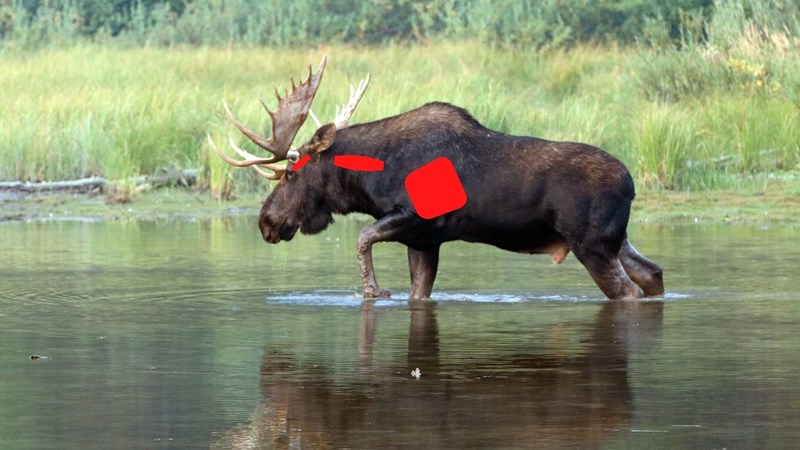
Pick the target area below and shoot for the area that you feel most confident you can place a mortal wound. For me personally, i would not be comfortable with a head or upper vertebrae shot. Some like AKDoc and others are very experienced Moose hunters and have the confidence/experience to take that shot.
My concern with head/vertebrae shot is the head & neck can move ever so slightly that the small target area can shift. quickly. That is just me and no criticism of others.
Below is a pic of the 3 shot placement options. Whichever you pick, make sure you are very practiced. With your rifle, put at least 200 rounds through it sitting, kneeling, and standing. I am a bow hunter and when the opportunity presents itself, and nerves kick in, you need to be comfortable locking in your anchor point, finding the right pin, etc. Get at least 1000 pulls on the bow at target range.
Practice to the point it is second nature to raise & anchor your weapon and you are not flinching.
Good luck, have a great trip!
My concern with head/vertebrae shot is the head & neck can move ever so slightly that the small target area can shift. quickly. That is just me and no criticism of others.
Below is a pic of the 3 shot placement options. Whichever you pick, make sure you are very practiced. With your rifle, put at least 200 rounds through it sitting, kneeling, and standing. I am a bow hunter and when the opportunity presents itself, and nerves kick in, you need to be comfortable locking in your anchor point, finding the right pin, etc. Get at least 1000 pulls on the bow at target range.
Practice to the point it is second nature to raise & anchor your weapon and you are not flinching.
Good luck, have a great trip!

Arcticmanak
Lil-Rokslider
I second the recommendation of a 30 caliber, 180gn Barnes ttsx through the heart/lungs. I have taken several with good results, also with Partitions. Given the close proximity that moose usually are to water, you don't want to let them walk very far. However, I was with a friend that hammered a nice bull 3 times through the vitals broadside at under 200 yds with an 06 and the moose didn't even flinch, then tipped over.
Another hunt with a L48 friend with 300RUM, he hit high in the hump, moose went down, he walked up to it, bull stood up and charged him, he managed one shot from the hip as he tripped over backward in the tussocks. Luckily, he hit it through the snout and it didn't stomp him into oblivion. A shot through the vitals put it down.
Personally, I would not try a head/spine shot unless circumstances were anything less than perfect. To me, there's just too much at risk and too many variables that could go wrong. Halfway up the body and in the crease right behind the front leg. You have a kill zone the size of a beach ball and little to no meat loss.
I usually have a ropealong and chest waders just in case things don't go according to plan!
Another hunt with a L48 friend with 300RUM, he hit high in the hump, moose went down, he walked up to it, bull stood up and charged him, he managed one shot from the hip as he tripped over backward in the tussocks. Luckily, he hit it through the snout and it didn't stomp him into oblivion. A shot through the vitals put it down.
Personally, I would not try a head/spine shot unless circumstances were anything less than perfect. To me, there's just too much at risk and too many variables that could go wrong. Halfway up the body and in the crease right behind the front leg. You have a kill zone the size of a beach ball and little to no meat loss.
I usually have a ropealong and chest waders just in case things don't go according to plan!
Attachments
Similar threads


- Replies
- 1
- Views
- 205

- Replies
- 18
- Views
- 1K

- Replies
- 5
- Views
- 124


Featured Video
Latest Articles
- Mule Deer Days Wildlife Conservation Mashup
- A Hidden Gem: Hunting Washington with Kari Thomas
- Prime Divide Bow Review
- Knowledge From Storms: Surviving and Thriving in the Backcountry with John Barklow
- DIY Wyoming Pronghorn Hunt
- Unlock Precision Shooting: Master Your Hunting Game with Competitive Insights
- Topo Topper Rincon Review
- Tony Trietch on Big Mule Deer, Desert Bulls & Western Hunting Evolution
- The Right to Hunt & Fish Colorado (and North America)
- Mastering New Zealand’s Mountain Hunts: Challenges and Rewards