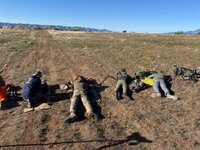
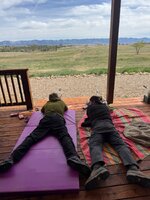
Shooting positions and Yoga lesson

Great video, great tips. Thanks Cliff.
Are you keeping your poles stored at a specific length so they’re ready for a kneeling position?
I change the length of my poles a ton while hiking around rough terrain… my knees are all messed up. Short uphill, long down hill, short/long sidehilling 🤦‍♂️. One thing nice about the single pole position is length doesn’t matter, you can clamp it in your hand where it needs to be. Even with both poles you can adjust them a lot by spreading them out, particularly in terrain/veg that you can get a bite in.

Main thing I really try to do… truthfully more often encouraging a client to do, is get things to the right length and ready to go before the last chunk of any stalk. A guy can even sit down and check everything once, before he proceeds past the last piece of cover on a stalk.
 
Thanks @Cliff Gray
Working my way through your elk course.
I’ll add this to my shooting prep.
I really appreciate the video work that enables clear understanding.
Glad it’s helpful.
I’ve got a big revamp going on the elk course. You’ll have access to all the new stuff too. I’m just perpetually behind at the moment.
 
I'm approaching a year of shooting off trek poles now, and teaching my kids to do it, and....

It's awesome if the ground is halfway soft. Awesome if there's a nice sod or even a halfway decent vegetation covering the ground. But here in the summer when the ground is hard and dry, or at our local flat range where the firing line is hard packed gravel or concrete, trek poles are really hard to work with. Positions that would work in the field won't work on the range because the poles won't grab into the hard dirt.

That's no fault of the position or the poles, just an annoying reality of trying to practice, especially on a commercial range built for comfort over practicality. One thing I've learned is that the shorter the poles are shortened, the steeper each 'leg' has to be, and the better they stay planted on harder ground.

 
I'm approaching a year of shooting off trek poles now, and teaching my kids to do it, and....

It's awesome if the ground is halfway soft. Awesome if there's a nice sod or even a halfway decent vegetation covering the ground. But here in the summer when the ground is hard and dry, or at our local flat range where the firing line is hard packed gravel or concrete, trek poles are really hard to work with. Positions that would work in the field won't work on the range because the poles won't grab into the hard dirt.

That's no fault of the position or the poles, just an annoying reality of trying to practice, especially on a commercial range built for comfort over practicality. One thing I've learned is that the shorter the poles are shortened, the steeper each 'leg' has to be, and the better they stay planted on harder ground.
These come with a bunch of different rubber feet that help.


I've noticed that the poles have to be nearly perfectly the same length to use on smooth surfaces or one will kick out and ruin your set up.
 
I had to add stretching into the routine for a protruding disc a few years ago. Started with free Yoga video off Amazon. I soon discovered many of the stretches were similar to what we did in football. However, the difference being I was not outside sitting in stickers and getting hit in the head with a whistle. The Yoga stretches had funny names, a soft mat to sit on and an attractive young lady in stretchy pants. I much prefer Yoga.

Thank you for the information. I may change up a the sitting position and add Lotus.
 
These come with a bunch of different rubber feet that help.


I've noticed that the poles have to be nearly perfectly the same length to use on smooth surfaces or one will kick out and ruin your set up.
Mine came with different feet and the little snow(?) circle thingies that screw on above the feet but I'd throw them away if using them depended on keeping track of the spare parts and accessories. I am much more of a 'assemble them one way and always use them that way' person.
 
Mine came with different feet and the little snow(?) circle thingies that screw on above the feet but I'd throw them away if using them depended on keeping track of the spare parts and accessories. I am much more of a 'assemble them one way and always use them that way' person.
I use the round ones when I fly so they don't tear up my stuff. It takes a second to put them on and shoot on my deck too. They are loose in an ammo box with a bunch of magazines and boxes of ammo and some chamber flags, etc.
 
Stretching is so important and so overlooked

X bajillion

Aches and pains that are "age related" are because you're inflexible AF. I tell EVERYONE that flexibility and strength are NOT exclusive to each other. They 100% compliment each other and the stronger you get; the more you should focus on flexibility
 
@Cliff Gray excellent video. Thanks!
Lots to unpack and incorporate into practice.

Every should take note of how square you are behind the rifle in prone. I continually struggle w it, take video or have someone take a picture to see how far off you are.
 
@Cliff Gray excellent video. Thanks!
Lots to unpack and incorporate into practice.

Every should take note of how square you are behind the rifle in prone. I continually struggle w it, take video or have someone take a picture to see how far off you are.
I make it awkward.

Pick up the shooters feet and move their body.
 
Back
Top