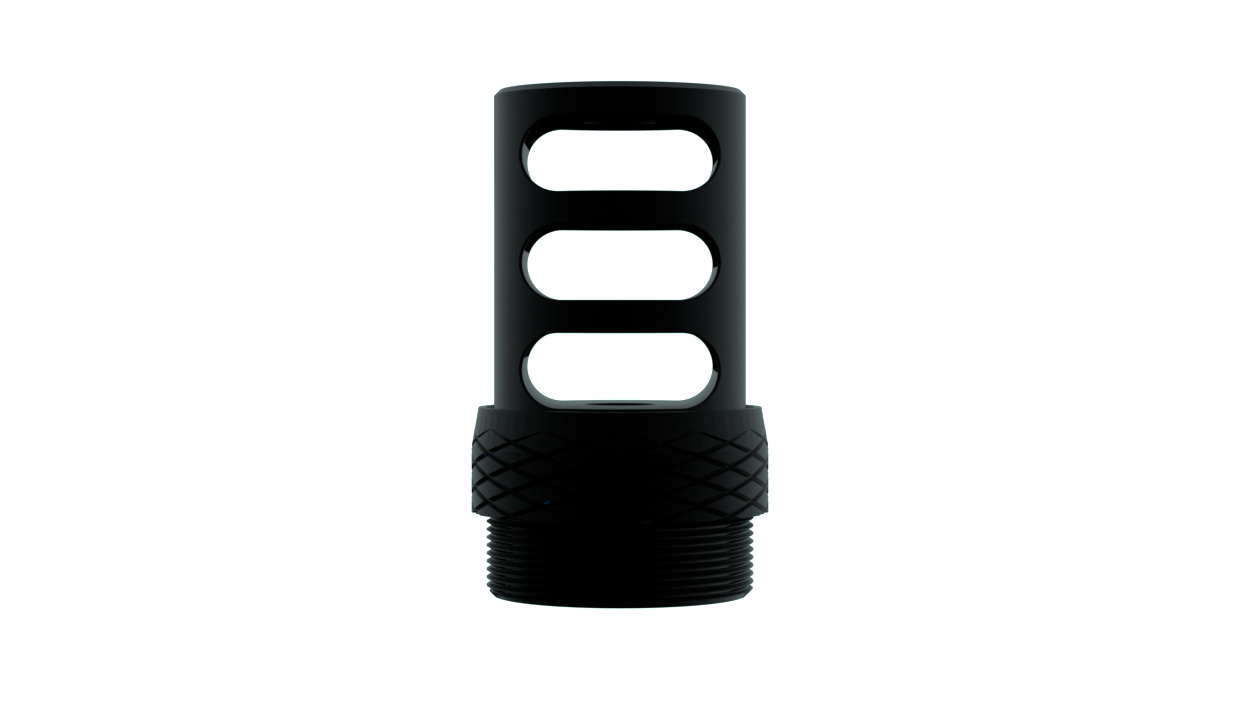
Reaper or the new OG 30 ?

Will the reflex make them quieter, or just change tone and balance?

Will a 4+4 be noticably quieter than a 6?

The reflex does make it quieter, but not equally so. The tests that AB ran suggest that 2” of reflex is about equivalent to one extra baffle. My experience with reflex suppressors seems to bear this out. So, a 4+4 reflex 6.5 suppressor seems to be equivalent to a 6” muzzle forward 6.5 suppressor of the same diameter.
 
AB Raptors huh?
Once I again, I learn about another good suppressor option I hadn't heard of previously. I really fell behind this research when I thought TBAC U7 was my one and only forever.

Raptor 6 w/ reflex sounds like another option I need to consider. I like that it's still on the lower diameter side and has an end cap. Now I have to look to see if there are any brake options in that diameter.
 
AB Raptors huh?
Once I again, I learn about another good suppressor option I hadn't heard of previously. I really fell behind this research when I thought TBAC U7 was my one and only forever.

Raptor 6 w/ reflex sounds like another option I need to consider. I like that it's still on the lower diameter side and has an end cap. Now I have to look to see if there are any brake options in that diameter.

There are some. SRS seems like the only one in stock and I think their new brake will eventually have an AB version
 
Avery, I think you’re arguing against a complaint most people never actually made.

The issue wasn’t that Unknown lied about the OG or manipulated numbers. Most of us understand suppressors are all about tradeoffs and that decibels don’t tell the whole story.

The frustration was that people trusted you, bought into the OG concept, laid out hard earned cash, and then almost immediately saw Unknown release what you yourself described as a “way better” solution for the same intended use case, before many even had a chance to get their OG to the field.

That’s why people felt burned. Defending the OG’s performance doesn’t really address that criticism.

I don’t think the OG was a failure, and I don’t think anyone is accusing Unknown of dishonesty. But I also don’t think it’s accurate to act like the backlash was about people claiming they were misled. It was mostly about timing, expectations, and product management considerations.
Tim, I see where you’re coming from, but I’ve also heard from others who felt we weren’t transparent, which is why I brought this up again. I get the concerns about launching a new suppressor while promoting the OG30, but that wasn’t our plan. After we released the OG30, customers started asking for a suppressor for 6.5 or smaller calibers. It’s normal for companies to learn from past products and use that knowledge to make improvements. 3D printing also helps speed up research and development. I don’t think companies should have to apologize for making progress. That is my opinion; I don't speak for US.

D0 you have an OG suppressor?
 
It does the same thing on my 22” Sauer 100 in 6.5 Creed. It was particularly noticeable with S&B 156-grain factory loads, but it happened with other factory loads too. This was in a range setting back in December (so clean rifle and cool weather). I eventually swapped to the OG 6.5 for that rifle and the problem stopped. I thought it was a “me” problem until I saw it happen to AJSomp’s rifle.

This is concerning as I have a Nano on the way for a 18" 22 Creed built on a Kelbly Atlas action. I sure hope I don't have any pressure issues with that, would be super disappointing.
 
I have only used my Nano on my .223s so far, but I haven’t seen any issues.

Would you say "most" of the time people are fine with not having back pressure issues with the Airlocks on bolt guns?

This is the first I have read about this so doesn't seem like a common problem.
 
Would you say "most" of the time people are fine with not having back pressure issues with the Airlocks on bolt guns?

This is the first I have read about this so doesn't seem like a common problem.

I think that is probably the case. I only know of two people who have experienced that issue and both of us encountered it during relatively high volume shooting. I don’t think it is likely to affect a hunter.
 
This is concerning as I have a Nano on the way for a 18" 22 Creed built on a Kelbly Atlas action. I sure hope I don't have any pressure issues with that, would be super disappointing.


Airlocks are high back pressure cans- that’s how they work. There were 4x 6.5’s and 3x Nanos IIRC in this years S2H classes. The 6.5’s were not used but for a hundred rounds or so at most each- two of them had stiff bolt/pressure issues. The Nano’s were used on 223’s- one had intermittent pressure issues, however I believe that was the ammo and not the can.

The Airlocks are good cans it seems from a suppression and weight perspective. However, high turbulence/high back pressure cans will always show issues with stiff bolts and pressure more than none high turbulence/high back pressure cans- especially with a headwind. As well they show mirage much sooner than most other cans and require a cover to shoot/practice/train with at all; even still in differing conditions without a crosswind sometimes 3-4 shots is all that can be taken before you can’t see through the mirage.

There is generally a price for everything.
 
Do your ears ring at all with the brake on the reaper? I've never shot a suppressor with a brake but i watched a video recently of a different can and the guy said his ears rang with a brake on the can.
I've only tried it without ear pro in the mountains when I was running mock scenarios with my daughter filming on the spotter. When you're rushing like that I didn't notice it at all. Definitely will under the hearing safe threshold, and I was taking two shots then transitioning to a different position. (22" 6.5 creed)

Ken
 
Airlocks are high back pressure cans- that’s how they work. There were 4x 6.5’s and 3x Nanos IIRC in this years S2H classes. The 6.5’s were not used but for a hundred rounds or so at most each- two of them had stiff bolt/pressure issues. The Nano’s were used on 223’s- one had intermittent pressure issues, however I believe that was the ammo and not the can.

The Airlocks are good cans it seems from a suppression and weight perspective. However, high turbulence/high back pressure cans will always show issues with stiff bolts and pressure more than none high turbulence/high back pressure cans- especially with a headwind. As well they show mirage much sooner than most other cans and require a cover to shoot/practice/train with at all; even still in differing conditions without a crosswind sometimes 3-4 shots is all that can be taken before you can’t see through the mirage.

There is generally a price for everything.

That makes sense. So answer me this:

It seems as though chamber pressure would be greatest shortly after ignition, and then tapper/curve off as a bullet moves down the barrel and creates more space for these gasses to occupy. Once the bullet enters the can, the can's job is to slow down the escape of these gasses/pressure to reduce noise.

After the pressure spike shortly after ignition, it doesn't seem like a can would create a "second spike", but rather stay at a high-ish pressure for slightly longer? How would that create sticky bolts on some rifles as the extra back pressure from the can would still be far less than what happens at ignition?

Not trying to be argumentative in anyway, just trying to expand my knowledge on the subject. Worse case is I do have a Reaper to use as well for volume shooting :)
 
That makes sense. So answer me this:

It seems as though chamber pressure would be greatest shortly after ignition, and then tapper/curve off as a bullet moves down the barrel and creates more space for these gasses to occupy. Once the bullet enters the can, the can's job is to slow down the escape of these gasses/pressure to reduce noise.

After the pressure spike shortly after ignition, it doesn't seem like a can would create a "second spike", but rather stay at a high-ish pressure for slightly longer? How would that create sticky bolts on some rifles as the extra back pressure from the can would still be far less than what happens at ignition?

Not trying to be argumentative in anyway, just trying to expand my knowledge on the subject. Worse case is I do have a Reaper to use as well for volume shooting :)

I do not have a definitive answer for you- it is a real thing that happens however.
 
That makes sense. So answer me this:

It seems as though chamber pressure would be greatest shortly after ignition, and then tapper/curve off as a bullet moves down the barrel and creates more space for these gasses to occupy. Once the bullet enters the can, the can's job is to slow down the escape of these gasses/pressure to reduce noise.

After the pressure spike shortly after ignition, it doesn't seem like a can would create a "second spike", but rather stay at a high-ish pressure for slightly longer? How would that create sticky bolts on some rifles as the extra back pressure from the can would still be far less than what happens at ignition?

Not trying to be argumentative in anyway, just trying to expand my knowledge on the subject. Worse case is I do have a Reaper to use as well for volume shooting :)

I have operated on the assumption that it's not necessarily increased peak pressure that causes pressure signs but rather more gas in the chamber that makes it harder for the brass to grip chamber walls and thus increases bolt thrust.

I've had suppressor contributed bolt lift issues with U7, Scythe, Ti XC, and OG65 depending on atmospheric conditions. My Tikkas seem more prone to it but the only non-tikka bolt gun I have left has a 28" barrel so that might be helping it because the can is further from bolt face.
 
That makes sense. So answer me this:

It seems as though chamber pressure would be greatest shortly after ignition, and then tapper/curve off as a bullet moves down the barrel and creates more space for these gasses to occupy. Once the bullet enters the can, the can's job is to slow down the escape of these gasses/pressure to reduce noise.

After the pressure spike shortly after ignition, it doesn't seem like a can would create a "second spike", but rather stay at a high-ish pressure for slightly longer? How would that create sticky bolts on some rifles as the extra back pressure from the can would still be far less than what happens at ignition?

Not trying to be argumentative in anyway, just trying to expand my knowledge on the subject. Worse case is I do have a Reaper to use as well for volume shooting :)
Great question. I believe the suppressor is not generating higher pressure just creating a environment that allows a little bit of case set back. Low pressure subsonic loads can cause sticky bolt lift. A empty primed case can jam up a revolver. These are both primer issues and I think Wind Gypsy explained it better.
 
I’ve had sticky bolt lift at some point or other with all my cans and it only happens to me with high volume shooting and a headwind. I just figured the gas was getting all over the chamber leaving deposits, the bolt looks sooty as heck after those sessions. Didn’t stick with the Airlock long enough to really notice it stand out moreso than other cans so can’t comment there.
 
Back
Top