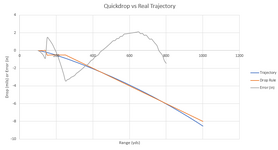
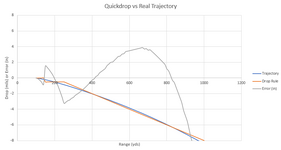
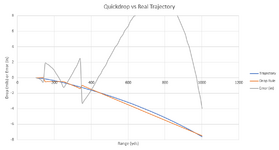
The 270win Ive been using as my example has a .2mil change in dope at 600 yards between 0’ DA and 6000’ DA. Now, if we’re saying .1 or .2mil off from actual dope is acceptable as part of QD, then .2 isnt a lot. BUT it’s on top of any other error including QD’s +\- inherent “close enough” error, ranging errors, environmental, precision of gun, wobble, etc. FWIW my 6.5cm in the exact same situation has a .3mil change.
At the same time I think virtually no one goes up or down 6000’ in one hunt, that takes some serious elevation or a roughly 100-degree temp swing. It begs the question of how much change in DA is truly relevant vs just needlessly overcomplicating things; but also being cognizant that the error is additive and if you had .1 or .2 mil fudge-factor before, it may no longer be “ok” if that grows to .3 or .4+ without taking it into account. Also obviously if we’re accepting .1 or .2 mil error that is +\- meaningless at 300 yards, but probably meaningful at some longer range.
It does take a significant amount of DA change to have a noticeable effect within 600 yards, but it is possible as
@solarshooter explained. You are correct in that compounding environmental error with potentially imperfect QD error does have the possibility to become unacceptable. I don't have any hard rule-of-thumb on how much DA is relevant, and address on a case-by-case basis.
Here is the way I handle it when I am hunting. Each morning, I'll check and set DA in shooter, then verify my quick drop. For this example, I'll start at 2,000' DA, and would use base +0.1 for QD. Note this is within 0.1 mil to 550.
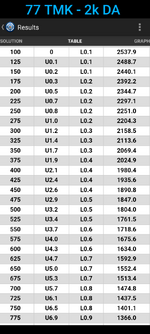
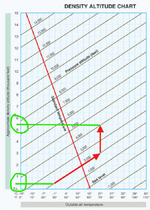
DA is very easy to check with a chart or kestrel, so I do if there's a significant change in elevation and/or temperature since I set it that morning. I'll then input the new DA into shooter, and run it to compare the drop chart to what I am using for QD. To continue with my example, I gain elevation and it warms up so I check DA to be 5,000', and update shooter accordingly.
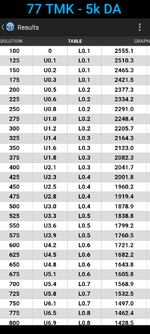
If it's different than before, I just mentally note a new QD. In this case, my QD remains base +0.1, but is now within 0.1 mil out to 600 yards.
To take it a step farther, let's say the DA is now 8,000'.
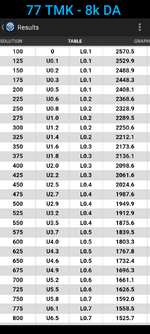
At this point, I would adjust my mental QD of the gun to be base with no modification. This will be within 0.1 mil of my calculated drop out to 675 yards.
This is lengthy to write up, but relative quick to perform once you understand when to check and what you are checking. Usually the morning of I set DA for the average elevation and temp I expect for the day and do not have to change QD for my gun.
For you folks who use and have a lot of field experience with quick drop, where are your parameters as far as what is max “quick drop” range for a 1st shot at an animal (ie not for a follow up on an already-wounded animal), and how much change in dope does it take to cause you to make corrections to your qd math for environmentals?
I usually just see at what point QD diverges too far from the calculated values, I prefer within 0.1 mil past 500 yards. You'll notice in my above example, when establishing QD for the given environmentals I will note "base out to 675". This is how far out it is close enough to QD and the maximum range that you're referring to.
Please note that rest of the situation factors in far more than QD max range when determining max shot distance for a given situation. The only way this factors in is if an animal is on the edge of max QD and there's a possibility of it moving past max QD and ballistics must be looked up or calculated.
It strikes me that a gun with higher “danger space” might be a tough fit for QD in the first place, but might be more forgiving of the max range where qd can legitimately be used, and of changes to your QD math. Those things alone seem valuable, maybe?
They would be more forgiving of max QD range and changes to QD if they didn't have the inherent problem of not matching up to QD in the first place, and unfortunately they only match up less with more distance.