Quick Drop vs Danger Space

5k ft DA changes can easily happen in a day, but you're right, it's not a make or break. Just another couple tenths of error. If you were already dealing with some error, it could put bump you out of the vitals. So maybe correcting within a day is a little over dramatic. But I personally have hunted 10k+ DA variations from one week to the next, so you might still be adjusting week to week.

DA and the ballistics calculations of all of this in precision rifle are still pretty foreign to me, I genuinely didn't/don't know how much it would need to be accounted for at 600yds and in, what causes changes in DA, etc.
 
I do practice quick drop. Question I have is why a bdc turret (ie one marked in yardage, not in angular measurements) is any more problematic than quick drop itself.

To me basic quick drop without a “correction factor” is simple and easy and makes perfect sense to me. What Im missing a bit is why a bdc turret is problematic in comparison, because all of the factors that add variability to a bdc turret, also add exactly the same variation to quick drop. So if you are willing to accept that quick drop is “close enough out to xx range”, why is a bdc turret any different? Is it simply that it prevents or makes it more difficult to utilize a correction factor? Or?

In either case a cartridge with more “danger space” will be more forgiving of any method that involves “close enough”. Seems a cartridge on the high-end of fitting into quick drop would be quantifiably better than a cartridge on the low end of fitting. At a minimum, from that perspective danger space seems relevant and beneficial to quick drop, at least to a point.
It’s pretty tough to argue with your logic here.
 
Another thing folks aren't discussing here is that cartridges with more danger space than a "good" QD gun would give are going to be high recoiling and/or have very limited barrel life and/or very restrictive barrel heating.

Any really fast 7 or 6.5 with high BC bullets kicks way too much for 98% of shooters to shoot well over and over again. Muzzle brakes mitigate this only on the surface, and make other aspects of shooting and communicating much harder (vs suppressors, which typically mean lower recoil cartridges).

A 6UM burns a barrel in under 1k rds, which I don't care about from a cost perspective, but from a simple reliability/usability perspective. You might be on shot 600 shooting fine and see the gun absolutely shit itself and throw grape shot groups by round 650. Next barrel might be good to 750 but you aren't sure and don't want to have it go out during a hunt, so you pull it at 600 just to be safe. At those round counts I would be doing a barrel every year or maybe every other year, which is simply too much hassle for me to tolerate. Or, I leave it alone and don't shoot it much - which to me is also unacceptable. I want to practice consistently with all my guns, since they are all different and require different input to shoot correctly.

22CM or some other fast 22 might literally be the only cartridge too good for QD that maximizes danger space and doesn't have any other horrendous drawbacks. Though barrel life is right on the line.
Good point.

I’m actually shooting mostly 308 right now simply for simplicity (QD) and barrel life.
 
DA and the ballistics calculations of all of this in precision rifle are still pretty foreign to me, I genuinely didn't/don't know how much it would need to be accounted for at 600yds and in, what causes changes in DA, etc.
Try some potential pressure altitude, temp and humidity scenarios in your ballistics app and see what happens to your charts.
 
Try some potential pressure altitude, temp and humidity scenarios in your ballistics app and see what happens to your charts.
The 270win Ive been using as my example has a .2mil change in dope at 600 yards between 0’ DA and 6000’ DA. Now, if we’re saying .1 or .2mil off from actual dope is acceptable as part of QD, then .2 isnt a lot. BUT it’s on top of any other error including QD’s +\- inherent “close enough” error, ranging errors, environmental, precision of gun, wobble, etc. FWIW my 6.5cm in the exact same situation has a .3mil change.

At the same time I think virtually no one goes up or down 6000’ in one hunt, that takes some serious elevation or a roughly 100-degree temp swing. It begs the question of how much change in DA is truly relevant vs just needlessly overcomplicating things; but also being cognizant that the error is additive and if you had .1 or .2 mil fudge-factor before, it may no longer be “ok” if that grows to .3 or .4+ without taking it into account. Also obviously if we’re accepting .1 or .2 mil error that is +\- meaningless at 300 yards, but probably meaningful at some longer range.

For you folks who use and have a lot of field experience with quick drop, where are your parameters as far as what is max “quick drop” range for a 1st shot at an animal (ie not for a follow up on an already-wounded animal), and how much change in dope does it take to cause you to make corrections to your qd math for environmentals?

It strikes me that a gun with higher “danger space” might be a tough fit for QD in the first place, but might be more forgiving of the max range where qd can legitimately be used, and of changes to your QD math. Those things alone seem valuable, maybe?
 
At the same time I think virtually no one goes up or down 6000’ in one hunt, that takes some serious elevation or a roughly 100-degree temp swing. It begs the question of how much change in DA is truly relevant vs just needlessly overcomplicating things; but also being cognizant that the error is additive and if you had .1 or .2 mil fudge-factor before, it may no longer be “ok” if that grows to .3 or .4+ without taking it into account.
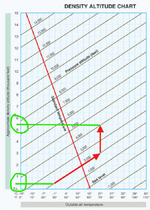
Just as an example, say you wake up at 2000ft and 30deg (500ft DA). Then you climb another 2000ft throughout the day, and it warms up to 70deg (5500ft DA). That's a 5000ft DA change in one day, and an extremely common scenario (for me at least, where I hunt in the weather I can get during hunting season).

1773671542058.png

For you folks who use and have a lot of field experience with quick drop, where are your parameters as far as what is max “quick drop” range for a 1st shot at an animal (ie not for a follow up on an already-wounded animal), and how much change in dope does it take to cause you to make corrections to your qd math for environmentals?
However, that's only a 0.1-0.2mil error vs standard QD even out to 600+ yds. I would generally look at where I'm hunting and the predicted weather and check a range of conditions in my ballistics app to figure out if I need to incorporate or modify a correction factor. Both of my main guns are very close to perfect QD guns with no correction factor, and so I don't need to react unless it's a BIG change. But last year, I went from 7000ft mean altitude and 60-70deg down to sea level and 45deg from one weekend to the next, and that required an adjustment. Which again is just a mental correction factor.

My guns are such good QD matches that I can shoot to 700+ with negligible error using QD. However, due to the drastic and nonlinear reduction in hit rates on vitals sized targets beyond 500yds for most hunting scenarios, I work hard to avoid shots beyond 500yds. And QD is more than adequate to that range for me. So I do not consider it a limitation at all.

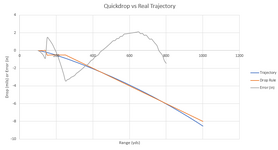
Here's a plot showing how my 284 shooting a Berger 175 EH at 2670fps tracks QD:
1773672245183.png
This is with no correction factor. Within about 3" outright. Within 2" from ~300 to 800+yds. The jog in the curve from ~150 to ~250yds is because I just override and hold 0.5mil in this range. This amount of error is trivial compared to the other sources of error in the shot, and therefore you will barely be able to even detect this in practice. And to be clear I am talking about shots under pressure on game sized vitals from imperfect positions in novel terrain and wind.
 
The 270win Ive been using as my example has a .2mil change in dope at 600 yards between 0’ DA and 6000’ DA. Now, if we’re saying .1 or .2mil off from actual dope is acceptable as part of QD, then .2 isnt a lot. BUT it’s on top of any other error including QD’s +\- inherent “close enough” error, ranging errors, environmental, precision of gun, wobble, etc. FWIW my 6.5cm in the exact same situation has a .3mil change.

At the same time I think virtually no one goes up or down 6000’ in one hunt, that takes some serious elevation or a roughly 100-degree temp swing. It begs the question of how much change in DA is truly relevant vs just needlessly overcomplicating things; but also being cognizant that the error is additive and if you had .1 or .2 mil fudge-factor before, it may no longer be “ok” if that grows to .3 or .4+ without taking it into account. Also obviously if we’re accepting .1 or .2 mil error that is +\- meaningless at 300 yards, but probably meaningful at some longer range.
It does take a significant amount of DA change to have a noticeable effect within 600 yards, but it is possible as @solarshooter explained. You are correct in that compounding environmental error with potentially imperfect QD error does have the possibility to become unacceptable. I don't have any hard rule-of-thumb on how much DA is relevant, and address on a case-by-case basis.

Here is the way I handle it when I am hunting. Each morning, I'll check and set DA in shooter, then verify my quick drop. For this example, I'll start at 2,000' DA, and would use base +0.1 for QD. Note this is within 0.1 mil to 550.
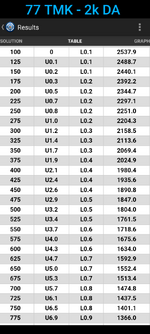
Screenshot_20260316-120021.png

DA is very easy to check with a chart or kestrel, so I do if there's a significant change in elevation and/or temperature since I set it that morning. I'll then input the new DA into shooter, and run it to compare the drop chart to what I am using for QD. To continue with my example, I gain elevation and it warms up so I check DA to be 5,000', and update shooter accordingly.
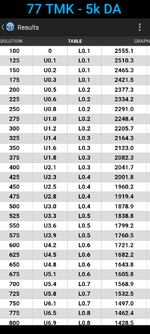
Screenshot_20260316-115911.png

If it's different than before, I just mentally note a new QD. In this case, my QD remains base +0.1, but is now within 0.1 mil out to 600 yards.

To take it a step farther, let's say the DA is now 8,000'.
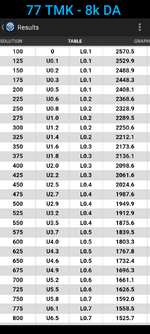
Screenshot_20260316-132411.png

At this point, I would adjust my mental QD of the gun to be base with no modification. This will be within 0.1 mil of my calculated drop out to 675 yards.

This is lengthy to write up, but relative quick to perform once you understand when to check and what you are checking. Usually the morning of I set DA for the average elevation and temp I expect for the day and do not have to change QD for my gun.

For you folks who use and have a lot of field experience with quick drop, where are your parameters as far as what is max “quick drop” range for a 1st shot at an animal (ie not for a follow up on an already-wounded animal), and how much change in dope does it take to cause you to make corrections to your qd math for environmentals?
I usually just see at what point QD diverges too far from the calculated values, I prefer within 0.1 mil past 500 yards. You'll notice in my above example, when establishing QD for the given environmentals I will note "base out to 675". This is how far out it is close enough to QD and the maximum range that you're referring to.

Please note that rest of the situation factors in far more than QD max range when determining max shot distance for a given situation. The only way this factors in is if an animal is on the edge of max QD and there's a possibility of it moving past max QD and ballistics must be looked up or calculated.
It strikes me that a gun with higher “danger space” might be a tough fit for QD in the first place, but might be more forgiving of the max range where qd can legitimately be used, and of changes to your QD math. Those things alone seem valuable, maybe?
They would be more forgiving of max QD range and changes to QD if they didn't have the inherent problem of not matching up to QD in the first place, and unfortunately they only match up less with more distance.

 
I will. What app would you recommend?
If Strelok Pro ever becomes available again, I really liked using that one.

Between Shooter App, and Applied Ballistics, I think Shooter is more straightforward, and probably the best once you learn how to navigate. It hasn’t steered me wrong as long as I remember to update DA.

Applied ballistics has a ton of features that I think go a little beyond the type of shooting that we typically do as hunters. Their custom bc profiles have some issues. The WEZ is a nice visualization of statistical probability. 100% a Bryan Litz thing.

The key is just being able to make range tables with drop, correction, wind, and velocity.

I haven’t found a good app besides Strelok that will compute for the transonic and subsonic ranges very well. But that is so far into the weeds, I hesitate to even bring it up.

The Revic app is nice, but unless using one of their rangefinders, probably wouldn’t be my first choice. Their custom profiles have lined up well with my real life dope.

Hornady 4DOF is pretty buggy, and not worth using given the current options available.

I think that’s all the major players out currently.
 
Ok, had some time to wrap my head around this a bit and I have some additional questions for the brain trust. Maybe Im misunderstanding or misusing some of this, but it seems many of the advantages of QD are really degraded if you dont have a cartridge that fits into it exceptionally well, but notably also anytime a “partial” or non-linear correction is required on top of the basic qd math. Hence the original question obviously, but given the necessary adjustments it seems even many guns that “fit into QD” will run into this at some DA where a correction is needed…

First, NONE of my guns fit into QD as well as those pictured. That may be the first issue. If I go way up in DA to something like a “western mountains” zone my 6.5’s start to fit pretty well. But just as an example, this morning waking up Im at NEGATIVE 3000’ DA. So nothing I have is a perfect “base qd” that stays within a tenth out to full practice range. So I’ve got limited range to functionally use base QD (which is +\- where Ive had success using it), and/or I frequently have MULTIPLE correction factors just at one DA. Example is my 270, where I can use base qd to 350yds, but after that I have to use a .5 correction. So if “mental load” is a significant goal, then it’s basic qd math (easy enough) but only to 350 yards (hardly past pbr), then past that range its a different math with a correction. The key is that frequently I’ve not been able to apply one correction across the entire trajectory, which introduces an additional thing to remember and an additional mid-shot decision. So “in the moment” when QD is useful, Im left with
1) qd math
2) multiple corrections to remember
3) in the moment decision: choose WHICH correction factor to use
4) apply correct correction factor

Thus far when practicing on a clock I have been unable to consistently apply the correct adjustment to the base qd when Im hovering around my cutoff range (ie first shot is at base qd, but a follow up enters the range where a correction is needed, or vice versa).

So Im left asking the same question that I have been struggling to articulate. I do understand base qd. I do understand a standard correction to it. The issue is that in my situation, for the guns I have, it’s rarely been that simple, even with standard cartridges. In order to stay within a reasonable amount of error for a first shot at an animal, what applies is multiple correction factors all at the same DA. To me this is not achieving “lower mental load”. And while I may have taken one too many wacks to the head as a child, my apparently-smooth brain just hasnt managed it well.

So, in this case, is there a simpler solution? Why not a taped BDC turret marked in yardage…in conjuntion with a correction factor? Folks have argued pretty vocally that such a turret is a bad idea, and I would have tended to agree…but Im curious on this, given the specific situation what youd actually be giving up, and what situations that would make a difference? I guess it just seems to me that utilizing yardage on the turret with ZERO math, and then only using and having to remember a correction factor (ie “dial to X marked on turret, then dial correction clicks) is actually less of a mental load than QD+correction, but would utilize the same correction factor in order to achieve equal precision across DA’s without needing the math. Plus, if that allows a flatter-shooting cartridge it would have the benefit of 1) minimizing the correction needed in the first place, and widening the range of DA’s where no correction is needed, 2) minimizing the impact of ranging errors, etc, everything that goes with that flatter trajectory.

Curious on folks thoughts on this.
 
Might be time for a paradigm shift on cartridge and bullets and barrel length.
Could you elaborate? If youre suggesting I just need a gun that matches better, neither my 24” nor my 20” 6.5creedmoors match especially well with factory-loaded 140eldms, they are better than the example gun I used but only out to moderate range and definitely not as cut and dried as the examples others have posted about, so I think its fair to say its not only an issue of uber-flat shooting cartridges.
 
Ok, had some time to wrap my head around this a bit and I have some additional questions for the brain trust. Maybe Im misunderstanding or misusing some of this, but it seems many of the advantages of QD are really degraded if you dont have a cartridge that fits into it exceptionally well, but notably also anytime a “partial” or non-linear correction is required on top of the basic qd math. Hence the original question obviously, but given the necessary adjustments it seems even many guns that “fit into QD” will run into this at some DA where a correction is needed…

First, NONE of my guns fit into QD as well as those pictured. That may be the first issue. If I go way up in DA to something like a “western mountains” zone my 6.5’s start to fit pretty well. But just as an example, this morning waking up Im at NEGATIVE 3000’ DA. So nothing I have is a perfect “base qd” that stays within a tenth out to full practice range. So I’ve got limited range to functionally use base QD (which is +\- where Ive had success using it), and/or I frequently have MULTIPLE correction factors just at one DA. Example is my 270, where I can use base qd to 350yds, but after that I have to use a .5 correction. So if “mental load” is a significant goal, then it’s basic qd math (easy enough) but only to 350 yards (hardly past pbr), then past that range its a different math with a correction. The key is that frequently I’ve not been able to apply one correction across the entire trajectory, which introduces an additional thing to remember and an additional mid-shot decision. So “in the moment” when QD is useful, Im left with
1) qd math
2) multiple corrections to remember
3) in the moment decision: choose WHICH correction factor to use
4) apply correct correction factor

Thus far when practicing on a clock I have been unable to consistently apply the correct adjustment to the base qd when Im hovering around my cutoff range (ie first shot is at base qd, but a follow up enters the range where a correction is needed, or vice versa).

So Im left asking the same question that I have been struggling to articulate. I do understand base qd. I do understand a standard correction to it. The issue is that in my situation, for the guns I have, it’s rarely been that simple, even with standard cartridges. In order to stay within a reasonable amount of error for a first shot at an animal, what applies is multiple correction factors all at the same DA. To me this is not achieving “lower mental load”. And while I may have taken one too many wacks to the head as a child, my apparently-smooth brain just hasnt managed it well.

So, in this case, is there a simpler solution? Why not a taped BDC turret marked in yardage…in conjuntion with a correction factor? Folks have argued pretty vocally that such a turret is a bad idea, and I would have tended to agree…but Im curious on this, given the specific situation what youd actually be giving up, and what situations that would make a difference? I guess it just seems to me that utilizing yardage on the turret with ZERO math, and then only using and having to remember a correction factor (ie “dial to X marked on turret, then dial correction clicks) is actually less of a mental load than QD+correction, but would utilize the same correction factor in order to achieve equal precision across DA’s without needing the math. Plus, if that allows a flatter-shooting cartridge it would have the benefit of 1) minimizing the correction needed in the first place, and widening the range of DA’s where no correction is needed, 2) minimizing the impact of ranging errors, etc, everything that goes with that flatter trajectory.

Curious on folks thoughts on this.

I have a few rifles where it doesn't work too. Don't try to force it, some combos aren't QD friendly and you either need to use a dope card or memorize your drops (or mark your turret). I have some setups that QD nails within .1 mil to 700, others where no single correction factor would work for more than 200 yds.

From what I have seen, QD can be very good for 25-2700ish fps cartridges in the .3-.5 BC range, at 'common' DAs (0-8000). It becomes more setup specific outside of those parameters.

I would say in general, my thoughts are 1) I want a fast cartridge to hunt with, QD capable or not. I want my RF binos to be my primary ballistic solver, and errors in ranging or atmospherics are absorbed by the larger danger space. 2) If it's not a fast cartridge, I want it to be a simple correction factor (if any) with QD to 500 or so. I will still use my RF binos, but if something happens QD is easy to fall back to. Knowing QD here will help tell you your danger space for that round (.1mil/10 yds is most common).

It's a rule of thumb, not a "you have arrived at the end-all be-all" type of thing that you have to feel forced into.
 
I might be missing something because I haven’t used QD or studied it enough. I have a question.

To the extent that QD is stable/reliable for hits, couldn’t it also be marked on a turret?

Is there a difference that makes QD stable that makes it different than marking non QD rifle/ammo drop on the turret?

I saw an example above, where the animal moves 60 yards, and it was said using QD you don’t have to come off the gun to use a rangefinder. How do you know it was 60 yards? Is there a margin of error in ranging with QD?
 
Could you elaborate? If youre suggesting I just need a gun that matches better, neither my 24” nor my 20” 6.5creedmoors match especially well with factory-loaded 140eldms, they are better than the example gun I used but only out to moderate range and definitely not as cut and dried as the examples others have posted about, so I think its fair to say its not only an issue of uber-flat shooting cartridges.

What's your velocity and DA? Shooting 143eldx at 2710fps at 2K DA has me no more than 1/10th off (2/10 @300 and 800)
 
What's your velocity and DA? Shooting 143eldx at 2710fps at 2K DA has me no more than 1/10th off (2/10 @300 and 800)
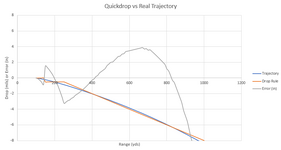
Yeah, using a 140 ELDM at 2700fps, I get that you're within 4" from 0-900ish yards with QD with no correction factor:
1773848577483.png

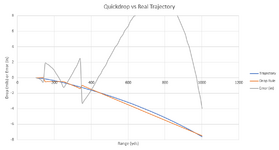
Your 270 is a worse fit, but with a simple 0.5 correction applied beyond 350yds, you are within 4" out to ~530yds:
1773848896644.png
 
I might be missing something because I haven’t used QD or studied it enough. I have a question.

To the extent that QD is stable/reliable for hits, couldn’t it also be marked on a turret?

Is there a difference that makes QD stable that makes it different than marking non QD rifle/ammo drop on the turret?

I saw an example above, where the animal moves 60 yards, and it was said using QD you don’t have to come off the gun to use a rangefinder. How do you know it was 60 yards? Is there a margin of error in ranging with QD?

Quick Drop is first two digits of range minus 2 (400 yds - 2 = 2 mils, 500 yds - 2 = 3 mils, 627 - 2 = 4.3 mils), so .1 mil drop per 10 yds of range. A correction factor can be applied easily if your drops line up with the .1 mil/10 yd, but not with the base number. An example would be a 16" .223 with 2700 fps 69 gr SMK is a +.3 correction factor at my DA, meaning the same range examples above are 400 yds - 2 = 2 +.3 = 2.3 mils, 500 yds - 2 = 3 +.3 = 3.3 mils, etc... On this combo, QD taps out at 500 yds. My dope for 627 is 5 mils. The correction factor & applicable distance is what changes with DA.

If I am hunting and have pre-ranged an opening with close edge at 391, middle at 447, and far side at 500; quick drop lets me easily recalculate in my head if the animal moves from middle to far, or middle to near. QD is not a method for ranging, it is pre-known solution/pattern recognition for drop at a known range. Danger space for the middle shot, in this context (let's call it 12" vitals) can be calculated as approximatley 410 yds to 490 yds (.4 mil will take you more than 6" off). The larger the danger space, the less likely a combo is to work with quick drop reasonably well.

I don't have as strong of convictions about marking my turret as some, but once I did enough reps QD is easy to remember and doesn't require re-marking my turret as I bounce between different ammo types or large changes in DA.
 
Back
Top