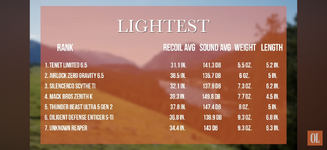
A few thoughts taking this article at face value. First, if you read the article, the author says outright that "These numbers aren’t, however, indicative of an absolute ranking that’s set in stone. There’s enough squish in these numbers — as I detailed above — that drawing such a conclusion would be misguided." In short, anyone relying on these numbers to try to prove which suppressor is best is totally missing the point.
Additionally, as the article makes clear elsewhere, they weren't comparing all new suppressors with all new suppressors. In fact, they excluded a TBAC Ultra 7 because it was an old can that was significantly heavier and full of carbon than when it was new. Nor is there any standard hub mount. So, depending on whatever configuration something showed up, the one someone carries to the field might weigh a bit more or a bit less. So, when it comes to weights, that's something to keep in mind. I'm not the kind of person to sweat an extra half ounce, but I sure as hell won't do it without knowing the basic configuration.
I'm also just a bit irritated that Outdoor Life apparently doesn't care about diameter at all. The diameters for the Tenet cans aren't listed anywhere in the data or the article, as far as I can tell. If someone knows that, please share it. Diameter is an important metric.
With those caveats, the article also states, "the numbers give an excellent account of their relative performance." And I agree with that, so as long as we know some of the baseline values and compare the correct measurements, we can get some idea of how the Outdoor Life data compares with other data sets. To that end, it is useful to look at the baseline value in this data set and the TBAC Suppressor summit data sets. The bare muzzle average upon which the Outdoor Life test relies is 165 db at "one meter to the left of the rifle muzzle, the mil spec standard." By way of comparison, the bare muzzle left average for a .308 from the 2024 TBAC Summit is 170.28 db. But, when one attempts to start comparing these numbers, it immediately becomes clear that Outdoor Life is actually measuring dbA numbers, while labeling them "db." For which the appropriate comparison point from the TBAC Summit is 166.90 dbA. That kind of imprecision bothers a person like me, but I can live with it. It's just sloppy.
As a way of comparing "apples to apples", it is important to keep these baseline numbers in mind. Unless there is something really wacky going on with the test, one would expect the other numbers to track off that baseline.
In the Outdoor Life test, the PTR Vent 1 measures in at 130.7 dB, 16 ounces, and 9.1 inches. The TBAC Suppressor Summit lists it at 133.23 dbA, 15 ounces, and 9.1 inches. Anyone who has looked at suppressor test results enough knows to say that at least for this suppressor, when measured against the baseline bare muzzle values, this is pretty darn close to the same (166.9:133.23; 165:130.7). So, too, in the Outdoor Life test, the Abel Theorem L measures 133.5 db, 16.1 ounces, and 8.8 inches. The Abel Theorem L from TBAC measures at 133.65 dbA, 16.9 ounces, and 8.8 inches. Given the small sample sizes used in each test, it is hardly surprising to see some variation, but it is reassuring to be able to say that the Outdoor Life numbers don't appear to be complete bollocks. I look forward to seeing more suppressors compete on the same playing field at the TBAC Summit and through PEW Science down the road.
Here is a link to the data from the Outdoor Life pdf, as I chose to export it to Google Sheets. This way you can actually sort the columns.

docs.google.com
Sorting by length immediately makes the Airlock suppressors jump off the page at me. Nothing that Outdoor Life measured comes close to the ZG 6.5. If we are going to argue about decibels, the 135.7 for the ZG 6.5 versus the 141.3 for the Tenet Limited 6.5 is a significant jump to me. That's one reason I really want to know the diameters.
As a consumer, I look forward to more entries into the suppressor market.