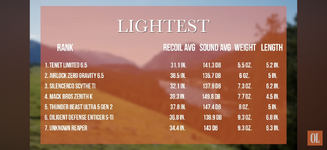
Outdoor life suppressor testing

The Scoute tests pretty poor too. Interesting test results. I agree, shooter's ear #'s would have been useful. Of the can's I own, my rankings would follow theirs #'s.

As much as some guys on here have a problem with PEW. I do believe that is the best way to get accurate #'s. A standardized recoil reduction test, would be very useful.
 
Yeah the muzzle control is where the tenet cans are leaps and bounds ahead of the competition. It will soon own the market for hunters carrying a bigger gun.

Light, short, quiet, reduces recoil like a brake, and controls muzzle movement better then anything I have ever seen.
Light, short, quiet? Remember we are talking about adding 7” (not short relative industry standards) and 8 ounces (not light relative industry standards), all for a 145 DbA rating (not remotely quiet relative industry standards).

Is there a role for this in NRL? Yes, probably so. I just struggle to see the appeal of running this on a western hunting rifle.
 
Light, short, quiet? Remember we are talking about adding 7” (not short relative industry standards) and 8 ounces (not light relative industry standards), all for a 145 DbA rating (not remotely quiet relative industry standards).

Is there a role for this in NRL? Yes, probably so. I just struggle to see the appeal of running this on a western hunting rifle.
Which tenet are you referring to?

Quiet: #4
Recoil: #1
Weight: #1
Length: basically tied #1

Not sure how you can complain about those numbers, especially on a moderate recoiling round. On a 22cm give me the airlock all day long, but bump that up to a 6.5prc and the recoil becomes a factor.
 

Attachments

  • IMG_1446.png
    IMG_1446.png
    714.3 KB · Views: 35
Which tenet are you referring to?

Quiet: #4
Recoil: #1
Weight: #1
Length: basically tied #1

Not sure how you can complain about those numbers, especially on a moderate recoiling round. On a 22cm give me the airlock all day long, but bump that up to a 6.5prc and the recoil becomes a factor.
You’re cherry picking single can attributes. I’m talking about their flagship can, the Limited 30 Single Port. In aggregate, who wants to add 7” and 8 ounces to still have a rifle that is not remotely competitive from a suppression standpoint?

The majority of those who have been running a suppressor for multiple years now will agree, this isn’t the answer. Will it sell to first time suppressor buyers and competitive shooters? Absolutely. Is an 8 ounce, 7” suppressor that is not remotely hearing safe what most experienced suppressor owners here out west desire in a their rifle system? No.
 
You’re cherry picking single can attributes. I’m talking about their flagship can, the Limited 30 Single Port. In aggregate, who wants to add 7” and 8 ounces to still have a rifle that is not remotely hearing safe?

Everyone who has been running a suppressor for multiple years now knows, this isn’t the answer. Will it sell to first time suppressor buyers, and competitive shooters, absolutely. Is a 28” plus all in package that is still not remotely hearing safe what most experienced suppressor owners here out west desire in a their rifle system, no.
Sounds like you’re the one cherry picking. You are saying back country, lightweight, short, but then don’t want to talk about their light weight can? And how am I cherry picking? There are 4 categories and I listed all 4 categories for their LIGHTWEIGHT, BACKCOUNTRY, can.

Sure the other one is bigger, why are you only focusing on that one? I have a TBAC 338 ultra, it’s huge and awesome, but I don’t try to convince people it’s a lightweight, backcountry can.
 
Tenet Limited 6.5 is interesting, and performed well in this testing case.

I’m encouraged by the push for suppressor improvements.

The OL testing raised discussion, that’s good for consumers and hopefully manufacturers take note and consider where they need to focus on improving their product performance and some market demand areas to consider.

Good things are happening in process currently.
New products coming.
 
Im not sure what i think about the Reaper numbers. Of the suppressors included in this test I have a Scythe, Enticer S, and a Reaper (prototype). It could be that the Reaper does better at shooters ear? I don't know but it does not sound 4-5 db louder when I shoot them. I would rank them scythe the quietest, and enticer the loudest. I must admit though that the enticer has a tingy sound that I dont care for, and that the Reaper is a not a production model.

The last thing I need to spend money on right now is a another suppressor but it is an exciting time for suppressor consumers!
 
A few thoughts taking this article at face value. First, if you read the article, the author says outright that "These numbers aren’t, however, indicative of an absolute ranking that’s set in stone. There’s enough squish in these numbers — as I detailed above — that drawing such a conclusion would be misguided." In short, anyone relying on these numbers to try to prove which suppressor is best is totally missing the point.

Additionally, as the article makes clear elsewhere, they weren't comparing all new suppressors with all new suppressors. In fact, they excluded a TBAC Ultra 7 because it was an old can that was significantly heavier and full of carbon than when it was new. Nor is there any standard hub mount. So, depending on whatever configuration something showed up, the one someone carries to the field might weigh a bit more or a bit less. So, when it comes to weights, that's something to keep in mind. I'm not the kind of person to sweat an extra half ounce, but I sure as hell won't do it without knowing the basic configuration.

I'm also just a bit irritated that Outdoor Life apparently doesn't care about diameter at all. The diameters for the Tenet cans aren't listed anywhere in the data or the article, as far as I can tell. If someone knows that, please share it. Diameter is an important metric.

With those caveats, the article also states, "the numbers give an excellent account of their relative performance." And I agree with that, so as long as we know some of the baseline values and compare the correct measurements, we can get some idea of how the Outdoor Life data compares with other data sets. To that end, it is useful to look at the baseline value in this data set and the TBAC Suppressor summit data sets. The bare muzzle average upon which the Outdoor Life test relies is 165 db at "one meter to the left of the rifle muzzle, the mil spec standard." By way of comparison, the bare muzzle left average for a .308 from the 2024 TBAC Summit is 170.28 db. But, when one attempts to start comparing these numbers, it immediately becomes clear that Outdoor Life is actually measuring dbA numbers, while labeling them "db." For which the appropriate comparison point from the TBAC Summit is 166.90 dbA. That kind of imprecision bothers a person like me, but I can live with it. It's just sloppy.

As a way of comparing "apples to apples", it is important to keep these baseline numbers in mind. Unless there is something really wacky going on with the test, one would expect the other numbers to track off that baseline.

In the Outdoor Life test, the PTR Vent 1 measures in at 130.7 dB, 16 ounces, and 9.1 inches. The TBAC Suppressor Summit lists it at 133.23 dbA, 15 ounces, and 9.1 inches. Anyone who has looked at suppressor test results enough knows to say that at least for this suppressor, when measured against the baseline bare muzzle values, this is pretty darn close to the same (166.9:133.23; 165:130.7). So, too, in the Outdoor Life test, the Abel Theorem L measures 133.5 db, 16.1 ounces, and 8.8 inches. The Abel Theorem L from TBAC measures at 133.65 dbA, 16.9 ounces, and 8.8 inches. Given the small sample sizes used in each test, it is hardly surprising to see some variation, but it is reassuring to be able to say that the Outdoor Life numbers don't appear to be complete bollocks. I look forward to seeing more suppressors compete on the same playing field at the TBAC Summit and through PEW Science down the road.

Here is a link to the data from the Outdoor Life pdf, as I chose to export it to Google Sheets. This way you can actually sort the columns.


Sorting by length immediately makes the Airlock suppressors jump off the page at me. Nothing that Outdoor Life measured comes close to the ZG 6.5. If we are going to argue about decibels, the 135.7 for the ZG 6.5 versus the 141.3 for the Tenet Limited 6.5 is a significant jump to me. That's one reason I really want to know the diameters.

As a consumer, I look forward to more entries into the suppressor market.

 
You gotta learn to take any suppressor test for exactly what they are. Mostly non-scientific, bro science. Pew and Tbac summit are really the only ones that might make a guy like Q happy. I look more at the comparison values vs. the actual values. In most tests I've seen of the cans I own, the comparative data (can vs. can), lines up with my thoughts as well.
 
Did they sponsor this whole testing process? Overall, their cans tested pretty dang good.
Nobody sponsored this event. Request were sent out to a ton of supressor companies, some wanted to be evaluated, some didn't. The guys that facilitated this test received zero financial compensation, barrel, brass bullets and powder were donated by people participating. Quite a bit of time, money and resources went into this project for no gain other than the data and information acquired.

Everything here needs be taken with a grain of salt, test was not conducted in a closed controlled environment, weather was slightly variable throughout the day. The numbers collected, are just that, the data we recorded over a 4 shot average from each configuration.

There will be many pointing fingers at some fly in the ointment, however nobody else has done anything of this magnitude on a recoil sense. The group started this project knowing there will be nay-sayers and critics. Yes there are a lot of data sets and compilations of sound metric out there, but nothing of this variety actually testing what the rifles behavior is with each config.
 
The reaper results were pretty disappointing. It’s louder than the scythe by more than it’s quieter than the nhs. I say this as an owner of both of these.

During development of the reaper I remember direct testing against the scythe and the scythe being louder. In this test the scythe is significantly quieter than the reaper.

Maybe it’s the position of the meter?

Regarding the CGS Hyperion K, I wish they’d have tested it with the flat end cap. I regularly get questions about it at matches because of how good it sounds. I think it’s mostly a tone thing, based on how it has tested at the thunderbeast summit.

I’d guess that the scythe looking better on sound than reaper is largely a result of meter location. Braked cans seem to do better with left of muzzle metering.
 
They were included. You can find them…if you look hard enough…
I saw them, and they didnt fair well in the OL test. Im hoping they do their own test so we can compare results and the difference between the cans that US comes up with vs the OL test.

Sent from my SM-S928U using Tapatalk
 
I saw them, and they didnt fair well in the OL test. Im hoping they do their own test so we can compare results and the difference between the cans that US comes up with vs the OL test.

Sent from my SM-S928U using Tapatalk
Why would you want a company to do their “own” test? Give me a 3rd party, unbiased test. We’ve already heard the “tone” spin.
 
Back
Top