
Navigation
Install the app
How to install the app on iOS
Follow along with the video below to see how to install our site as a web app on your home screen.
Note: This feature may not be available in some browsers.
More options
Style variation
You are using an out of date browser. It may not display this or other websites correctly.
You should upgrade or use an alternative browser.
You should upgrade or use an alternative browser.
Elk Bullets - LRX vs HHT
- Thread starter armiller1991
- Start date

Unclecroc
Lil-Rokslider
- Joined
- Jun 22, 2020
- Messages
- 248
With experience with Barnes, HHT Hammers and the hollow point Hammer lines, I will take the hollow point Hammers myself.
When you fill the tip with oil they open like a varmint bullet and penetrate like a solid.
With that said you will not be disappointed with either bullet, something to consider is availability, it will always be in Hammers corner and as a whole Barnes seem to work better the faster they impact.
When you fill the tip with oil they open like a varmint bullet and penetrate like a solid.
With that said you will not be disappointed with either bullet, something to consider is availability, it will always be in Hammers corner and as a whole Barnes seem to work better the faster they impact.

Okay. I’m curious. Can you elaborate on this? How do you fill it? Doesn’t it run out into the chamber?When you fill the tip with oil they open like a varmint bullet and penetrate like a solid.

35WhelenAI
WKR
- Joined
- Nov 20, 2021
- Messages
- 2,316
Truly curious, not trying to stir a pot here. How have you determined oil in the tip expands the Hammer hollow points differently/more quickly than they are designed originally? The Hammer hollowpoint design already is to expand quickly, shed petals and create ancillary projectiles going through the animal to do more damage. And for the shank to exit.
Hammers initiate expansion pretty much on contact, petals come off the bullet and the shank penetrates like a solid. As we know, the Hammer loses petals by design. A hollow point Hammer, even more so with respect to opening quickly and shedding petals.
From a layman's standpoint, the difference in expansion characteristics between the modification you are doing vs how they are designed would be minimal at best?
Hammers initiate expansion pretty much on contact, petals come off the bullet and the shank penetrates like a solid. As we know, the Hammer loses petals by design. A hollow point Hammer, even more so with respect to opening quickly and shedding petals.
From a layman's standpoint, the difference in expansion characteristics between the modification you are doing vs how they are designed would be minimal at best?
wapitibob
WKR
Oil remained in the tip from their mfg process. When it was removed a while back, several users who have extensive history with the bullets noticed less than stellar results. There is/was a long thread on long range hunting forum about it.Okay. I’m curious. Can you elaborate on this? How do you fill it? Doesn’t it run out into the chamber?
35WhelenAI
WKR
- Joined
- Nov 20, 2021
- Messages
- 2,316
Your post made it sound like you filled them with oil. Have you filled them with oil and experienced a difference in your use?
Less than Stellar results would mean to infer the bullets sucked in on game performance. Hammers are not known for poor on game performance anymore or less than any other bullet with respect to how they are designed to perform and the terminal results. It sounds like the oil is a silver bullet for a copper bullet that makes them almost infallible. I did a search and didn't find a thread with respect to oil in the tips of hammers with the in-depth information you are referencing. Is it buried in some other thread?
Less than Stellar results would mean to infer the bullets sucked in on game performance. Hammers are not known for poor on game performance anymore or less than any other bullet with respect to how they are designed to perform and the terminal results. It sounds like the oil is a silver bullet for a copper bullet that makes them almost infallible. I did a search and didn't find a thread with respect to oil in the tips of hammers with the in-depth information you are referencing. Is it buried in some other thread?
wapitibob
WKR
Your post made it sound like you filled them with oil. Have you filled them with oil and experienced a difference in your use?
Less than Stellar results would mean to infer the bullets sucked in on game performance. Hammers are not known for poor on game performance anymore or less than any other bullet with respect to how they are designed to perform and the terminal results. It sounds like the oil is a silver bullet for a copper bullet that makes them almost infallible.
I used production hammer hunters with the oil from the factory, they worked just fine for me. I stopped using them because I found a better grouping bullet that kills E/D/P just as dead, just as fast.
If you want addl info, the thread I linked on page 1, has 30 pages of info and a lot of "noise" regarding the hammers and changes some have seen with oil, no oil, early tipped bullets, and production tipped bullets.
35WhelenAI
WKR
- Joined
- Nov 20, 2021
- Messages
- 2,316
Got you. Our posts crossed as I was editing mine a bit. Thanks for sharing what you have.
Unclecroc
Lil-Rokslider
- Joined
- Jun 22, 2020
- Messages
- 248
When I first started using hammer bullets they had residual cutting oil on the hollow points. The additional fluid in the hole opened the bullet much quicker into the animal. I was getting 2”+ entry holes in the ribs and inside vital s were more souped with fluid in them vs 1.5” entry and a more narrow cavity in the onside vitals with the bullet reaching full expansion and shed petals usually 5” in without the oil.Okay. I’m curious. Can you elaborate on this? How do you fill it? Doesn’t it run out into the chamber?
Now I just take my bottle of hoppes oil and put a drop or two on the hollow point before season. I’ve not noticed it running everywhere in my rifle.
Please don’t think they don’t work well dry. They are very lethal bullets but the oil gives them a little more pop if you will.
Typical entry with oil.

Typical entry without
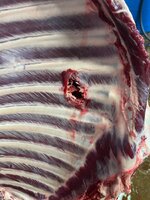
Exits average about the same actually. About 1.5” with petal distribution more widespread with oil and more centric without.
This data is observed over roughly 15 deer with the same bullet. (90 absolute hammer).
Unclecroc
Lil-Rokslider
- Joined
- Jun 22, 2020
- Messages
- 248
See my post above for a more detailed explanation. There are threads on long range hunting and hammertime forum discussing oil. There is debate among users at the amount of difference between oiled or unoiled, but I think it’s a meaningful difference and I choose to apply some fluid to the hollow point. But oiled or unoiled they don’t suck.Your post made it sound like you filled them with oil. Have you filled them with oil and experienced a difference in your use?
Less than Stellar results would mean to infer the bullets sucked in on game performance. Hammers are not known for poor on game performance anymore or less than any other bullet with respect to how they are designed to perform and the terminal results. It sounds like the oil is a silver bullet for a copper bullet that makes them almost infallible. I did a search and didn't find a thread with respect to oil in the tips of hammers with the in-depth information you are referencing. Is it buried in some other thread?
I could see an advantage here to someone who shoots bigger animals who maybe wants to delay expansion for a few more inches by not applying oil.
Oil is a WONDERFUL Thing!
I have been quietly testing Absolute Hammers with oil added to the hollow point. As most know, when Weatherby started loading Hammers, they asked that the bullets be cleaned so the machining oil would be removed. We have stumbled on to the fact that residual oil in the hp cavity may actually...
hammerbullets.com
35WhelenAI
WKR
- Joined
- Nov 20, 2021
- Messages
- 2,316
That's pretty cool! Any idea if it lowers expansion threshold as well? Just thinking out loud here as it could apply to other copper hollow point bullets..
If your goal is quick killing Elk with an easy-to-load bullet, then you’ve got sub-ideal options.
The issue you’re accidentally creating with the bullets you’re asking about—-they are going to have a long neck of penetration before they start expanding (at mid ranges or longer). Bullets that are “tough” are slow to expand. Not just limited overall expansion (also true), but only doing so after passing through much of the vitals.
It’s clear you would be using the ABLR but it’s finicky to load and inconsistent. That’s an incredibly soft and quick expanding bullet and, if they were made better, would be a decent choice.
But you won’t use ELDX? It’s very similar to ABLR in terms of expansion. Just easier to make accurate. Someone who would use ABLR but not ELDX is not thinking things through.
My recommendation is to reset your thinking and ask yourself what style bullet kills the quickest.
The issue you’re accidentally creating with the bullets you’re asking about—-they are going to have a long neck of penetration before they start expanding (at mid ranges or longer). Bullets that are “tough” are slow to expand. Not just limited overall expansion (also true), but only doing so after passing through much of the vitals.
It’s clear you would be using the ABLR but it’s finicky to load and inconsistent. That’s an incredibly soft and quick expanding bullet and, if they were made better, would be a decent choice.
But you won’t use ELDX? It’s very similar to ABLR in terms of expansion. Just easier to make accurate. Someone who would use ABLR but not ELDX is not thinking things through.
My recommendation is to reset your thinking and ask yourself what style bullet kills the quickest.
35WhelenAI
WKR
- Joined
- Nov 20, 2021
- Messages
- 2,316
I alluded to that in post #44: "From a layman's standpoint, the difference in expansion characteristics between the modification you are doing vs how they are designed would be minimal at best?"
Interested to see where this discussion goes from here.
Interested to see where this discussion goes from here.
Thanks for the detailed response. Thinking out loud here, it makes sense in my head. Fluid will apply the necessary expanding force more effectively than air. Like when a firecracker is dropped in a porcelain toilet full of water, it will crack the bowl. If the firecracker is dropped in a dry bowl, no damage. The same reason hydraulic fluid is used in machines instead of air.When I first started using hammer bullets they had residual cutting oil on the hollow points. The additional fluid in the hole opened the bullet much quicker into the animal. I was getting 2”+ entry holes in the ribs and inside vital s were more souped with fluid in them vs 1.5” entry and a more narrow cavity in the onside vitals with the bullet reaching full expansion and shed petals usually 5” in without the oil.
Now I just take my bottle of hoppes oil and put a drop or two on the hollow point before season. I’ve not noticed it running everywhere in my rifle.
Please don’t think they don’t work well dry. They are very lethal bullets but the oil gives them a little more pop if you will.
Typical entry with oil.
View attachment 995471
Typical entry withoutView attachment 995472
Exits average about the same actually. About 1.5” with petal distribution more widespread with oil and more centric without.
This data is observed over roughly 15 deer with the same bullet. (90 absolute hammer).
The terminal performance you've observed also seems to line up with speculation I've seen from respected voices on this forum that some failures to open are due to an open tip getting plugged with more solid material before it begins expanding.
I'm now thinking about self-tipping HHTs that so many gripe about. Maybe it's a good chance to place a drop of oil in there before placing the tip.
The only side effect I see is keeping the weight of the bullet consistent from one to the next for a consistent POI. But I suspect the difference in weight from one drop of oil to the next isn't enough to see an effect at hunting ranges.
Rather than a drop of oil I think it would make as much or more sense to use something like vaseline that is thicker and has a melt point higher than something like coconut oil...
Even with the higher melt point the tip of the bullet gets pretty hot with air friction hence the special no melt tips so it would likely melt enroute but for a hollowpoint inertia would probably keep it in place?
Even with the higher melt point the tip of the bullet gets pretty hot with air friction hence the special no melt tips so it would likely melt enroute but for a hollowpoint inertia would probably keep it in place?
I'm shooting 131g Hammer Hunters and 140 Absolute Hammers in my 7 SAUM right now and was pleased with the accuracy and terminal performance of the AH on a whitetail doe this fall. 3150 muzzle velocity from the AH on a doe at 70 yards. Entry was point of the shoulder, exit was back of the left ham. She turned to soup inside.
I'm playing around with the 145 and 160 lrx now and haven't quite dialed in the accuracy I'm looking for. The 160 needs to be single fed in a short action SAUM to get it's full potential.
I'm playing around with the 145 and 160 lrx now and haven't quite dialed in the accuracy I'm looking for. The 160 needs to be single fed in a short action SAUM to get it's full potential.

In the past that wasn’t necessarily true, there were revisions to the hollow point size along the way and more than one user got bullets from “bad batches of alloy”. Ideally all those issues are in the rear view but not gonna pretend some growing pains and lessons weren’t learned that affected the hunts of customers.Hammers are not known for poor on game performance anymore or less than any other bullet with respect to how they are designed to perform and the terminal results.
That out of the way I just ordered some HHT and HBC to try out. The hammers have always loaded easily for me and I like the idea of the larger hollow point behind the tip on these versus the HH.
Dunno about expansion but the vapor trail the cutting oil mist created was fun to see.
Similar threads


- Replies
- 8
- Views
- 830



Featured Video
Latest Articles
- The Fundamentals of Scouting For Mule Deer & Elk | Hunt West Crossover
- Wiser Precision BA-7 Sparrow Binocular Adapter Review
- How to Kill Giant Bulls with Ryan Carter
- Kifaru Enters the Hunting Apparel Space: Review
- From Big Bucks to Bear Hunts: Catching Up with Jordan Budd
- Mule Deer Days Wildlife Conservation Mashup
- A Hidden Gem: Hunting Washington with Kari Thomas
- Prime Divide Bow Review
- Knowledge From Storms: Surviving and Thriving in the Backcountry with John Barklow
- DIY Wyoming Pronghorn Hunt