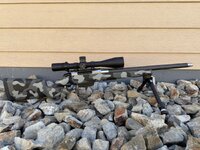
.223 for bear, mountain goat, deer, elk, and moose.

Was doing some practice at the range when two guys next to me were desperately getting their braked 280AI dialed back in after the scope came 2 feet off zero, bear hunt in Montana tomorrow. Asked me if I’m hunting just coyotes with the .223 and said that 77gr tmk is too heavy to be shot out of .223.

All in the span of a 2 min conversation. Certified rokslide moment
Oh, and they only had 5 hand loaded rounds left, so they made the 2ft correction, landed one single shot 2” high, and called it dialed.
 
Wife's cousin has a bad gopher problem on their farm. I figured it'd be a good opportunity to fireform for the 223 ai. Was a little worried the 77 tmk wouldn't have enough whallop for gophers.

At about 75 rounds with the flat face Triggertech special. Yes it is "better". I lost my oem trigger during a barrel swap. We will see if the TT can survive the S2H school and shooting all summer before I decide to put one in my other gun.
Looks like the TMK was barely adaquate!;)
 
Well, Brushcreekbill I'm not sure about "too much gun." If i look at time from hit to death my one 223 example (bear) is as good as my bigger caliber. On the other hand...

I keep hearing the TMK is the bees knees, and maybe it is. I've only used it once. But the wound channel from the one kill was nothing to write home about and it stopped against the inside of the far shoulder (not just under the hide). That tells me it was running out of steam inside the bear not doing the "trampoline" thing against the hide (Form has pointed out, accurately I believe that a bullet often stops under the hide, regardless of how big the animal is because the hide stretches with the bullet).

I went back and looked at some pictures of grizzly, moose and black bear kills with a 6.5 Grendal, a 308 and a 358. In all cases, the entrance wound was bigger and there was usually an exit wound, and the depth of penetration through the animal was greater, i.e. either and exit wound or a bullet stuck right under the hide, not partway through a shoulder.

So to sum it it up. Time to incapacitation in a sample of 1, would say the 223 is dead equal with all my bigger guns. If we measure the wound channel's width and depth, I would say the 223 is a step down from bigger calibers. Does it matter? Well maybe, maybe not. Is there an animal in North America that I would NOT shoot with a 223 on a broadside shot? None, except Bison. Are there shots on a grizzly or moose I would take with my 358 that I would NOT take with a 223? At this point, YES, but I want more data. I'll try to shoot a few more things with the 223 to see how it goes.

Editing to add - My back up shot with my 308 didn't have spectacular penetration either, although the entrance wound was more impressive. It was a noticeably fatter bear then most we've shot in the spring. So its possible both bullets slowed down a good bit going through that inch of fat. I'd like get some 200 gr ELDX handloads going for my 308 just to have a bit more "insurance" in such situations vs the 168 ELDM. And I'm going to shoot a more typical sized bear with the 223 for more data. At this point though, I don't think I'd take the 223 on a moose hunt unless weight was a top priority. I could imagine shots I'd take with my 308 that I would not take with my 223.

 
  • Like
Reactions: BLJ
Well, Brushcreekbill I'm not sure about "too much gun." If i look at time from hit to death my one 223 example (bear) is as good as my bigger caliber. On the other hand...

I keep hearing the TMK is the bees knees, and maybe it is. I've only used it once. But the wound channel from the one kill was nothing to write home about and it stopped against the inside of the far shoulder (not just under the hide). That tells me it was running out of steam inside the bear not doing the "trampoline" thing against the hide (Form has pointed out, accurately I believe that a bullet often stops under the hide, regardless of how big the animal is because the hide stretches with the bullet).

I went back and looked at some pictures of grizzly, moose and black bear kills with a 6.5 Grendal, a 308 and a 358. In all cases, the entrance wound was bigger and there was usually an exit wound, and the depth of penetration through the animal was greater, i.e. either and exit wound or a bullet stuck right under the hide, not partway through a shoulder.

So to sum it it up. Time to incapacitation in a sample of 1, would say the 223 is dead equal with all my bigger guns. If we measure the wound channel's width and depth, I would say the 223 is a step down from bigger calibers. Does it matter? Well maybe, maybe not. Is there an animal in North America that I would NOT shoot with a 223 on a broadside shot? None, except Bison. Are there shots on a grizzly or moose I would take with my 358 that I would NOT take with a 223? At this point, YES, but I want more data. I'll try to shoot a few more things with the 223 to see how it goes.

Editing to add - My back up shot with my 308 didn't have spectacular penetration either, although the entrance wound was more impressive. It was a noticeably fatter bear then most we've shot in the spring. So its possible both bullets slowed down a good bit going through that inch of fat. I'd like get some 200 gr ELDX handloads going for my 308 just to have a bit more "insurance" in such situations vs the 168 ELDM. And I'm going to shoot a more typical sized bear with the 223 for more data. At this point though, I don't think I'd take the 223 on a moose hunt unless weight was a top priority. I could imagine shots I'd take with my 308 that I would not take with my 223.
What 358?
 
Well, Brushcreekbill I'm not sure about "too much gun." If i look at time from hit to death my one 223 example (bear) is as good as my bigger caliber. On the other hand...

I keep hearing the TMK is the bees knees, and maybe it is. I've only used it once. But the wound channel from the one kill was nothing to write home about and it stopped against the inside of the far shoulder (not just under the hide). That tells me it was running out of steam inside the bear not doing the "trampoline" thing against the hide (Form has pointed out, accurately I believe that a bullet often stops under the hide, regardless of how big the animal is because the hide stretches with the bullet).

I went back and looked at some pictures of grizzly, moose and black bear kills with a 6.5 Grendal, a 308 and a 358. In all cases, the entrance wound was bigger and there was usually an exit wound, and the depth of penetration through the animal was greater, i.e. either and exit wound or a bullet stuck right under the hide, not partway through a
Let me preface by saying I'm not a very experienced hunter, and have killed 0 bears. I'm just asking to better understand. Is there something about destroying the off-side shoulder that results in a quicker time to incapacitation? Does the two holes or larger entrance wound matter? I keep hearing a ton of people say bears don't leave much blood trail regardless of how many or how large of holes (again - I have no real world experience).
 
Billdoe, the 358 was a 358 Winchester with 225 grain Swift Bullets and 160 grain Cutting Edge bullets. Both gave similar performance in a small sample size. Both would have punched through that bear farther based on performance on moose (which had thicker ribs and belly meat) and bears (all exits). A 308 hits exited all bears except extreme quartering shots at wounded bears and a very light kid load that was more like 6.5 Grendal ballistics.

WhoGerDenn breaking the off side shoulder probably would not have killed the bear any faster. Bears can move quit fast on 3 legs. My concern is not breaking the shoulder, it's the fact that the 223 seemed to run out of steam in a situation where the 358 (or a 308, 375 Ruger etc) probably would have gone through the shoulder and either penetratrated out or lodged under the hide. In one example I hit a wounded grizzly through the back hip with my 308 and the bullet angled into the heart before stopping. On a broadside the 223 worked. On a quartering shot that the 223 would fail in a situation where the 308 or 358 goes farther.

In a sense if I found the "edge" of what a 223 would do, i.e. where the bullet runs out of gas. It was enough for most situations. I could see a benefit of a wider wound or a bit more penetration in some situations with bigger critters.

I like blood trails. We usually get them with bigger bullets. I don't think a lung shot with a blood trail necessarily kills an animal faster. The lungs are trashed either way. It just makes it quicker to find them.
 
  • Like
Reactions: BLJ
Back
Top