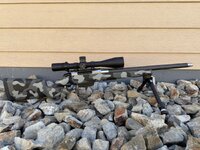
Well, Brushcreekbill I'm not sure about "too much gun." If i look at time from hit to death my one 223 example (bear) is as good as my bigger caliber. On the other hand...
I keep hearing the TMK is the bees knees, and maybe it is. I've only used it once. But the wound channel from the one kill was nothing to write home about and it stopped against the inside of the far shoulder (not just under the hide). That tells me it was running out of steam inside the bear not doing the "trampoline" thing against the hide (Form has pointed out, accurately I believe that a bullet often stops under the hide, regardless of how big the animal is because the hide stretches with the bullet).
I went back and looked at some pictures of grizzly, moose and black bear kills with a 6.5 Grendal, a 308 and a 358. In all cases, the entrance wound was bigger and there was usually an exit wound, and the depth of penetration through the animal was greater, i.e. either and exit wound or a bullet stuck right under the hide, not partway through a shoulder.
So to sum it it up. Time to incapacitation in a sample of 1, would say the 223 is dead equal with all my bigger guns. If we measure the wound channel's width and depth, I would say the 223 is a step down from bigger calibers. Does it matter? Well maybe, maybe not. Is there an animal in North America that I would NOT shoot with a 223 on a broadside shot? None, except Bison. Are there shots on a grizzly or moose I would take with my 358 that I would NOT take with a 223? At this point, YES, but I want more data. I'll try to shoot a few more things with the 223 to see how it goes.
Editing to add - My back up shot with my 308 didn't have spectacular penetration either, although the entrance wound was more impressive. It was a noticeably fatter bear then most we've shot in the spring. So its possible both bullets slowed down a good bit going through that inch of fat. I'd like get some 200 gr ELDX handloads going for my 308 just to have a bit more "insurance" in such situations vs the 168 ELDM. And I'm going to shoot a more typical sized bear with the 223 for more data. At this point though, I don't think I'd take the 223 on a moose hunt unless weight was a top priority. I could imagine shots I'd take with my 308 that I would not take with my 223.