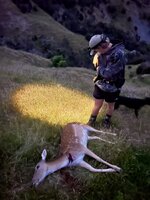
.223 for bear, mountain goat, deer, elk, and moose.

Lack of Authority should be taken seriously. I put badges on all my rounds so that they arrive with authority and animals don’t resist. It has affected my BC. But the seriousness of the authority makes up for that.
e38c49f5edb02f8d198c45f3bf00d182.jpg


4447e85bbf805cfd40eb74b42ecc5c0e.jpg
Don'tmakeablackbearjokedon'tmakeablackbearjokedon'tmakeablackbearjokedon'tmakeablackbearjoke......
 
Or should I get this one that is already threaded:

Is there any other difference between these rifles?
 
Or should I get this one that is already threaded:

Is there any other difference between these rifles?
Do you have a local Scheel's?

I've never bought a rifle from them, but just as a general rule I am a tiny bit reluctant to assume too much when buying online, if there's been a slight model change. If you google the current SKU number of certain rifles from certain makers, it's possible to end up looking at an older version of the same rifle and think you've found a deal when in reality you've found someone trying to move old stock with a different twist rate or unthreaded barrel.

Now, assuming you're getting a current SKU with the proper barrel length, twist, and threads, you'd be fine that way.

Honestly, buying the unthreaded one and having it threaded might be the easy button. It really depends on how certain you are of the rifle from Scheel's (it's easy if they are local to you and you can examine before purchase) and maybe how much your local guy charges for threading.

(And yes, I'd trust EuroOptic to sell me exactly what they advertised. Other online sellers, maybe a bit less so without some investigation before purchase)
 
The 2025 Lite has a bit of a bell at the muzzle and 5/8"-24 threads. The EuroOptic closeout is the old taper, which can be threaded 1/2"-28.
 
I've read most of this thread. It seems:
  • 0.223 is fun to shoot and easy to shoot. It can facilitate more practice. More practice can work to improve shooting skills and start to eliminate bad habits from larger cartridges
  • 0.223 with 77 grain TMK is quite deadly on elk and deer. But... there is often no significant exit wound or blood trail. Animals are usually dead within 50 to 75 yards.
  • Nearly all the necropsy pictures in the thread are for very good shot placement. This round is demonstrated to be very deadly for well placed shots.
I'm wondering about marginal shots...

I imagine that gut shots with the 0.223 TMK are just as deadly as other shots. They might even be more deadly due to the significant trauma caused by the little round. Bigger rounds might just pass through with less damage.

What about bone shots? If you hit the thick part of an elk shoulder blade or a deer knuckle, how does the little round perform?
 
I'm wondering about marginal shots...

I imagine that gut shots with the 0.223 TMK are just as deadly as other shots. They might even be more deadly due to the significant trauma caused by the little round. Bigger rounds might just pass through with less damage.

What about bone shots? If you hit the thick part of an elk shoulder blade or a deer knuckle, how does the little round perform?

Gut shots with any cartridge and bullet combination are generally lethal, eventually. But for quick, humane kills, as far as I know, there’s no shoulder-fired hunting cartridge and bullet combination that will overcome poor shot placement.

It’s been a while since I went through this thread, but I recall several pictures of .224 caliber bullets that punched right through the thickest bones in an elk or deer to reach the vitals.
 
I've read most of this thread. It seems:
  • 0.223 is fun to shoot and easy to shoot. It can facilitate more practice. More practice can work to improve shooting skills and start to eliminate bad habits from larger cartridges
  • 0.223 with 77 grain TMK is quite deadly on elk and deer. But... there is often no significant exit wound or blood trail. Animals are usually dead within 50 to 75 yards.
  • Nearly all the necropsy pictures in the thread are for very good shot placement. This round is demonstrated to be very deadly for well placed shots.
I'm wondering about marginal shots...

I imagine that gut shots with the 0.223 TMK are just as deadly as other shots. They might even be more deadly due to the significant trauma caused by the little round. Bigger rounds might just pass through with less damage.

What about bone shots? If you hit the thick part of an elk shoulder blade or a deer knuckle, how does the little round perform?
See my previous post on blood trails (last page). There's plenty of pictures of broken bones in here but I try to avoid them because it really makes a mess of the meat.
 
I've read most of this thread. It seems:
  • 0.223 is fun to shoot and easy to shoot. It can facilitate more practice. More practice can work to improve shooting skills and start to eliminate bad habits from larger cartridges
  • 0.223 with 77 grain TMK is quite deadly on elk and deer. But... there is often no significant exit wound or blood trail. Animals are usually dead within 50 to 75 yards.
  • Nearly all the necropsy pictures in the thread are for very good shot placement. This round is demonstrated to be very deadly for well placed shots.
I'm wondering about marginal shots...

I imagine that gut shots with the 0.223 TMK are just as deadly as other shots. They might even be more deadly due to the significant trauma caused by the little round. Bigger rounds might just pass through with less damage.

What about bone shots? If you hit the thick part of an elk shoulder blade or a deer knuckle, how does the little round perform?
There's a moose humerus and at least one elk humerus in this thread. And a lot of elk scapulas. I've put 73 ELDMs and 77 TMKs though a lot of deer (WT) bones without issue.
 
Back
Top