Sharing a few paragraphs I found interesting if others aren’t subscribers…
Across North America, bald eagle population growth rates are being suppressed by 3.8% because of lead exposure, according to a study published Thursday in the journal Science. Continentwide, golden eagles’ population growth, too, is being stunted by almost 1%.
“A lead fragment the size of a grain of rice is enough to kill an eagle,” said Krysten Schuler, a Cornell University wildlife disease ecologist who wasn’t involved in the new study, adding, “This is an anthropogenic source of mortality for eagles.”
The U.S.’s bald eagle population, which numbers around 316,000 in the Lower 48 states, is growing 10% annually, so the 4% growth rate suppression shown in the new study isn’t as concerning as the trend noted in golden eagle populations, according to Vince Slabe, a research wildlife biologist at Conservation Science Global, a New Jersey-based nonprofit, and co-author of the new study.
The researchers said there are roughly 36,000 golden eagles in the Lower 48 states.
After eagles ingest lead, acid in their stomachs breaks the neurotoxin down: The lead moves into the bloodstream, then into soft tissues like the liver and finally accumulates in the animals’ bones. Bone samples, collected from the femurs of dead eagles, can reveal chronic lead poisoning that recurs throughout an animal’s lifetime.
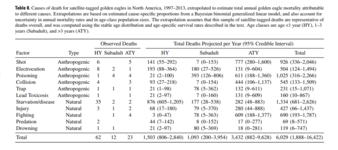
The study authors found that up to 33% of the bald eagles and up to 35% of the golden eagles they looked at showed signs of acute poisoning. Almost 50% of the 448 dead bald and golden eagles they sampled had bone lead concentra-tions above the threshold that veterinary pathologists classify as indicative of clinical poisoning.
The study authors found that up to 33% of the bald eagles and up to 35% of the golden eagles they looked at showed signs of acute poisoning. Almost 50% of the 448 dead bald and golden eagles they sampled had bone lead concentra-tions above the threshold that veterinary pathologists classify as indicative of clinical poisoning.
The study authors found that up to 33% of the bald eagles and up to 35% of the golden eagles they looked at showed signs of acute poisoning. Almost 50% of the 448 dead bald and golden eagles they sampled had bone lead concentra-tions above the threshold that veterinary pathologists classify as indicative of clinical poisoning.
Copper ammunition is more expensive than lead, Mr. Oliva said, adding that if hunters have concerns, they can also bury gut piles or field-dress animals out of the woods.


 www.wsj.com