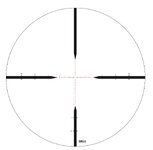
You've used the word killing a lot with regards to this scope and I just want to make sure I understand why you're being so specific with that term. My take is (please correct if wrong) that the thicker/closer posts and lack of an xmas tree limit the utility for big holdover or holdover+ wind one might find in a "competition" scope (designed for "hitting"), but make it better for hunting (my word choice) due to it's low-zoom low-light prowess. And the intuitive wind brackets and aim short/long dots are meant to work with quickdrop and wind number methods favored by hunters. But I'm saying hunting, and you're saying killing, so can you elaborate a bit on if there's something I'm missing or getting wrong?
You are correct, it is purposeful.
Without writing a dissertation about it:
Most reticles are made because they are pleasing to look at- symmetrical, even; and or because that is what is common and has always been done. The rest are made for how people “think” they might shoot one day at targets- not for how they actually shoot.
Neither of those reasons is “what helps kill living, moving animals in all light and terrain” the best.
The original THLR, and I would say as much or maybe more, this simplified version- is designed/optimized for drawing your eye to what’s important for shooting living things.
@THLR has written quite a bit about the “why” behind most of the reticles design- and that “this feature helps support this thing”, or “this helps support that”, etc. I will go farther than that: the reticle doesn’t just help support- it
drives your eye and brain to what you need to be looking at in use- and it does so generally intuitively. It starts thick on the outside and gets thinner as you get to the center- it draws your eye in. The fine .2 mil ticks are
small, the .5 marks are slightly thicker, the 1 mil marks are even thicker. The box and solid wind bracket line tell you subconsciously so much about your acceptable wind error, and target size error. And it does it without hearing about it beforehand.
It’s hard to explain in text- I have killed a lot of animals for something more akin to professional culling than hunting with a lot of reticles, and in a lot of diverse environments. This reticle is the only one that continually shows that it was made for helping kill animals as a specific intent, and not for shooting plates on a range. Several people have used the scopes on animals in the last few weeks- almost all have said something akin to “it seemed a bit different and busy looking at it inside. After shooting animals with it- that the best/most intuitive reticle I have ever used”.