I should have clarified in my original post that Litz and the Hornady guys were talking about sighting in so when you feed the info. into whatever ballistic program you use it’s precise as possible for hunting situations. I figure if those guys are saying it makes a difference then it can’t hurt to pull a tape and follow what they recommend. Probably would have slowed some of the BS in this thread, even though its entertaining.I once saw a YT video of Bryan Litz with three laser range finders and a surveyors chain measuring roughly 100 yd distance to target.
I'm not Bryan Litz. You're not Bryan Litz. Bryan Litz is gathering scientific data and designing bullets.
I am practicing shooting for the sport of hunting. Whatever my LRF measures from my body to target is the same relative measurement it will provide in the field, within reason.
I am not trying to do the same thing as Bryan Litz. Are you trying to practice for hunting or are you doing what Bryan Litz is trying to do?

Navigation
Install the app
How to install the app on iOS
Follow along with the video below to see how to install our site as a web app on your home screen.
Note: This feature may not be available in some browsers.
More options
Style variation
You are using an out of date browser. It may not display this or other websites correctly.
You should upgrade or use an alternative browser.
You should upgrade or use an alternative browser.
Turrets or end of barrel for sight in?
- Thread starter kickemall
- Start date

ColPenguin
Lil-Rokslider
I don't think you need to pull a tape to measure exact distance. If you have a LRF, or pace it off, then you can build a profile.I should have clarified in my original post that Litz and the Hornady guys were talking about sighting in so when you feed the info. into whatever ballistic program you use it’s precise as possible for hunting situations. I figure if those guys are saying it makes a difference then it can’t hurt to pull a tape and follow what they recommend. Probably would have slowed some of the BS in this thread, even though its entertaining.
You are creating an external ballistics profile. The bullet is being cast from your muzzle, not your turret or reticle. The exit velocity is measured from your muzzle not your turret, so the muzzle is where the measurement begins. Your barrel length is factored into the external ballistics simulation as one of the inputs.
You're sweating extra stuff that doesn't matter. Maybe it matters, more from their perspective, because they are trying to gather the most consistent data about their products and design.
If your data doesn't true up at longer distance you'll have to adjust one of either MV or BC to match the profile to reality. You aren't going to fudge things up from a 1/2 yard discrepancy.
I should have clarified in my original post that Litz and the Hornady guys were talking about sighting in so when you feed the info. into whatever ballistic program you use it’s precise as possible for hunting situations. I figure if those guys are saying it makes a difference then it can’t hurt to pull a tape and follow what they recommend. Probably would have slowed some of the BS in this thread, even though its entertaining.
You can just plug this into your calculator and find out on your own.
For the load on my calculator right now, 500 yards is 57.85" of drop (3.2 mils). A 98 yard zero is 57.95" of drop (3.2 mils), a 102 yard zero is 57.74" (3.2 mils). So 0.1" of difference at 500 yards.
At 700 yards, it's 145.27" for a 100 yard zero, 145.42" for a 98 yard zero, and 145.12" for a 102 yard zero. Again, it's 0.15" at 700 yards. That is less than you can adjust out even when zeroing at 100 yards (it's under the .25MOA/0.1MIL adjustment of your scope).
It is completely inconsequential, and you can even play with numbers 5, 10, and 15 yds off on your zero range and see what happens. It just might surprise you.
You can just plug this into your calculator and find out on your own.
For the load on my calculator right now, 500 yards is 57.85" of drop (3.2 mils). A 98 yard zero is 57.95" of drop (3.2 mils), a 102 yard zero is 57.74" (3.2 mils). So 0.1" of difference at 500 yards.
At 700 yards, it's 145.27" for a 100 yard zero, 145.42" for a 98 yard zero, and 145.12" for a 102 yard zero. Again, it's 0.15" at 700 yards. That is less than you can adjust out even when zeroing at 100 yards (it's under the .25MOA/0.1MIL adjustment of your scope).
It is completely inconsequential, and you can even play with numbers 5, 10, and 15 yds off on your zero range and see what happens. It just might surprise you.
Maybe that is why some target scopes have 1/8 MOA clicks. Now you can dial that 0.15 (or closer at 0.125 anyway). Mystery solved!
Sent from my iPhone using Tapatalk

EastHumboldt
WKR
- Joined
- Nov 14, 2020
- Messages
- 2,002
I hate it when I miss by a tenth of an inch at 500 yards. Ruins my day.

So do you have to sit on your scope when lazing to get the distance reading? 
I hate it when I miss by a tenth of an inch at 500 yards. Ruins my day.
It’s exactly why .325 bores and up will always be better than .223. That’s where they really shine! You get an extra .1 to work with. Well, I guess only .05 since you’re only missing in one direction from center. Hmmm maybe 45-70 is always the answer.
Sent from my iPhone using Tapatalk
So do you have to sit on your scope when lazing to get the distance reading?

Range, clench, rotate to dial?
Sent from my iPhone using Tapatalk
The wife gonna get suspicious about my sudden increase in range time!Range, clench, rotate to dial?
Sent from my iPhone using Tapatalk
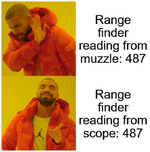
How do you guys account for moon position?
@OP if this isnt trolling, you have to be a truly exceptional shooter with a truly exceptional rifle with exceptionally consistent ammo for it to matter. And even then you would have to control a nearly endless list of other variables to be able to measure the difference.
@OP if this isnt trolling, you have to be a truly exceptional shooter with a truly exceptional rifle with exceptionally consistent ammo for it to matter. And even then you would have to control a nearly endless list of other variables to be able to measure the difference.
I get that and all the other similar comments. I was just repeating two, what I consider reliable sources, said to do. I figure that anything as simple as taping a distance for sight in, and could possibly improve accuracy at distance, is worth doing.How do you guys account for moon position?
@OP if this isnt trolling, you have to be a truly exceptional shooter with a truly exceptional rifle with exceptionally consistent ammo for it to matter. And even then you would have to control a nearly endless list of other variables to be able to measure the difference.
well as Rancher pointed out above, a 4yd spread in zeroing distance results in ~.3" spread in drop @500.I get that and all the other similar comments. I was just repeating two, what I consider reliable sources, said to do. I figure that anything as simple as taping a distance for sight in, and could possibly improve accuracy at distance, is worth doing.
So while I am a believer in controlling what you can control, you wouldnt realistically be able to measure the difference between the muzzle and the turrets.
My conclusion is pick one, always do that, and dont think about it anymore.

Wait until she catches you doing anal kegel exercises in the garage.The wife gonna get suspicious about my sudden increase in range time!
You've got to strengthen that keister if want to spin turrets.
Sent from my SM-S931U using Tapatalk
Dave Thomas
WKR
- Joined
- Aug 30, 2024
- Messages
- 436
And who are the people that say a bigger bullet can't make up for a bad shot?It’s exactly why .325 bores and up will always be better than .223. That’s where they really shine! You get an extra .1 to work with. Well, I guess only .05 since you’re only missing in one direction from center. Hmmm maybe 45-70 is always the answer.
Sent from my iPhone using Tapatalk

Wait until she catches you doing anal kegel exercises in the garage.
You've got to strengthen that keister if want to spin turrets.
Sent from my SM-S931U using Tapatalk
As if we needed another reason to dislike the giant SWFA turrets.

Tobe_B
WKR
I bet you guys eat your hotdogs sideways…
I bet you guys eat your hotdogs sideways…
That's offensive.
I eat them for the shape.
Similar threads

- Replies
- 22
- Views
- 2K


Featured Video
Latest Articles
- Topo Topper Rincon Review
- Tony Trietch on Big Mule Deer, Desert Bulls & Western Hunting Evolution
- The Right to Hunt & Fish Colorado (and North America)
- Mastering New Zealand’s Mountain Hunts: Challenges and Rewards
- Iron Will Turkey Broadhead Review
- Nevada Mule Deer & The Trade-Offs in Wildlife Management
- Spartan SpringBok Bipod Review
- All About Pronghorn & Hunting Big Ones with Chance Marshall
- Bill Vanderheyden Debunks Myths About Long-Distance Accuracy
- What Do Elk Eat? Elk Nutrition, Habitat, and Finding More Elk with Luke Schultz