The Welfare Cattle Empire That Controls Your Public Lands: article

The 1.6% used in the article and the less than 3% used above are misleading at best. Notice that they are using the amount of forage provided by public land and not the number of cow that use public land. The public land forage is just one link in the supply chain that is needed to get a calf to the stake on the plate. Remove that link and the whole supply chain breaks down.
General this is how a public land rancher operates.
Bring the cattle home in the fall off the public.
Sell or wean the calves.
Winter the cows on hay you made or bought.
Calve the cows in March, April.
Return cows to the Public range in late May or June.
When you sell the calves in the fall they are still a long way from the plate. There are several options on where they are headed
Straight to the feed lot where they are finished and slaughtered or put on a backgrounding ration and then put back on grass during summer and then they are back to the feedlot in late summer to be finished.
or they go to someone with winter pasture like winter wheat or corn stalks and then go to the feed lot to be finished.
Point is that wile the public forage is only small part of the forage needed to get the public land ranchers cattle to the plate, without it the cow does not exist. The people touting the less than 3% number act like you can just replace the public forage with the other forage sources easily. The rancher is not going to be able to switch to graze his hay fields with out a substantial cut in cow numbers. The wheat farmer in Kansas or the corn farmer in Iowa are not going to switch to growing grass. Numbers on the actual number of cattle on Public is hard to find, but eliminating public grazing would likely result in a reduction in the cow herd between 10 and 15 percent.
The less than 3% number is misleading at best and if the authors of the article are misleading you here they are likely miss leading you else where.
This was the first thing that caught my eye as well. Very misleading number. You broke it down well.
 
AHayes, did they have you count the Blades of Grass in a square inch? and then move over foot or so and count the blades in another square. And then submit a report so that you can document the status of the Grazing? And yes, that is a 100% true example of a Forest Service Allotment grazing requirement.
True story. When my brother was a little boy, (he is 58 now) he and my grandfather had to stop in at the forest service office. My grandfather was talking with the range personal and my brother was growing impatient. Finally he can't take it any more and blurts out " grampa are we going to be here all day, when are we going to go out and count the grass".
 

Seemingly no
Before Bundy Arizona had the Klump’s. The Klump’s lost the battle. There wasn’t much sympathy for the Klump’s around here. They routinely ran the public off public land they had leases on. They acted like they owned all of it. They were an example of a bad rancher IMO.

https://www.eenews.net/articles/meet-the-klumps-blms-pre-bundy-roundup-nightmare/
 
Im curious - what do you think the percentage of "responsible" management occurs - especially in a dry year?

What happens to the irresponsible operators?

Oh im certain you’ll disagree, but I think the majority of it is handled responsibly.

I spend a lot of time on state and federal land all over the place and it usually is no better or worse than the private stuff adjacent.

Is there abuse? Sure there is. And it should be dealt with when it arises, fines/restitution, loss of lease, etc. But that’s kind of a different topic.
 
Oh im certain you’ll disagree, but I think the majority of it is handled responsibly.

I spend a lot of time on state and federal land all over the place and it usually is no better or worse than the private stuff adjacent.

Is there abuse? Sure there is. And it should be dealt with when it arises, fines/restitution, loss of lease, etc. But that’s kind of a different topic.
I dont disagree with that at all actually.
 
Who would own the FS and BLM land if our government had not set it aside for timber production (FS) and grazing (BLM)? Does any one think the government would set aside millions of acres just for public recreation?
 
Who would own the FS and BLM land if our government had not set it aside for timber production (FS) and grazing (BLM)? Does any one think the government would set aside millions of acres just for public recreation?
The government didn't actually set BLM aside for grazing. This is how we got most of the BLM there is today. In the 1860's the government passed the homestead act. At this time just about everything west of the Mississippi was goverment land. This allowed people to lay claim to 160 acres of government land. The goverment requied you to prove up on the land. (make some improvments). When you were able to prove up on the land the goverment deeded the land to you and it became yours. Over the years the homestead act was ameneded several times to increase the amount of land. Of course the people doing the homesteading would clain the most productive land that was still avalable. When the homestead act was discontinued in I think the 1930's in the lower 48 the land that people were unable to prove up on or was so poor in quality that it was never claimed became the BLM we have today.
 
The government didn't actually set BLM aside for grazing. This is how we got most of the BLM there is today. In the 1860's the government passed the homestead act. At this time just about everything west of the Mississippi was goverment land. This allowed people to lay claim to 160 acres of government land. The goverment requied you to prove up on the land. (make some improvments). When you were able to prove up on the land the goverment deeded the land to you and it became yours. Over the years the homestead act was ameneded several times to increase the amount of land. Of course the people doing the homesteading would clain the most productive land that was still avalable. When the homestead act was discontinued in I think the 1930's in the lower 48 the land that people were unable to prove up on or was so poor in quality that it was never claimed became the BLM we have today.
This was my general understanding of the situation but I did go to Idaho public schools. It could definitely be socialist propaganda.
 
Thanks for this very informative comment. I've got a question about fencing leased BLM or NF land. Can you enclose leased land with a fence and if so, can public access be prohibited? I have not seen this in Idaho, but I have seen BLM fence lines near canyon rims (not enclosed or marked but on BLM land with classic BLM fence design).
A fence has nothing to do with if you can access the public or not. The only way a landowner can deny the public access is if the public has to set foot on the landowners private land and even then the public can fly in, but it is currently expensive
I have seen a few landowners with more money than sense build fences to try to keep elk from going on Public land, but they can not deny you access if there is a legal way. (easement, public road or navigable water way)
Fences may or may not be on the line when it comes to Public land. If I was to see a buck that was on the wrong side of the fence but still on public, I am shooting. In the past people were not concerned if the fence was right on the line. People built the fence where it was the most convenient and the cheapest to put the fence. Now days if you are fencing on the public boundary or using government assistance to build the fence you are required to fence on the line in most instances. I can see the reasoning behind this, but it also can really jack up the cost.
 
Every time I find cattle on public in mule deer county I refuse to hunt it, the mule deer imo do not tolerate them nearly as good as whitetails and the numbers are drastically lower compared to when the cows ain’t there.

You'd be hard-pressed to find any mule deer zone in Nevada that doesn't have cattle run on it at different times of the year. They're only a problem in some places in damaging water embankments, turning them into mudholes. The biggest problem out here is actually feral horses people in other states romanticize as "wild mustangs". They devastate mule deer habitat, and magically multiply every time there's an economic downturn, and people can't afford their hay.

Given that, I would rather that there was no cattle grazing on marginal public land. I’d like to see that marginal public land used as public recreation land for hiking, fishing, hunting, etc.

Please keep in mind that in talking Nevada, Utah, and a couple of other Great Basin states especially, you're literally looking at north of 80% of the land being "public", government-controlled, government owned land.

I don't think it's in the long-term interest of our national character, economy, or culture of being a free-market, rule-of-law democratic republic to lock up entire states as parks. Conservation is not about keeping things untouched by humanity - it's about managing and stewarding national resources for ourselves and future generations.

The more we sequester "public" lands into national-park status, to be untouched by human hands, the worse off our liberties will be in just about every way - it's just one angle that's already being hit hard as part of a larger effort to those ends. This is very much why anything related to the Agenda 2030 efforts is trying to do just that.


A large expanse of open range bison is still a nice fantasy…

I'm glad you're noting that aspect of this. And, I agree. Some of the bigger Rez governments in the West are doing experiments with it, to varying degrees of success - mainly in places that are vast and were never developed for ag or anything else, with little to no private land ownership or industry. Just Rez communism, in the literal, pre-Marx tribal nature of communal ownership.

I hope you can also consider what I wrote above, especially in terms of Great Basin realities, not just the broader West. Ranchers out here make a living just fine if they're left alone - in some of the most worthless and indescribably remote land in the US, where mining is the only other viable public-resource use.

It's difficult to explain just how remote most of the Great Basin's cattle ranches are - we're talking an hour or two from already desolate, remote paved roads in many cases, just to get to the main ranch house, and multiple hours of lava-scree two-track to get out to different grazing areas. The economics aren't as good as wetter, grassier, friendlier terrain, but our ranchers can make a living if left alone. We're not talking Yellowstone ranching here - think hardscrabble desert life, with most of the homes being mobile homes, 90yo cinderblock structures, or in a few places with water and bottomland for growing alfalfa, a two or three bedroom stick-built home from the 1920s. But, they're also producing some of the best free-range, grass-fed, non-feedlot cattle in the US.

 
Let's kick all the cows off public lands, turn out a bunch of shitty buffalo, and while we're at it give all the land back to the Indians.

The whole rewilding scam is just that, a scam.

There’s room for both rewilding in some places and cattle.

Bison are awesome and if they have enough room are much better for the ecosystem than cattle, horses, or sheep.
 
I hear cattlemen talk about how poor the BLM/FS leases are all the time to justify the extremely low lease rates. So why are we grazing there !? It’s a myth that grazing these areas reduces potential of, and/or intensity of wildfire so there’s no benefit for the non-ranching public either. Seems like a poor use of a shared resource 🤷‍♂️
The short answer is because at low rate there is still a little money to be made at the low rate for most public allotments. Another poster stated that there are quite a few allotments that are abandoned. There could be several reasons for the allotments are not used, but the number one reason it that they are not used is that there is no money to be made even at the low grazing rate. Truth is that all allotments have a break even threshold and it is different for every allotment. For some allotments the break even rate is less than what is currently charged, others break even may be close to what is charged on private land. The only way to find break even on all of the allotments is to put them out for bid, but as I outlined in a previous post there are some serious issues with putting grazing allotments out for bid. Almost none of the BLM allotments are worth as much as private, look at my post on the homestead act and the BLM. If the BLM grazing allotment was more productive than the near by private land, the homesteaders would have claimed the BLM instead of the now private land they did claim.
You can not be serious about the fire claim. Have you ever been on a fire in range land, I have been to over a 100 ranging is size from a few square yards to nearly 200 thousand acres. The more grass the more intense the fire and the harder it is to put out. I have first hand experince with this many times. Range land that has been grazed always burns with less intensity that range land that is ungrazed. A fire needs three things to burn. Heat, oxygen and fuel. Remove one of the three and the fire goes out. Reduce any one of the three and the fire burns with less intencity. Grass is fuel. To think that redusing the amout of grass does not reduse the intencity of the fire is illogical.
 
The short answer is because at low rate there is still a little money to be made at the low rate for most public allotments. Another poster stated that there are quite a few allotments that are abandoned. There could be several reasons for the allotments are not used, but the number one reason it that they are not used is that there is no money to be made even at the low grazing rate. Truth is that all allotments have a break even threshold and it is different for every allotment. For some allotments the break even rate is less than what is currently charged, others break even may be close to what is charged on private land. The only way to find break even on all of the allotments is to put them out for bid, but as I outlined in a previous post there are some serious issues with putting grazing allotments out for bid. Almost none of the BLM allotments are worth as much as private, look at my post on the homestead act and the BLM. If the BLM grazing allotment was more productive than the near by private land, the homesteaders would have claimed the BLM instead of the now private land they did claim.
You can not be serious about the fire claim. Have you ever been on a fire in range land, I have been to over a 100 ranging is size from a few square yards to nearly 200 thousand acres. The more grass the more intense the fire and the harder it is to put out. I have first hand experince with this many times. Range land that has been grazed always burns with less intensity that range land that is ungrazed. A fire needs three things to burn. Heat, oxygen and fuel. Remove one of the three and the fire goes out. Reduce any one of the three and the fire burns with less intencity. Grass is fuel. To think that redusing the amout of grass does not reduse the intencity of the fire is illogical.
Keep in mind, my comments are based on my experience with grazing in the mostly arid, western states. I understand the history of homesteading and the way it shaped grazing and land ownership through history . That’s why I’m saying, why keep grazing very marginal ground ? If it was worth grazing, it would’ve been homesteaded or bought up at some point. Grazing marginal ground has multiple problems. It’s risky for the ranchers, takes forage from wildlife that may already be living on the edge of survival , etc. Just saying, it doesn’t seem to be the “ best, highest use” of the land.

As far as my comment about the fire risk reduction: you’re right that it can help reduce fuels on rangeland ( although there is the issue with grazing promoting the spread of cheatgrass and potentially increasing potential for fire and/or the burn rate).

When I said that it’s a myth that grazing prevents fires, I was speaking more about forest fires, for which grazing does very little to nothing to prevent or reduce the intensity of these fires. Grazing doesn’t reduce the woody fuels that exist in the forest. Grazing the grasses and understory just isn’t enough unless maybe if it’s strategically, intentionally overgrazed to create a fire break of some kind in a targeted area...
 
Keep in mind, my comments are based on my experience with grazing in the mostly arid, western states. I understand the history of homesteading and the way it shaped grazing and land ownership through history . That’s why I’m saying, why keep grazing very marginal ground ? If it was worth grazing, it would’ve been homesteaded or bought up at some point. Grazing marginal ground has multiple problems. It’s risky for the ranchers, takes forage from wildlife that may already be living on the edge of survival , etc. Just saying, it doesn’t seem to be the “ best, highest use” of the land.

As far as my comment about the fire risk reduction: you’re right that it can help reduce fuels on rangeland ( although there is the issue with grazing promoting the spread of cheatgrass and potentially increasing potential for fire and/or the burn rate).

When I said that it’s a myth that grazing prevents fires, I was speaking more about forest fires, for which grazing does very little to nothing to prevent or reduce the intensity of these fires. Grazing doesn’t reduce the woody fuels that exist in the forest. Grazing the grasses and understory just isn’t enough unless maybe if it’s strategically, intentionally overgrazed to create a fire break of some kind in a targeted area...
I encourage you to read what happened on the Wall Creek game range when MT FWP eliminated cattle grazing if you think that cattle grazing takes forage from wildlife.
 
Dude,
I hate mega rich people who are corrupt , read greedy, who’s main purpose is to cheat the system.
Not all mega rich people are dishonest and greedy. The ones I have distain for are the ones I know first hand , who use their money entirely to manipulate the government systems. These mega rich land owners are not concerned about anyone or anything outside of their empire building , and creating wealth through means that intentionally cheat the system . These people have hired staff and power attorneys on their staffs whose only jobs are to manipulate our tax systems for their own gain.
I don’t know your back ground. So here’s a few questions. Does your accountant, if you have one, use the tax code to make you pay less taxes? Do you own a business and use tax write offs? Do you use your children or wife as dependents when you file taxes? Do you get a tax return? If you answer yes on any of these what’s the difference between you and these billionaires? These things are all in some way a manipulation of our tax system. People with lots of money pay lots of taxes whether it be income taxes or payroll taxes or property taxes or sales tax.
 
I encourage you to read what happened on the Wall Creek game range when MT FWP eliminated cattle grazing if you think that cattle grazing takes forage from wildlife.
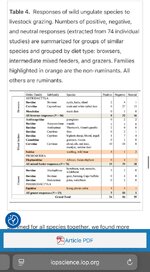
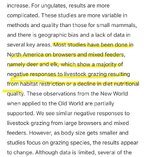
Grazing impacts are hard to study and vary drastically from area to area. You can easily point out examples of positive impact from grazing and I can just as easily point out studies that show a negative impact. It’s an extremely complex situation. The examples from below are from a meta-analysis of many studies and the overall impacts to ungulates are negative…


IMG_0305.jpeg

IMG_0306.jpeg
 
I just want to say that the bulk of this thread has trended towards more civility and honest discussion than I expected for such a politically charged topic.

Carry on. :)
 
Grazing impacts are hard to study and vary drastically from area to area. You can easily point out examples of positive impact from grazing and I can just as easily point out studies that show a negative impact. It’s an extremely complex situation. The examples from below are from a meta-analysis of many studies and the overall impacts to ungulates are negative…


View attachment 1084882

View attachment 1084883
Studies also overwhelmingly conclude that grass that is not grazed becomes unpalatable and produces less forage.
Cattle grazing on public land has been reduced all over the west. It has not lead to more game on the public. If anything there is less game now than thirty years ago.
Near me the Custer has cut 10,000 AUMs in the last 30 years. The range has never looked better, the mule deer herd is as bad as I have ever seen it.
 
Back
Top