Stuck on Quick Drop

the target is in MOA I assume because it's close to 1 inch increments which makes sense to people and is easy to measure.

unless I missed your point, my point was human error will possibly double (or more) a math error.

if the math error equates to 5.5" inches at 550yds, (1 Moa for the parallel) a 2 MOA shooter is at 11" with no other error like wind introduced.
So, random error is part of the system (shooting, rifle, ammo, optic, position) dispersion. None random error shifts the entire cone of fire.

So, a 0.5 mil system at 300 yards will hit a 10 inch target (cone is 5.4 inches at that distance).

You shift the entire point of aim by 0.3 mils and now when you think you are aiming at the center you are actually aiming 3.25 inches closer to the edge, but will still have an ok hit rate as the edge of the 5.4 inch cone only overlaps the edge of the target by 0.9 inches. (17%). (Edit: 15% by area if target is also a circle).

Take that 10 inch target to 500 yards and it is still large enough to contain the entire cone of 9 inches, but start aiming 0.3 mils (5.4 inches) off center and now 4.9 inches (54%) is not over the target. (Edit: 88% by area if target is also a circle).

On the 500 yard example above. If your error is 0.2 mils, you shift your 9 inch cone over 3.6 inches and 3.1 inches of it is off target (34%). (Edit: 58% by area if target is also a circle).

Your angular error compounds over distance, and thus an acceptable angular error in POI at 300 yards is not an acceptable angular error at 500 yards.
 
So, random error is part of the system (shooting, rifle, ammo, optic, position) dispersion. None random error shifts the entire cone of fire.

Edit: Fumble fingered and hit post before finished typing.

So, a 0.5 mil system at 300 yards will hit a 10 inch target (cone is 5.4 inches at that distance).

You shift the entire point of aim by 0.3 mils and now when you think you are aiming at the center you are actually aiming 3.25 inches closer to the edge, but will still have an ok hit rate as the edge of the 5.4 inch cone only overlaps the edge of the target by 0.9 inches. (17%).

Take that 10 inch target to 500 yards and it is still large enough to contain the entire cone of 9 inches, but start aiming 0.3 mils (5.4 inches) off center and now 4.9 inches (54%) is not over the target.

On the 500 yard example above. If your error is 0.2 mils, you shift your 9 inch cone over 3.6 inches hand 3.1 inches of it is off target (34%).

Your angular error compounds over distance, and thus an acceptable angular error in POI at 300 yards is not an acceptable angular error at 500 yards.
great in depth explanation
 
View attachment 979145

14.5" 243
108's @ 2710
avg gun QD(5000 DA)
38.5" end to end

avg gun Quick drop is range minus 2 (move the decimal but that becomes automatic, I mention it so people understand it)

400yds becomes 4.00
4-2 =2 Mil

600yds -2 =4Mil

742yds -2 =5.4 Mils

it's super easy to remember and convert. You can range it and do the math while you reach for the turret.
it also works across platforms and calibers, less to remember.

I have a limited hard drive. the less I have to remember, the better.

QD has a range of velocity and BC it works in. Above or below that, the quick answer is electronic solutions or a drop card.

Do you account for AJ and different DA’s when using range and QD to get your firing solution? I think QD is a good solution for humanoid targets under time stress. Your solution at 600 yards is off .2 mils under those circumstances. That’s 4” of error just from data. I don’t like dope giving me that much error when I have so many other stacking variables in the field already. If you add in a 7-10 mph right wind that becomes 6” of error, fairly significant amount.
 
Do you account for AJ and different DA’s when using range and QD to get your firing solution? I think QD is a good solution for humanoid targets under time stress. Your solution at 600 yards is off .2 mils under those circumstances. That’s 4” of error just from data. I don’t like dope giving me that much error when I have so many other stacking variables in the field already. If you add in a 7-10 mph right wind that becomes 6” of error, fairly significant amount.
my data shows .1 mil off QD at 600, but I have not trued or proven this one yet.
The data says it hits 1800 fps @ 680 yds, but my intent for this rifle is a 0-600 gun for game.
I haven't played with 6mm's starting this slow at longer ranges so I don't know what to expect past about 700.
 
So, random error is part of the system (shooting, rifle, ammo, optic, position) dispersion. None random error shifts the entire cone of fire.

Edit: Fumble fingered and hit post before finished typing.

So, a 0.5 mil system at 300 yards will hit a 10 inch target (cone is 5.4 inches at that distance).

You shift the entire point of aim by 0.3 mils and now when you think you are aiming at the center you are actually aiming 3.25 inches closer to the edge, but will still have an ok hit rate as the edge of the 5.4 inch cone only overlaps the edge of the target by 0.9 inches. (17%). (Edit: 15% by area if target is also a circle).

Take that 10 inch target to 500 yards and it is still large enough to contain the entire cone of 9 inches, but start aiming 0.3 mils (5.4 inches) off center and now 4.9 inches (54%) is not over the target. (Edit: 88% by area if target is also a circle).

On the 500 yard example above. If your error is 0.2 mils, you shift your 9 inch cone over 3.6 inches and 3.1 inches of it is off target (34%). (Edit: 58% by area if target is also a circle).

Your angular error compounds over distance, and thus an acceptable angular error in POI at 300 yards is not an acceptable angular error at 500 yards.

I updated to percentages using area. The original percentage calculation was just based on diameter, which over represents small lunes and under represents large ones. Different target shapes would give different percentages.
 
Do you account for AJ and different DA’s when using range and QD to get your firing solution? I think QD is a good solution for humanoid targets under time stress. Your solution at 600 yards is off .2 mils under those circumstances. That’s 4” of error just from data. I don’t like dope giving me that much error when I have so many other stacking variables in the field already. If you add in a 7-10 mph right wind that becomes 6” of error, fairly significant amount.
to answer the first part, yes, the current DA has to be used.

No, I don't worry about AJ inside 800. it's an insignificant source of error compared to the dispersion of the rifle and my ability to call wind.
 
The title of the fn thread had “quick drop” in it. What the hell did you think we were using to get ballistic solutions? Then you post a link to quick drop being explained. All you do is troll every thread made on here and regurgitate information you heard second hand.. then reaffirm you own question with said secondhand regurgitated information that you have no clue the mechanics or case use of. Instead of spending all your time regurgitating information maybe you should take you 25-06 out and actually learn something and experience failure points so you can actually contribute.
He’s asking you to explain the process while you just want to belittle him.


@Q_Sertorius read this if you haven’t already. It explains it since these guys won’t


This is the first I have heard of QD and it seems awesome. For those of you using it for hunting are you tailoring your rifle so it works? For those that are, do you hunt at a very similar DA? I’m new to a lot of this ballistic stuff and took my first long range shooting class this year so forgive me if it’s a dumb question.

What about on backpack hunts when through the hunt your elevation could change 5,000’ and 40 degrees? I do a hunt every other year where we start hiking at 1500’ and 70 degrees and then at times we will be at 7k and it’ll be snowing. How much effect would these variables have on QD and it being usable?
 
read this if you haven’t already. It explains it since these guys won't.
I didn't want to go on a pointless monolog since the link to one example was posted.
I don’t understand why someone would change the load or barrel length to align with some system. Why not just keep your dope on your rifle? What am I missing here?
The whole point of QD is QUICK, EASY math when you dont have time to do all the things like pull out a phone or maybe even check a range card. range, math in your head as you reach for the dial, dial it, shoot.

If you have all day then QD isn't necessary but it still saves effort in a lot of cases.

It really shines in a time crunch but it's not less useful with more time.

Another major benefit is its universal. it works across platforms and calibers. If my partner and I are shooting the same QD gun, I know his drop data and he knows mine when calling corrections.
Or if I have to use his gun, I know his data just from him telling me his QD factor.

higher BC bullets can start slower and carry that efficiency out far enough to be effective further than most people can or should shoot.

If the bullet doesn't need to start at 3300 fps, you can down load the cartridge or use a shorter barrel to start with less velocity.
I choose short barrel so I can add a suppressor and not have to carry a 4 foot long rifle, did that for too long.

If FAST and high BC is your thing, QD isn't for you and that's fine.

We really need a high quality video detailing QD with maybe some shooting to illustrate how it's used and when it is most beneficial.

Q and anyone else that's curious, If you true your data, QD is no more an estimation than truing your data and making a drop card for the purpose of hitting a relatively large target, 10"-16" kill zone.

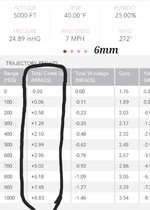
Screenshot_20251206_184554.jpg
This is the data for the short 243 I'll be starting with and truing.
as you can see, from 400-700, range minus 2 is within .1 Mil of a whole number like 700yds -2 = 5Mil come up.
even at 300yds, .29 is still well within the intended target of 10" on the small side.


Yes, this is technically an "estimation", but .1 Mil is within the acceptable margin for error given the target size. A bad wind call is far more likely to cause a miss than a .1 Mil error inside 700 yds. and the dispersion of the rifle will still put you on either side of that.

If the discrepancy is linear, you can add a correction factor, say +.2 or -.2

The argument can be made for "precision" or bad data, error stacking etc, but it flat works. If it didn't, I wouldn't use it. Like anything, you have to understand the limitations.


It REALLY needs to be taught and done in person to fully grasp it. Typing it out and reading it are vastly different than having it explained, then demonstrated, then experienced first hand.
 
This is the first I have heard of QD and it seems awesome. For those of you using it for hunting are you tailoring your rifle so it works? For those that are, do you hunt at a very similar DA? I’m new to a lot of this ballistic stuff and took my first long range shooting class this year so forgive me if it’s a dumb question.

What about on backpack hunts when through the hunt your elevation could change 5,000’ and 40 degrees? I do a hunt every other year where we start hiking at 1500’ and 70 degrees and then at times we will be at 7k and it’ll be snowing. How much effect would these variables have on QD and it being usable?
yes, you have to know your approximate DA. You may have to add a correction factor to make it line up.

yes, quite a few guys are choosing cartridge/ bullet/barrel length to line up with QD.
 
I didn't want to go on a pointless monolog since the link to one example was posted.

The whole point of QD is QUICK, EASY math when you dont have time to do all the things like pull out a phone or maybe even check a range card. range, math in your head as you reach for the dial, dial it, shoot.

If you have all day then QD isn't necessary but it still saves effort in a lot of cases.

It really shines in a time crunch but it's not less useful with more time.

Another major benefit is its universal. it works across platforms and calibers. If my partner and I are shooting the same QD gun, I know his drop data and he knows mine when calling corrections.
Or if I have to use his gun, I know his data just from him telling me his QD factor.

higher BC bullets can start slower and carry that efficiency out far enough to be effective further than most people can or should shoot.

If the bullet doesn't need to start at 3300 fps, you can down load the cartridge or use a shorter barrel to start with less velocity.
I choose short barrel so I can add a suppressor and not have to carry a 4 foot long rifle, did that for too long.

If FAST and high BC is your thing, QD isn't for you and that's fine.

We really need a high quality video detailing QD with maybe some shooting to illustrate how it's used and when it is most beneficial.

Q and anyone else that's curious, If you true your data, QD is no more an estimation than truing your data and making a drop card for the purpose of hitting a relatively large target, 10"-16" kill zone.

View attachment 980429
This is the data for the short 243 I'll be starting with and truing.
as you can see, from 400-700, range minus 2 is within .1 Mil of a whole number like 700yds -2 = 5Mil come up.
even at 300yds, .29 is still well within the intended target of 10" on the small side.


Yes, this is technically an "estimation", but .1 Mil is within the acceptable margin for error given the target size. A bad wind call is far more likely to cause a miss than a .1 Mil error inside 700 yds. and the dispersion of the rifle will still put you on either side of that.

If the discrepancy is linear, you can add a correction factor, say +.2 or -.2

The argument can be made for "precision" or bad data, error stacking etc, but it flat works. If it didn't, I wouldn't use it. Like anything, you have to understand the limitations.


It REALLY needs to be taught and done in person to fully grasp it. Typing it out and reading it are vastly different than having it explained, then demonstrated, then experienced first hand.
I didn’t see anyone try explaining it either, nor did I see a link. Just trying to help these guys out since it was clear no one else was going to. They just took their chance to throw out little grasshopper jabs and other nonsense instead of helping. I posted a link that does a great job explaining it.
 
What’s the general consensus for allowable error?
+ or - (0.2mil) or (0.3mil)
it depends on range and target size right?

.3 @ 300 is roughly 3 inches. on an elk, no big deal.

at 600 .3 is roughly 6 inches. pretty big deal on a coues deer.

Part of it is knowing what you can get away with given all the other variables.
 
Assuming the main benefit of QD is the speed it gives you in taking the shot, what part of the shot process takes the longest for you guys? For me, it is by far my wind call. Admittedly, I am not a master wind caller. Typically on longer shots, where wind matters, I like to bounce my wind # off my buddy and see what he thinks. Also need to get an exact direction and study the terrain to determine if the wind is constant or more likely, more or less than felt at the shooting position.
 
Assuming the main benefit of QD is the speed it gives you in taking the shot, what part of the shot process takes the longest for you guys? For me, it is by far my wind call. Admittedly, I am not a master wind caller. Typically on longer shots, where wind matters, I like to bounce my wind # off my buddy and see what he thinks. Also need to get an exact direction and study the terrain to determine if the wind is constant or more likely, more or less than felt at the shooting position.
I would say wind or shooting position.

both take reps to get better/faster at.

My experience is as you shoot for the sake of learning wind, it becomes more of a 6th sense so to speak. You look at indicators and terrain and just "know" what it's doing.

I'm certainly no pro wind reader, I still have "what happened there?" moments.

I can only speak from where I was several years ago to now.

I've also learned more in the last year with a 223 than several years prior put together.
a 4mph 223 will teach you things very quickly vs a 12 mph 338.
 
Assuming the main benefit of QD is the speed it gives you in taking the shot, what part of the shot process takes the longest for you guys? For me, it is by far my wind call. Admittedly, I am not a master wind caller. Typically on longer shots, where wind matters, I like to bounce my wind # off my buddy and see what he thinks. Also need to get an exact direction and study the terrain to determine if the wind is constant or more likely, more or less than felt at the shooting position.
I’m already determining wind during glassing not just before the shot. Looking at general tendencies, gust tendencies, mirage, potential bullet high points from the ground, etc.

I do this sort subconsciously then when it’s shot time the wind call is quick, but can be fluid depending on shooter skill level (speed mainly). A wind call can and likely will change in the time it takes for the shooter to say “ready” (meaning he is racked, elevation call given and turret dialed, guided to target face on gun, safety now off, shooter ready for wind call for a left/right hold).

Folks are incredibly slow at this process because it’s never practiced.

For me, QD is great to have in your back pocket because gear can fail in the field, and dope cards are slow… BUT, range finding binos spitting out an instant come up and base wind is way easier for my smooth brain and is faster. Memorization isn’t as easy as many make it sound under stress while trying to kill an animal in the mountains. I don’t have to memorize a “yardage” I honestly don’t even look at the yardage number anymore in the binos. All I care about is the ballistics numbers right in front of my face, the yardage means nothing.
 
I don’t have to memorize a “yardage” I honestly don’t even look at the yardage number anymore in the binos. All I care about is the ballistics numbers right in front of my face, the yardage means nothing.
What about yardage for wind?
 
What about yardage for wind?
The full value base wind number is in the binos for the yardage right in front of my face. I don’t care about the yardage, I adjust the left/right base wind number based on actual wind I’m observing and make the call…

Let’s say I have a base wind of 5 MPH in the bino profile for that gun (say one of my Tikka 6 creeds), and I range at “500 yards”. It’s giving me my elevation dial of 2.8 for my current DA and it’s giving me my full value 5 mph (3 o clock or 9 o clock) wind hold number of 0.4.

You obviously dial the 2.8 and then just make the adjustment to that 0.4 wind number to your best guess of actual wind condition/direction and give the call.
 
@Q_Sertorius if I’m remembering correctly you’re a former marine right? You’ll probably find this interesting.

Quick drop is optimized for the BC and speeds mentioned above because it happened to match up with 308 sniper systems and mil dot scopes of the Vietnam era. You can imagine guys would run the ballistic math enough to notice the range minus 2.0 trend.

So anybody downloading or cutting barrels to fit inside of the QD window is just trying to fit the 165/168gr 308 ballistic profile.

Now I haven’t been to the class, and I’m sure there is more that you guys learn to hit targets on demand. But I did use quick drop for an entire NRL season 2 years ago. After getting comfortable with it, I actually just slipped my turret to accommodate for my QD factor (2.2 for 140gr 6.5 CM). I would range a target, and then dial the range in my turret. Cutting out the mental subtraction step. I had my dope printed for reference if I had a target outside of the QD window, but almost never needed it. I shot well enough to be competitive, and it was a good workaround for not having ballistic range finding binoculars.
 
I would say wind or shooting position.

both take reps to get better/faster at.

My experience is as you shoot for the sake of learning wind, it becomes more of a 6th sense so to speak. You look at indicators and terrain and just "know" what it's doing.

I'm certainly no pro wind reader, I still have "what happened there?" moments.

I can only speak from where I was several years ago to now.

I've also learned more in the last year with a 223 than several years prior put together.
a 4mph 223 will teach you things very quickly vs a 12 mph 338.
This is such an underrated aspect of shooting a 223 trainer in the mountains.
 
Back
Top