Stuck on Quick Drop

the target is in MOA I assume because it's close to 1 inch increments which makes sense to people and is easy to measure.

unless I missed your point, my point was human error will possibly double (or more) a math error.

if the math error equates to 5.5" inches at 550yds, (1 Moa for the parallel) a 2 MOA shooter is at 11" with no other error like wind introduced.
So, random error is part of the system (shooting, rifle, ammo, optic, position) dispersion. None random error shifts the entire cone of fire.

Edit: Fumble fingered and hit post before finished typing.

So, a 0.5 mil system at 300 yards will hit a 10 inch target (cone is 5.4 inches at that distance).

You shift the entire point of aim by 0.3 mils and now when you think you are aiming at the center you are actually aiming 3.25 inches closer to the edge, but will still have an ok hit rate as the edge of the 5.4 inch cone only overlaps the edge of the target by 0.9 inches. (17%).

Take that 10 inch target to 500 yards and it is still large enough to contain the entire cone of 9 inches, but start aiming 0.3 mils (5.4 inches) off center and now 4.9 inches (54%) is not over the target.

On the 500 yard example above. If your error is 0.2 mils, you shift your 9 inch cone over 3.6 inches hand 3.1 inches of it is off target (34%).

Your angular error compounds over distance, and thus an acceptable angular error in POI at 300 yards is not an acceptable angular error at 500 yards.

Edit: Percent is calculated off of radius, not area (I'm in the middle of an incline treadmill hike, and not good enough to figure area without paper).
 
So, random error is part of the system (shooting, rifle, ammo, optic, position) dispersion. None random error shifts the entire cone of fire.

Edit: Fumble fingered and hit post before finished typing.

So, a 0.5 mil system at 300 yards will hit a 10 inch target (cone is 5.4 inches at that distance).

You shift the entire point of aim by 0.3 mils and now when you think you are aiming at the center you are actually aiming 3.25 inches closer to the edge, but will still have an ok hit rate as the edge of the 5.4 inch cone only overlaps the edge of the target by 0.9 inches. (17%).

Take that 10 inch target to 500 yards and it is still large enough to contain the entire cone of 9 inches, but start aiming 0.3 mils (5.4 inches) off center and now 4.9 inches (54%) is not over the target.

On the 500 yard example above. If your error is 0.2 mils, you shift your 9 inch cone over 3.6 inches hand 3.1 inches of it is off target (34%).

Your angular error compounds over distance, and thus an acceptable angular error in POI at 300 yards is not an acceptable angular error at 500 yards.
great in depth explanation
 
View attachment 979145

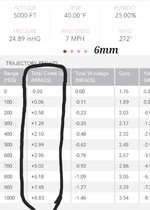
14.5" 243
108's @ 2710
avg gun QD(5000 DA)
38.5" end to end

avg gun Quick drop is range minus 2 (move the decimal but that becomes automatic, I mention it so people understand it)

400yds becomes 4.00
4-2 =2 Mil

600yds -2 =4Mil

742yds -2 =5.4 Mils

it's super easy to remember and convert. You can range it and do the math while you reach for the turret.
it also works across platforms and calibers, less to remember.

I have a limited hard drive. the less I have to remember, the better.

QD has a range of velocity and BC it works in. Above or below that, the quick answer is electronic solutions or a drop card.

Do you account for AJ and different DA’s when using range and QD to get your firing solution? I think QD is a good solution for humanoid targets under time stress. Your solution at 600 yards is off .2 mils under those circumstances. That’s 4” of error just from data. I don’t like dope giving me that much error when I have so many other stacking variables in the field already. If you add in a 7-10 mph right wind that becomes 6” of error, fairly significant amount.
 
Back
Top