Spotting your shot, most import factors.

Joined
Jun 7, 2016
Messages
84
Ive researched the other threads on this, and cannot quite find a satisfying answer. I'm mostly an archery guy so my apologies if I overlooked something.

I understand spotting your shots in field conditions can be difficult but I believe setting up a rifle that can spot shots has multiple ancillary benefits I.E. remaining on target for follow up shots, keeping eyes on primary target so you dont accidentally shoot the wrong animal on a follow up, potentially seeing the wound placement, and it assumes excellent recoil management so its likely more forgiving to shoot in general, etc.

I want to set up some initial parameters/factors so that the information isnt as subjective.

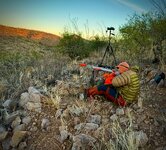
This is for a hunting rig (assume around 9lbs or less) and we're not always going to be able to shoot with a loaded bipod, prone. Some shots will be off the backpack, tripod, or trekking poles, etc.

Factors:

- Form/Fundamentals (if so, please clarify or provide content on what specific form changes helped you)

-Caliber (whats the maximum caliber you find to be able to spot shots with a 9# suppressed rifle, all other things being dialed in)

- Supression/Braked Supressors ( what is your recommendation on a suppressor for recoil reduction)

- Stock Design (this one really interests me the most) there are very few designs out there with a negative comb and near flat toe line/fore end.

- Something i missed.

Overall, if you were building a hunting rig, in what order would you rank these or what is your current setup that allows you to spot your shots!?

Im going back and fourth on if I should buy a Tikka/Rokstock combo or get a Seekins PH3 so I can shoot like a .223 for practice and switch over to my hunting round with a fairly cheap extra barrel/bolt face.
 
#1 fundamentals/practice
#2 proper rifle set up/fit
#3 6mm or .22 cal
#4 suppressor
#5 support gear (bags, bipod, tripod, pack, etc.
#6 stock style (I can shoot a factory Tikka stock with vertical grip just as well as others, but it is harder to build position automatically/easily)

Just get a Tikka in .223 and another in whatever flavor you want. Eurooptic has a threaded .223 on sale now.

I have written a lot about these topics. Check out some of the long range tips in that section. I need to get back to it.
 
#1 fundamentals/practice
#2 proper rifle set up/fit
#3 6mm or .22 cal
#4 suppressor
#5 support gear (bags, bipod, tripod, pack, etc.
#6 stock style (I can shoot a factory Tikka stock with vertical grip just as well as others, but it is harder to build position automatically/easily)

Just get a Tikka in .223 and another in whatever flavor you want. Eurooptic has a threaded .223 on sale now.

I have written a lot about these topics. Check out some of the long range tips in that section. I need to get back to it.

I've read some of your responses on this, and have got a lot of information from those. Can you expand/point to thread on priper rifle setup/fit?
 
Anything from Antelope to Elk but I dont want to derail this thread based in caliber efficacy... thats thoroughly covered and debated on here.
I agree it’s been covered and beaten down, but assuming you are from Alaska there are some critters that you could hunt that you might want to go heavier caliber. Elk and antelope are not what I’m getting at so no need for digression I guess.
 
I've read some of your responses on this, and have got a lot of information from those. Can you expand/point to thread on priper rifle setup/fit?
  1. butt stock length (shorter so that you can put the rifle on collarbone closer to centerline of body for recoil management)
  2. grip to trigger/vertical grip (put your finger and hand in neutral position for clean press)
  3. comb straight or neg (my face doesn't work well with Rokstock unless I have high rings)
  4. toe more flat than typical (some angle helps with long range adjustment of bag)
  5. grip size (relaxed hand)
  6. flatish forend (for resting on bags and not rolling)

  1. scope height (I prefer higher because it improves the angle your neck has to tilt forward, reducing strain, prone especially. The taller you are the longer your neck is and higher rings should be)
  2. scope eyebox set up so that prone is at one end of the eye box and standing is on the other end
 
  1. butt stock length (shorter so that you can put the rifle on collarbone closer to centerline of body for recoil management)
  2. grip to trigger/vertical grip (put your finger and hand in neutral position for clean press)
  3. comb straight or neg (my face doesn't work well with Rokstock unless I have high rings)
  4. toe more flat than typical (some angle helps with long range adjustment of bag)
  5. grip size (relaxed hand)
  6. flatish forend (for resting on bags and not rolling)

  1. scope height (I prefer higher because it improves the angle your neck has to tilt forward, reducing strain, prone especially. The taller you are the longer your neck is and higher rings should be)
  2. scope eyebox set up so that prone is at one end of the eye box and standing is on the other end

I dont want to sound patronizing but isnt this the same thing as saying to get the right stock?
 
Good info being presented here. This comes back to equipment, shooting fundamentals and position building and optics. Each one can be a limiting factor.

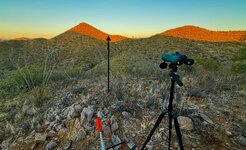
Once you get the equipment side worked out, it’s about training to build stable positions quickly, train yourself to perform with the minimum magnification needed, and execute quickly. For me, this journey started with moving to smaller calibers and spending more time putting rounds down the gun, learning that 6x was good for just about any range I am likely to shoot at something with hair, and then learning to get a front and rear rest setup quickly. I generally use a bag attached to my pack with my bino harness in the rear for prone or a pair of hiking sticks or a long Spartan bipod with the pack against my body for a rear rest when kneeling or seated.

The stock design is an issue and can be big or small depending on how much recoil you’re dealing with. But unless you’re dealing with extremes, the effect of the stock is relatively small. That said, the flat toe and forearm of the RokStok does really help minimize muzzle rise when shooting off a rest. I honestly think that is more important than the negative comb. I also think the grip on the RokStok is one of the best designs for field shooting.
 
Scope magnification is a huge factor in my opinion.

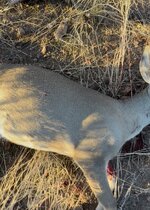
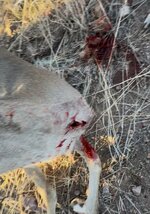
I recently experimented with this on a hunt. At 8-10x I was almost immediately back on target and observing the animals reaction but had a little trouble spotting the impacts themselves. For the last animal, I switched to 6x. Observed the impact and results perfectly.

These shots were between 240 and 310 yards with a 9.25lb 6 CM in a Rokstok.

Distance can obviously decrease or improve your observations as well.
 
Back
Top