
22”. Stainless T3X liteWhat length barrel?

Navigation
Install the app
How to install the app on iOS
Follow along with the video below to see how to install our site as a web app on your home screen.
Note: This feature may not be available in some browsers.
More options
Style variation
You are using an out of date browser. It may not display this or other websites correctly.
You should upgrade or use an alternative browser.
You should upgrade or use an alternative browser.
Show your Tikka ten round groups
- Thread starter HighUintas
- Start date

NWBLKTAIL
WKR
How many grains N140?Factory Tikka 223
75gr ELDM over N140. Around 2870fps on chrono
20 shot group.
Pretty happy with this result.
That’s book max at 25grs. I think I had some loaded at 24.5grs too mixed in there.How many grains N140?

stan_wa
WKR
Got my dad a tika for Christmas
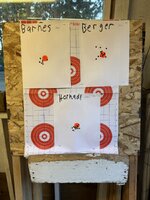
It’s a 243 with an eight twist in the process of trying different load combinations now first thing we did was test bullets each of us shot groups with the 112 match burner, the 108EDM, and the 108 elite Hunter below is my testing
The first image is 8 x 112 mb, 15x 108 eldm and 12 x 108 eh
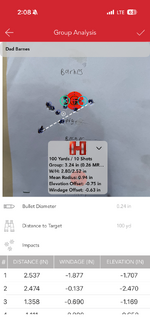
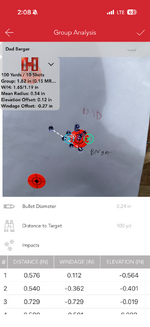
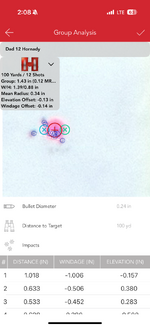
The 108 eldm is best with a Mr of .39 for my 15 shot group and .34 Mr for my dads 10 shot group
 And here is my dad’s. He shot three groups of 10 one for each of the bullets.
Next step find max pressure for the 108 eldm with h4350, h1000 and h4831sc
It’s a 243 with an eight twist in the process of trying different load combinations now first thing we did was test bullets each of us shot groups with the 112 match burner, the 108EDM, and the 108 elite Hunter below is my testing
The first image is 8 x 112 mb, 15x 108 eldm and 12 x 108 eh
The 108 eldm is best with a Mr of .39 for my 15 shot group and .34 Mr for my dads 10 shot group
And here is my dad’s. He shot three groups of 10 one for each of the bullets.Next step find max pressure for the 108 eldm with h4350, h1000 and h4831sc
Attachments

- Joined
- Mar 9, 2025
- Messages
- 42
Super exciting and cool to get to do with your Dad. Consider using extreme spread (ES) instead of mean radius (MR). MR really doesn’t tell us anything…you need to see the targets to understand that group size. We really only care about our worst rounds when it comes to making a shot hunting. You can also have a great sounding MR with a bad ES, and a great ES with a bad sounding MR.Got my dad a tika for Christmas
It’s a 243 with an eight twist in the process of trying different load combinations now first thing we did was test bullets each of us shot groups with the 112 match burner, the 108EDM, and the 108 elite Hunter below is my testing
The first image is 8 x 112 mb, 15x 108 eldm and 12 x 108 eh
The 108 eldm is best with a Mr of .39 for my 15 shot group and .34 Mr for my dads 10 shot group
View attachment 1023797 And here is my dad’s. He shot three groups of 10 one for each of the bullets.
Next step find max pressure for the 108 eldm with h4350, h1000 and h4831sc

Mattyq17
Lil-Rokslider
Got an 8-twist tikka 243, shooting factory Federal Premium loaded 95 grain Berger Hybrid Hunters. These are shots 11-20. The last two are the ones outside the main group, damn mirage got me..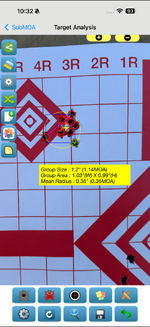
I bought some Bone Frog 5.56 loads and took them, and some others to the 100 yard line with my 16” Tikka.
Temp was about 50, mild breeze almost deed behind me. Seated position. Harris bipod with rear bag, NF 2.5-20 scope. Sig SRD556 can, (U.S. OG six-five is enroute.)
The 70TSX was OK but not stellar, with a 10 shot group at 1.24” and a 5 shot group at 1.63”.
I’m not hating the Bone Frog 62gr TTSX loads. In the center group, I did the three lower/right shots and adjusted a bit, then finished the magazine off. Then I shot the 10 round .96” group. These gave 2804fps.
I continue to like the BlackArc NAS3 62gr TTSX loads. I had a superb 4 shot group going until I pulled the fifth. Damn, nobody to blame but myself, I forced the shot. These loads gave 3101fps, 300fps faster than the Bone Frog 62TTSX loads. The bolt handle was a bit tight to open.
One of these 62gr TTSX loads will be my load of choice on my next pig hunt.
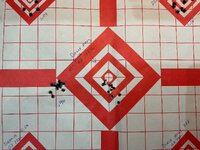
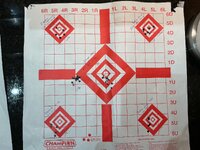
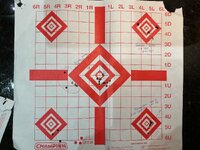
Temp was about 50, mild breeze almost deed behind me. Seated position. Harris bipod with rear bag, NF 2.5-20 scope. Sig SRD556 can, (U.S. OG six-five is enroute.)
The 70TSX was OK but not stellar, with a 10 shot group at 1.24” and a 5 shot group at 1.63”.
I’m not hating the Bone Frog 62gr TTSX loads. In the center group, I did the three lower/right shots and adjusted a bit, then finished the magazine off. Then I shot the 10 round .96” group. These gave 2804fps.
I continue to like the BlackArc NAS3 62gr TTSX loads. I had a superb 4 shot group going until I pulled the fifth. Damn, nobody to blame but myself, I forced the shot. These loads gave 3101fps, 300fps faster than the Bone Frog 62TTSX loads. The bolt handle was a bit tight to open.
One of these 62gr TTSX loads will be my load of choice on my next pig hunt.

JMundy84
WKR
- Joined
- Nov 29, 2023
- Messages
- 561
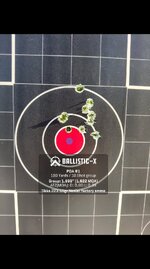
Shots 5-14 on a brand new 16" 223 shooting some 55gr nosler varmageddon

How many grains of 4831?Doing some testing with the new 20” 1:8 243. 100 yard groups using H4831 sc, starline brass, and cci primers
View attachment 1022752
stan_wa
WKR
Super exciting and cool to get to do with your Dad. Consider using extreme spread (ES) instead of mean radius (MR). MR really doesn’t tell us anything…you need to see the targets to understand that group size. We really only care about our worst rounds when it comes to making a shot hunting. You can also have a great sounding MR with a bad ES, and a great ES with
I don’t think that’s true. We can assume that bullet distance from center or radius is a normal distribution, mean radius will then converge and on the infinite data set result faster than es . Both are helpful
But as a single number Mr is more useful. Mr and standard devistion on the independ radii combined by doing Mr + 2 *sd . Will
Give you the single best number but having done this a bunch of times what your realize is that your sd scales with Mr. So you almost never a Mr go and sd go down ( this would mean a normal looking group vs a group that looks like a ring for example )
And so Mr is great the problem with es is that it doesn’t give you a good idea what most shots do and is very easily driven by shooter error especially with larger group sizes
Castle Rock
WKR
- Joined
- Mar 28, 2020
- Messages
- 2,248
Spoken like a true egg headI don’t think that’s true. We can assume that bullet distance from center or radius is a normal distribution, mean radius will then converge and on the infinite data set result faster than es . Both are helpful
But as a single number Mr is more useful. Mr and standard devistion on the independ radii combined by doing Mr + 2 *sd . Will
Give you the single best number but having done this a bunch of times what your realize is that your sd scales with Mr. So you almost never a Mr go and sd go down ( this would mean a normal looking group vs a group that looks like a ring for example )
And so Mr is great the problem with es is that it doesn’t give you a good idea what most shots do and is very easily driven by shooter error especially with larger group sizes
It’s the outliers that lose matches and miss or wound game

solarshooter
WKR
Super exciting and cool to get to do with your Dad. Consider using extreme spread (ES) instead of mean radius (MR). MR really doesn’t tell us anything…you need to see the targets to understand that group size. We really only care about our worst rounds when it comes to making a shot hunting. You can also have a great sounding MR with a bad ES, and a great ES with a bad sounding MR.
Spoken like a true egg head
It’s the outliers that lose matches and miss or wound game
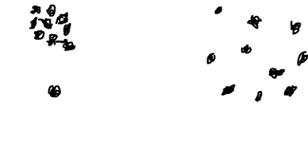
Which group is more precise? Stated differently, which will yield a higher hit rate on a smaller target?
solarshooter
WKR
It's a rhetorical question. Obviously, the group on the left is more precise and will yield a higher hit rate on a smaller target (provided you zero correctly). But, by your preferred metric of ES, these groups are the same. MR would show these groups are different. MR uses data from every shot in the group, rather than just the most extreme 2. ALL samples will have outliers provided enough shots are taken.View attachment 1024311
Which group is more precise? Stated differently, which will yield a higher hit rate on a smaller target?

- Joined
- Oct 22, 2014
- Messages
- 15,249
It's a rhetorical question. Obviously, the group on the left is more precise and will yield a higher hit rate on a smaller target (provided you zero correctly). But, by your preferred metric of ES, these groups are the same. MR would show these groups are different. MR uses data from every shot in the group, rather than just the most extreme 2. ALL samples will have outliers provided enough shots are taken.
Which one tells you what size target you can actually hit on demand?
As stated, hunting is “worst shot”- not “average of best”.
solarshooter
WKR
The load on the left will put more shots closer to POA. We happened to get a big outlier in this example. They both have the same ES (according to my sketching abilities). MR tells you this story where ES doesn't. Agree that if you want to characterize the effective accuracy of the system, you need to look at mean + 2-3sd radius OR ES of a meaningful shot count. As I've discussed many times before, tracking individual shot radius data and using mean + sd method will get you to the "correct" or "true" answer in fewer shots than ES method. However you can get the "correct" answer with both methods.Which one tells you what size target you can actually hit on demand?
As stated, hunting is “worst shot”- not “average of best”.
ETA: For comparing loads with smaller shot count groups, say 10, using this more "information rich" metric will give you a more accurate comparison. So for example (not perfect numbers but illustrates the point), 10rds of radius data is equivalent to a 15rd group ES in terms of telling you the real performance of the load.

Which one tells you what size target you can actually hit on demand?
As stated, hunting is “worst shot”- not “average of best”.
“On demand” is a statement of probability (99% chance, 99.999% chance, etc), which technically only MR can address, as ES doesn’t offer predictive power.
It’s semantics in practice though because the ES and 3*MR of a reasonable group are roughly equivalent, so you can use either to prepare for “worst shot”. Agree that only using the MR is being overly optimistic to a fault.
But if you could only know one quantity of a system, MR or ES, the former is better because you can derive the latter (along with much more), but the reverse is not true.

“On demand” is a statement of probability (99% chance, 99.999% chance, etc), which technically only MR can address, as ES doesn’t offer predictive power.
It’s semantics in practice though because the ES and 3*MR of a reasonable group are roughly equivalent, so you can use either to prepare for “worst shot”. Agree that only using the MR is being overly optimistic to a fault.
But if you could only know one quantity of a system, MR or ES, the former is better because you can derive the latter (along with much more), but the reverse is not true.
Honestly trying to understand the difference here, and admittedly need to read more into ES and MR... but if I shoot 100 rounds in a 2moa group, my ES is 2moa, and I know I have a 100% chance of hitting a 2moa target (excluding outliers like weather, ammo lots, etc). If I shot 100 rounds with 95 of them inside 2moa, and 5 of them outside of, say 2.5moa... then I have a 95% chance of hitting a 2moa target.
Isn't the ES telling me what I can hit with 100% certainty the more valuable metric in the field as a hunter?
Just trying to see both sides here.
solarshooter
WKR
Except you never get to 100% certainty, since you aren't shooting 100rds at one target. You always have something less than full confidence, especially when you're testing with only ~10rds per load. So then the question becomes, how quickly can I increase confidence in this metric I'm using to evaluate loads? And the answer is to use data from every single shot, instead of just the extreme 2 shots. The formal term here is statistical power. Using shot radius data gets you more power for the same number of shots.Honestly trying to understand the difference here, and admittedly need to read more into ES and MR... but if I shoot 100 rounds in a 2moa group, my ES is 2moa, and I know I have a 100% chance of hitting a 2moa target (excluding outliers like weather, ammo lots, etc). If I shot 100 rounds with 95 of them inside 2moa, and 5 of them outside of, say 2.5moa... then I have a 95% chance of hitting a 2moa target.
Isn't the ES telling me what I can hit with 100% certainty the more valuable metric in the field as a hunter?
Just trying to see both sides here.
- Joined
- Mar 9, 2025
- Messages
- 42
Except you never get to 100% certainty, since you aren't shooting 100rds at one target. You always have something less than full confidence, especially when you're testing with only ~10rds per load. So then the question becomes, how quickly can I increase confidence in this metric I'm using to evaluate loads? And the answer is to use data from every single shot, instead of just the extreme 2 shots. The formal term here is statistical power. Using shot radius data gets you more power for the same number of shots.
I’m looking for a circular group/pattern that fills in comparable to a Gaussian distribution. The more rounds I fire, the larger the pattern/cone, and the greater confidence I have in the mechanical capability of my weapon/ammo combo. Why not fire 20, 30, or 100 rounds into the same group to gain confidence in actual performance? Then, I care about my worst two rounds to determine actual capability. MR doesn’t give me this information, and delivered by itself, is useless for judging hit rate at distance or capability of that weapon/ammo combo.
- Joined
- Oct 22, 2014
- Messages
- 15,249
The load on the left will put more shots closer to POA. We happened to get a big outlier in this example. They both have the same ES (according to my sketching abilities). MR tells you this story where ES doesn't. Agree that if you want to characterize the effective accuracy of the system, you need to look at mean + 2-3sd radius OR ES of a meaningful shot count. As I've discussed many times before, tracking individual shot radius data and using mean + sd method will get you to the "correct" or "true" answer in fewer shots than ES method. However you can get the "correct" answer with both methods.
ETA: For comparing loads with smaller shot count groups, say 10, using this more "information rich" metric will give you a more accurate comparison. So for example (not perfect numbers but illustrates the point), 10rds of radius data is equivalent to a 15rd group ES in terms of telling you the real performance of the load.
That is not correct. You and every one else will zero off the cluster of shots, ignore the “flyer”, and then that flyer- is way off POA and falls outside the expected cone.
ES people zero off the center of all rounds, and all shots fall within the expected cone.
You are math dorking for the sake of math dorking. I have long history with this well before the last couple of years where certain groups are pushing it. There is “the math says…” And then there is- “reality on target in the field, shows…”.
I don’t have to math dork, I don’t have to convert, I don’t have to guess, or anything else. Shoot 20-30 shots, zero to center of all shots. Done. And at the same that 30 rounds tells me the 95% probability in MOA. 30 shot 2 MOA ES, at a base if I am missing 2 MOA targets- it is me, not the gun.
Similar threads

- Replies
- 64
- Views
- 4K



Featured Video
Latest Articles
- Kifaru Enters the Hunting Apparel Space: Review
- From Big Bucks to Bear Hunts: Catching Up with Jordan Budd
- Mule Deer Days Wildlife Conservation Mashup
- A Hidden Gem: Hunting Washington with Kari Thomas
- Prime Divide Bow Review
- Knowledge From Storms: Surviving and Thriving in the Backcountry with John Barklow
- DIY Wyoming Pronghorn Hunt
- Unlock Precision Shooting: Master Your Hunting Game with Competitive Insights
- Topo Topper Rincon Review
- Tony Trietch on Big Mule Deer, Desert Bulls & Western Hunting Evolution