OP
OP

- Joined
- Oct 22, 2014
- Messages
- 15,370
When are you running these trials?
As soon as the deep cold and snow comes. Usually in December.

Follow along with the video below to see how to install our site as a web app on your home screen.
Note: This feature may not be available in some browsers.
When are you running these trials?

If I knew anyone that had one, I would include it this year.
Yall are welcome to my new-ish BACO model 70 ewss if yall ever want it for something like this. Wouldn't hurt my feelings to have it tested in ways I really can't do convienently.
It's a bare muzzle .338 win mag though...

They can’t even function properly with a bit of desert sand in them, freezing them will be catastrophic I’d imagine. Just a guess though.Curious how a Ruger American would fair in this, since there are so many out there.


Here's at least a partial answer, and it's disappointing. Pulled this gun out of the safe to thread it, and the wheels got spinning. CRF, 3 position safety, easy to bed, solid scope mounting, very solid action, no extractor cut, super easy to rebarrel. Thought about spinning up a 6 UM barrel for it.Maybe I just missed it being discussed but is the ruger hawkeye crf design that much different in these teststhan a model 70?
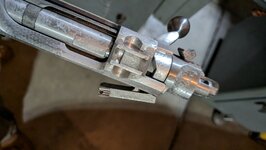
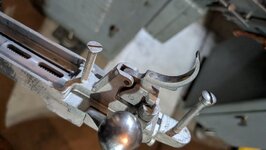
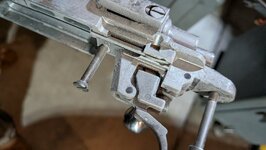
Here's at least a partial answer, and it's disappointing. Pulled this gun out of the safe to thread it, and the wheels got spinning. CRF, 3 position safety, easy to bed, solid scope mounting, very solid action, no extractor cut, super easy to rebarrel. Thought about spinning up a 6 UM barrel for it.
Since the triggers are usually the issue in ice tests, the M77 looked so promising. Very easy to lighten/modify, few components, not a lot of surface area for ice to stick to. The action was doused in water in a sink, then shoved in the freezer. Immediately on pulling it out, all trigger components moved freely. The bolt could be opened with a rubber mallet. Despite that, the bolt would not fire, it was frozen up badly. Maybe the open cuts on the bottom allowed a bunch of water to freeze the firing pin solid. Maybe it's the rear of the bolt. Either way, it could be tapped forward with a rubber mallet and re-cocked, but wouldn't fire for quite a while after.
I may disassemble the bolt and see if it can be mitigated, but it was pretty disappointing overall.View attachment 1007979View attachment 1007980View attachment 1007981
Surprised me too. I was all set on building this up and hunting with it.Holy cow. Cool test and good idea but I'm also surprised.
Can't be lube huh? Bet you're right about enough water getting in to actually make ice, Dang.
Surprised me too. I was all set on building this up and hunting with it.
The two likely culprits are the cuts on the bottom of the bolt and the exposed cocking indicator on the back of the bolt. I could hammer it back and forth and cock it, but it took a while to drop on its own at all. Much less hard enough to set off a primer. I'll post an update after stripping the bolt to see if it can be improved.
 . You going to be hunting in conditions it matters frequently?
The stock would probably help a bit. I test it outside for two reasons; to give a worst case scenario, and to better diagnose what freezes up.Testing it in the stock might help, or hurt
Here's at least a partial answer, and it's disappointing. Pulled this gun out of the safe to thread it, and the wheels got spinning. CRF, 3 position safety, easy to bed, solid scope mounting, very solid action, no extractor cut, super easy to rebarrel. Thought about spinning up a 6 UM barrel for it.
Since the triggers are usually the issue in ice tests, the M77 looked so promising. Very easy to lighten/modify, few components, not a lot of surface area for ice to stick to. The action was doused in water in a sink, then shoved in the freezer. Immediately on pulling it out, all trigger components moved freely. The bolt could be opened with a rubber mallet. Despite that, the bolt would not fire, it was frozen up badly. Maybe the open cuts on the bottom allowed a bunch of water to freeze the firing pin solid. Maybe it's the rear of the bolt. Either way, it could be tapped forward with a rubber mallet and re-cocked, but wouldn't fire for quite a while after.
I may disassemble the bolt and see if it can be mitigated, but it was pretty disappointing overall.View attachment 1007979View attachment 1007980View attachment 1007981
Is that just the difference between the original push feed M77 and the crf mark II? Or is it because most mark II's don't function correctly?The other issue is (which I did not realize until @longrangelead pointed it out) most/lots of M77’s are not controlled round feed.
Is that just the difference between the original push feed M77 and the crf mark II? Or is it because most mark II's don't function correctly?
Ouch, I've never paid attention to that, now I'm going to check all my M77s. Is that something a competent gunsmith could fix?Both. I didn’t realize that there were any that were push feed. I knew that very few of them were timed to CRF correctly.
Ouch, I've never paid attention to that, now I'm going to check all my M77s. Is that something a competent gunsmith could fix?

I needed that this morning. Thank you. Crap week full of layoffs with people staying that I wouldn’t let walk my dog. I have to remind myselfSure. But there aren’t very many “competent” gunsmiths, and they aren’t inexpensive.

I just checked all my crf actions. With the M77s the rim doesn't slide underneath the extractor until about halfway through pushing the bolt closed, and it's nowhere near completely underneath the extractor -just enough so that if I started pulling the bolt back it would pull the cartridge with it. The cartridge is not fully seated underneath that extractor until about the last 15% of closing the bolt. Is this what you're talking about? My CZ 550s, Husqvarna 1640s and sporterised 98s all function similarly although they are smoother than the M77s -the cartridges have a little more "pop up" with the M77s, and gradually slide up with everything else.Sure. But there aren’t very many “competent” gunsmiths, and they aren’t inexpensive.

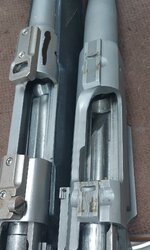
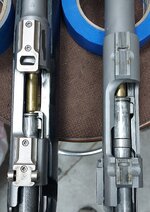
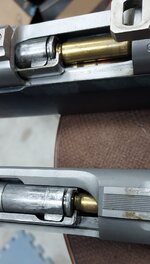
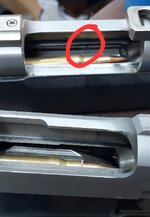
I happen to have both M70/M77 Mk2 in 308 at the shop currently.I just checked all my crf actions. With the M77s the rim doesn't slide underneath the extractor until about halfway through pushing the bolt closed, and it's nowhere near completely underneath the extractor -just enough so that if I started pulling the bolt back it would pull the cartridge with it. The cartridge is not fully seated underneath that extractor until about the last 15% of closing the bolt. Is this what you're talking about? My CZ 550s, Husqvarna 1640s and sporterised 98s all function similarly although they are smoother than the M77s -the cartridges have a little more "pop up" with the M77s, and gradually slide up with everything else.
Whatever the situation might be, I'm guessing @longrangelead could fix/improve it?