Reticle Design and Cold Weather Gear Podcast Thomas - THLR

Cliff Gray

Lil-Rokslider
Rokslide Sponsor
Joined
Feb 16, 2016
Messages
278

Enjoyed having Thomas @THLR on the podcast. We got into a lot of detail on reticles he’s been involved in designing, including the one in the new Shoot2Hunt scope that @Ryan Avery and @Formidilosus put together. We really broke that specific reticle down and got into the details.

The timeline was inverted here some. I've used the Gunwerks/Revic reticle quite a bit over the years and now the shoot2hunt reticle some recently. Honestly without fully understanding the design in/outs. I just figured out what I naturally used in hunting situations. Then sitting down with Thomas here gave me the full explanation, after the fact. Fun to compare what a hunter actually uses intuitively versus how it was designed to be used. Lots of alignment, but there are definitely a few things he explained that will change how I use these reticles going forward.

We also got into some good discussion on cold weather gear, which I’d like to dive deeper into on a future episode. Same with shooting and how to become more effective in real hunting scenarios.

Hope you enjoy it. feedback and thoughts are welcome.
 

Enjoyed having Thomas @THLR on the podcast. We got into a lot of detail on reticles he’s been involved in designing, including the one in the new Shoot2Hunt scope that @Ryan Avery and @Formidilosus put together. We really broke that specific reticle down and got into the details.

The timeline was inverted here some. I've used the Gunwerks/Revic reticle quite a bit over the years and now the shoot2hunt reticle some recently. Honestly without fully understanding the design in/outs. I just figured out what I naturally used in hunting situations. Then sitting down with Thomas here gave me the full explanation, after the fact. Fun to compare what a hunter actually uses intuitively versus how it was designed to be used. Lots of alignment, but there are definitely a few things he explained that will change how I use these reticles going forward.

We also got into some good discussion on cold weather gear, which I’d like to dive deeper into on a future episode. Same with shooting and how to become more effective in real hunting scenarios.

Hope you enjoy it. feedback and thoughts are welcome.

Thanks for posting this here, I follow you on YouTube but it can be hit-or-miss on how much I'm on there. Love the amount of great info you're putting out, including having really great interviews lately.
 
Well, as predicted there was lots of interesting stuff to learn about the reticle design that I hadn't heard before. The inclusion of findings from neurological, vision, and decision making studies was really cool to hear about. Also the intentional design of 3 separate aim points useful across the whole zoom range.

A couple further questions for @THLR (thank you for taking time to provide all this information):

I had not understood the usage of the 1mil box as a quick ranging "kill gauge" tool. Presumably this is using the rule of thumb that a man's torso is roughly a half yard wide at the shoulders and therefore if the 1mil box fits that dimension, the man is roughly 500yds away? In that case, to shoot dead on you would need to be carrying a 500yd zero dialed? And aim short would work down to 400yd, aim long out to 650yd? For a "normal" gun? Are there a different set of features and rules of thumb you would use when applying this gauge to game?

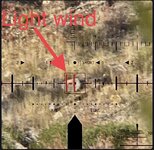
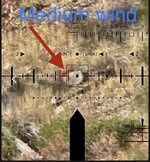
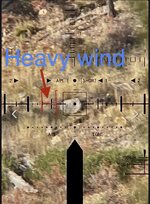
I also had not understood that the highlighted wind brackets were intended to be vitals sized for "normal" guns (and a shoot/don't shoot gauge). I think I understand the low (movement, no direction), med (see direction), hi (vegetation being bent in wind direction) wind levels, but could you also talk about how this should change with range? Or what the reference range is for the baseline brackets?

This is a bit of a tangent, but would also like to hear how you approach accounting for multiple different winds down range. Is it just by feel/intuition, or do you have a more mathematical/systematic approach?

More to come as I listen again in greater detail. Thanks again!
 
Well, as predicted there was lots of interesting stuff to learn about the reticle design that I hadn't heard before. The inclusion of findings from neurological, vision, and decision making studies was really cool to hear about. Also the intentional design of 3 separate aim points useful across the whole zoom range.

A couple further questions for @THLR (thank you for taking time to provide all this information):

I had not understood the usage of the 1mil box as a quick ranging "kill gauge" tool. Presumably this is using the rule of thumb that a man's torso is roughly a half yard wide at the shoulders and therefore if the 1mil box fits that dimension, the man is roughly 500yds away? In that case, to shoot dead on you would need to be carrying a 500yd zero dialed? And aim short would work down to 400yd, aim long out to 650yd? For a "normal" gun? Are there a different set of features and rules of thumb you would use when applying this gauge to game?

I also had not understood that the highlighted wind brackets were intended to be vitals sized for "normal" guns (and a shoot/don't shoot gauge). I think I understand the low (movement, no direction), med (see direction), hi (vegetation being bent in wind direction) wind levels, but could you also talk about how this should change with range? Or what the reference range is for the baseline brackets?

This is a bit of a tangent, but would also like to hear how you approach accounting for multiple different winds down range. Is it just by feel/intuition, or do you have a more mathematical/systematic approach?

More to come as I listen again in greater detail. Thanks again!
I second this re: the wind bracketing and how it applies to the reticle. It was a bit of a struggle to visualize that part of the conversation.

@Cliff Gray - I was hoping during this portion of the video you would throw up the reticle and draw in where the 3 wind brackets are (light, medium, strong). Is that something you could do here to help better visualize the discussion?

One particular note from @THLR in that interview I may have missed in the RS threads, is the thicker horizontal line intersection the box, and how it can be used if the animals body, or vital area is covered with that thicker line.

If I understood correctly, that is another way for a quick range shot that accounts for light wind?
 
Super helpful interview and beyond interesting regarding a reticle that can actually provide information back to you as a shooter. Looking forward to receiving my S2H scope and getting some hands on use with it in the field.
 
Back
Top