Quick Drop vs Danger Space

to add to this, dispersion hasn't been mentioned yet as a source of error if compounded.
a 1.44" solid zero group is .4 Mil cone of fire, or 1.08" = .3 Mil.
Extrapolate that out to range and start adding fudged corrections, variables and other errors.
I would say that it's precisely BECAUSE of all the other dispersions/errors present that QD works well in hunting scenarios on hunting sized targets. All that other noise means the loss in precision from QD has a much smaller or harder to detect effect on the overall achieved precision. Range error, wind error, position error, aiming error, environmental error, stress error, we suck error, all combine to turn your 0.4mil benchrest system into a 0.8-1mil plus system in hunting scenarios under pressure. Another 0.1-0.3mil variable dispersed in there doesn't materially change the overall cone of fire.

That's also why QD does not work as well or is not as recommended for precision/competition shooting on smaller targets. You would notice the error much more/it would make more of a material difference in hit rate.
 
Look at the cold bore challenge hit rates.

My premises are these:
Shooters suck
Danger space calculates the size of permissible error on the shot that will still result in a kill.
At 400, 2 moa field efficiency means roughly an 8” group.
At 500, 2 moa is 10”.
Past 400 the danger space shrinks quick enough that available range of error diminishes quickly.
Quick drop adds uncertainty to the equation.
Using good dope reduces calculation errors.

Conclusion:
When it comes to quickly shooting, MPBZ is the go to method for realistic shots you can make quickly.

Get a flat shooting cartridge for longer MPBZ and for larger “danger space”.

Use a ballistic calculator, it can be done as fast as ranging plus waiting a half second for the dope.
.....and to top that off, mark yardages (or meters if that's how you do it) on your elevation turret.
 
I would say that it's precisely BECAUSE of all the other dispersions/errors present that QD works well in hunting scenarios on hunting sized targets. All that other noise means the loss in precision from QD has a much smaller or harder to detect effect on the overall achieved precision. Range error, wind error, position error, aiming error, environmental error, stress error, we suck error, all combine to turn your 0.4mil benchrest system into a 0.8-1mil plus system in hunting scenarios under pressure. Another 0.1-0.3mil variable dispersed in there doesn't materially change the overall cone of fire.

That's also why QD does not work as well or is not as recommended for precision/competition shooting on smaller targets. You would notice the error much more/it would make more of a material difference in hit rate.
at range QD is most often applied by those that know their limit, I'd agree.
I just wanted to point it out as the error we all start from, that and we suck under pressure.
We tend to obsess over the minutia of data, scope tracking, etc, but the hard errors like base accuracy and skill don't get talked about as much, more lately, but the other sources get mentioned far more it seems.
 
Well, yeah, thats precisely why I mentioned it, and its also in part why I asked how far people were stretching QD. I know few of us can say our dope is PERFECT, I cant. Nor is my gun perfect given I havent met one yet that one-holes every shot. Any error we introduce by virtue of using a “close enough” shortcut is going to be adding to our imprecision. And my own error is on top of all that. Personally, I count on all of these errors being cumulative. That is certainly the worst case, but you can rely on that happening some portion of the time.
 
Well, yeah, thats precisely why I mentioned it, and its also in part why I asked how far people were stretching QD. I know few of us can say our dope is PERFECT, I cant. Nor is my gun perfect given I havent met one yet that one-holes every shot. Any error we introduce by virtue of using a “close enough” shortcut is going to be adding to our imprecision. And my own error is on top of all that. Personally, I count on all of these errors being cumulative. That is certainly the worst case, but you can rely on that happening some portion of the time.

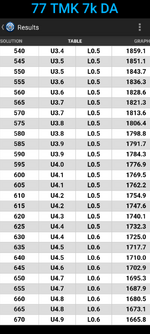
The cumulative error of using QD or a yardage marked turret at some middle level of DA on most hunts wil be maybe +/- one scope click at 600 yards.

That’s probably not a problem at 500 with a steady position. It’s a caution light at 600 - slow down and consider whether your immediate DA and shot angle call for dialing short or long. I see it as being ‘red’ at 600+. Stop and fully assess the shot and work the math or don’t take it.

And I say that as someone who doesn’t want to shoot game past 400-500 anyway.
 
Zero it at 145 yards and do that math.

You’ll have useable solution out to 700 yards without remembering any little adjustments.

Assumption:
2.1 bore height
6300 DA
Follow up on this.

My 20” 6.5cm which has more drop than basic qd formula allows, becomes pretty close to spot-on with a 140 yd zero. My sight height and DA are quite different than yours, but it still works, and it works across a wide range of DA.

My 270/lrx combo, no amount of fiddling with zero distance helps. On an extremely cold morning at sea level (ie DA of +\- -4000’) its ok, but as soon as I go up in DA to normal shooting/hunting it goes south fast. Zero distance does not seem to help this gun.

Regarding the give and take between qd and danger space (remember that?) it seems manipulating the zero distance is more of a trick for guns that are slower than is “qd ideal”, not so much for a flatter shooting gun. So this does not seem to be a trick that would allow having your QD cake, and eating it too (high danger space).
 
The cumulative error of using QD or a yardage marked turret at some middle level of DA on most hunts wil be maybe +/- one scope click at 600 yards.

That’s probably not a problem at 500 with a steady position. It’s a caution light at 600 - slow down and consider whether your immediate DA and shot angle call for dialing short or long. I see it as being ‘red’ at 600+. Stop and fully assess the shot and work the math or don’t take it.

And I say that as someone who doesn’t want to shoot game past 400-500 anyway.
Im not sure I agree on all counts.

The error from QD alone, if it lines up well, is .1 or .2mil. .2mil at 600yds is a little over 4”. That’s already completely off an 8” plate. Even if you give yourself a 10” or whatever size target, that leaves very little “budget” for much further error as the range approaches and exceeds 500, and you know for certain you can expect other error. It only takes .3mils of TOTAL error for a shot to be completely off of a 10” plate at 500 yards.

Given its never going to be the only source of error, Im curious what others think is an acceptable amount of error on target for their QD?
 
Im not sure I agree on all counts.

The error from QD alone, if it lines up well, is .1 or .2mil. .2mil at 600yds is a little over 4”. That’s already completely off an 8” plate. Even if you give yourself a 10” or whatever size target, that leaves very little “budget” for much further error as the range approaches and exceeds 500, and you know for certain you can expect other error. It only takes .3mils of TOTAL error for a shot to be completely off of a 10” plate at 500 yards.

Given its never going to be the only source of error, Im curious what others think is an acceptable amount of error on target for their QD?
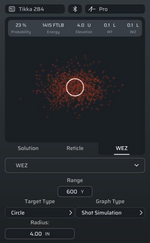
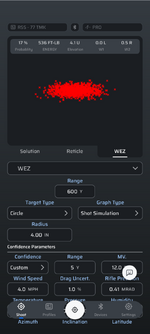
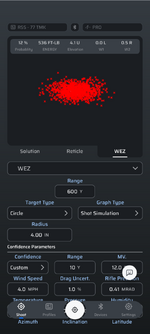
Your hit rate on an 8" plate at 600yds will already be abysmally low. You are thinking only about the laser beam shot to POA, but if you instead picture a large cloud of shots, with only 20-30% hitting that target, and move that cloud off-center by 0.2mil, you might then only have 15-20% hitting the target. But the affect is relatively small, 5-15% reduction in hit rate, to the point that you would need a lot of shots to even confidently see that difference.
 
Im not sure I agree on all counts.
I'm not going to respond to your QD points. I was speaking very generally and will let others chime in there if they want. But within the realm of scopes with 1/4moa elevation clicks and shots inside of 600 yards with moderate DA variations (which is how/what I actually shoot), it's a non-issue. At 500 yards it's a coin toss as to whether DA will ever change your solution by a full click, and on steep angles, app data indicates (and I don't live anywhere that I can flesh this out like I'd like, but generally trust app solutions) that you can ignore the first 5 degrees then drop a click of elevation for every additional ~5 degrees, up to a point.

Again, if you want perfect solutions, that ain't it, but that'll cover an awfully wide range of scenarios.

(ETA: And yes that ~5 degree figure varies between calibers/loads of course, but you can easily work out a figure that works for your rifle/load inside of maybe 30 degrees or less)
 
Your hit rate on an 8" plate at 600yds will already be abysmally low. You are thinking only about the laser beam shot to POA, but if you instead picture a large cloud of shots, with only 20-30% hitting that target, and move that cloud off-center by 0.2mil, you might then only have 15-20% hitting the target. But the affect is relatively small, 5-15% reduction in hit rate, to the point that you would need a lot of shots to even confidently see that difference.
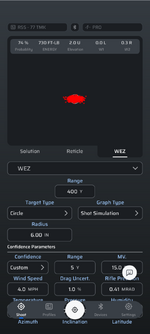
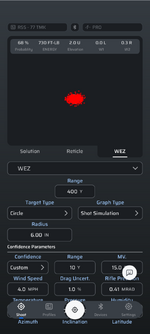
Gotta love WEZ, though I can't input an elevation adjustment or aiming error. But this illustrates my point:
1773948588157.png
 
Your hit rate on an 8" plate at 600yds will already be abysmally low. You are thinking only about the laser beam shot to POA, but if you instead picture a large cloud of shots, with only 20-30% hitting that target, and move that cloud off-center by 0.2mil, you might then only have 15-20% hitting the target. But the affect is relatively small, 5-15% reduction in hit rate, to the point that you would need a lot of shots to even confidently see that difference.
We’re saying the same thing. Im specifically saying you CANNOT think of it like a laser beam. I’ll leave quantifying that to you or others. No idea what your inputs are there, but the point remains that at some point your dispersion (ie including all other sources of error) is marginal already for making reliable hits, and at that point introducing another random tenth or two is going to matter. Fact is people ARE taking 600 yard shots with XX hit rate assuming good dope…and adding another .1 or .2 of error into the mix IS going to affect that. 15% is a big reduction imo. Hence my question about how much error from QD people think is acceptable.
 
Back
Top