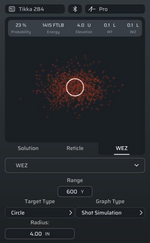
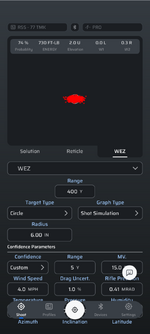
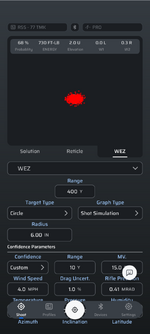
I'll preface this response with the bigger picture of first round hit rates in complex terrain on an 8" circle at 600 yards are quite low as
@solarshooter showed with WEZ to the point that a very small minority of even skilled, practiced, shooters should be shooting at game that far (myself excluded). So assuming someone is that skilled, we are taking QD to the extreme edge of it's capabilities, when it's most useful at medium ranges, say 2-450 yards.
Something else to keep in mind with the WEZ percentages is that while 15% seems like a lot, put it in the frame of reference of you shooting one shot in 100 different situations where the target size and distance happen to be the same. That is very different than shooting the same situation 100 times, and 10% is probably the start of possibly seeing a tangible difference in real hit rates in the field.
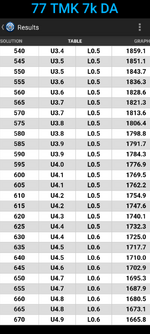
With that being said, I believe the point he was trying to make was that .1/.2 mil error is mostly swallowed in all the other error. To demonstrate that, I accounted for that .1/.2 by adjusting the range error in WEZ (which is 2SD, so it goes both ways). The drop chart below shows that a 5 yard error on WEZ (the default for normal ranging error regardless of QD) will reflect dialing 4.0 to 4.1 (-0.1 mil difference), and a 10 yard error on WEZ will reflect dialing 3.9 to 4.2 (-0.2/+0.1 mil difference).
View attachment 1040063
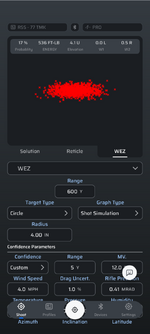
View attachment 1040057
A 0.1 mil difference is already built into the minimum realistic ranging error and is a non-issue even at this range.
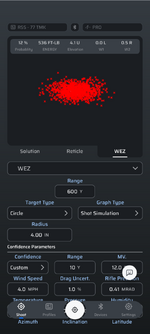
View attachment 1040058
A 0.2 mil difference results in a 5% lower probability, which is functionally unseeable in reality. The range/QD error is proportional to the rifles dispersion (1.5 MOA, which is quite good for field shooting), but wind is 5 times larger error than both in this analyses and subsequently the main reason for missing/source of error.
Let's look at a less extreme situation: 12 inch target at 400 yards, same inputs as before.
View attachment 1040144
Once again, 0.1 mil error is lost in the normal ranging error and makes no difference.
View attachment 1040145
And 0.2 mil difference results in a 6% less probability of hit - functionally unseeable in reality yet again. The error from range/QD at 0.2 mil is now greater than the error from rifle dispersion, but the error from wind is still three time greater, and subsequently still main reason for missing.
So to summarize all the math dork-nerd stuff, the 0.1/0.2 error in QD is not going to be the reason you miss. Provided your rifle's ballistics match it, the boundaries of quick drop are outside of the other boundaries of a given situation.
To use your boundary analogy, below is the order and (not necessarily proportional) magnitude of the boundaries that will determine whether you will hit or miss in a given situation (also assuming your rifle is correctly zeroed).
(-Shooter Skill-)
(---------Wind Call---------)
(---------------Quick Drop-----------------)
I've bolded the key part above - it works great where it does, but it is not a one-size fits all solution. Your rifles are at opposing edges of QD which is likely why you're having trouble fitting them without significant correction, and your extreme changes in DA make it difficult to match closely at either end.
No worries, this is what rokslide is for. I appreciate your genuine curiosity and desire to learn and understand.