
Fever Buck
WKR
- Joined
- Jun 21, 2020
- Messages
- 1,003
Yep. People got mad when I built generating facilities too. Just can’t winMan, when you work in the AEC industry, people will complain about every type of project you work on.


Follow along with the video below to see how to install our site as a web app on your home screen.
Note: This feature may not be available in some browsers.
Yep. People got mad when I built generating facilities too. Just can’t winMan, when you work in the AEC industry, people will complain about every type of project you work on.
Do you have any links to this information that explains the correlation between the data centers and ancillary job growth?Thanks for the question. We’ve seen food services, trash, waste water, power, fiber, standing construction teams, security, housing, medical services, and hospitality services all increase staffing. I won’t sugar coat it, It does get harder the more rural or “undesirable” a location is as people simply don’t want to move to the area for work. But you will see increased employment numbers in the area outside of the direct DC employees.
I would provide some but I can’t back up their actual numbers and I’m always wary of sending information I haven’t personally vetted or experienced. It seems to vary depending on what article or study you look at. Also seems to vary on how large the campus is that is built. Just use Google and you’ll see quite a few different articles. Just be wary of bias for or against data centers. Seems to either deflate or inflate the number of jobs created.Do you have any links to this information that explains the correlation between the data centers and ancillary job growth?
What company are you working for now?I would provide some but I can’t back up their actual numbers and I’m always wary of sending information I haven’t personally vetted or experienced. It seems to vary depending on what article or study you look at. Also seems to vary on how large the campus is that is built. Just use Google and you’ll see quite a few different articles. Just be wary of bias for or against data centers. Seems to either deflate or inflate the number of jobs created.
Also, everyone needs to understand we are in a high tech arms race with China. However you feel about US AI and Data Centers, you need to understand that China will not stop building. Do you want them to have better artificial intelligence and technology than the US?
totally agree. I’m hopeful someone a lot smarter than me has the answer.Similar existential crises are constantly used to justify the actions of a government or group - and they are never tangible, just 'what ifs' that can never be demonstrated nor proven to be true or false.
How will we know we are ahead or have lost?
We make tech or arms races and the problems that go with them, then use them as leverage to do what they hell we want to. Live long enough and you begin to grow weary of the whole damn thing.

To be fair, the First Law of Thermodynamics provides us with a very basic relationship between the energy drawn by a data center and the energy transferred away from the data center as heat: they are virtually the same at steady state operation. For example, if this proposed data center draws 9 GW-hours of electricity, then it will transfer 9 GW-hours of heat to the environment at steady state operation. Any difference goes into raising the temperature of the data center components, which is why such systems do best when they run at steady state after operational temperatures are attained. And that's not to mention the effects of literally dozens of combined-cycle gas turbine generating plants planned for the site; from what I've seen cited in this discussion, the plan is for 7.5 GW of capacity. Not sure if this is nameplate or after a capacity factor is applied.Just to add some context to the “heat island”. That study has not been peer reviewed. Nobody knows how the guy came up with his heat numbers and there’s a lot of variables not explained in his study. Just sucks because people have totally run with it which doesn’t help Data Center image.
Yes, I agree with what you are saying and I appreciate you being respectful with it. I would be curious what their PUE is to truly know what the actual heat output would be. And, like you said, who knows if they’ll build to their nameplate or not. I’ve yet to see any DC build to full capacity.To be fair, the First Law of Thermodynamics provides us with a very basic relationship between the energy drawn by a data center and the energy transferred away from the data center as heat: they are virtually the same at steady state operation. For example, if this proposed data center draws 9 GW-hours of electricity, then it will transfer 9 GW-hours of heat to the environment at steady state operation. Any difference goes into raising the temperature of the data center components, which is why such systems do best when they run at steady state after operational temperatures are attained. And that's not to mention the effects of literally dozens of combined-cycle gas turbine generating plants planned for the site; from what I've seen cited in this discussion, the plan is for 7.5 GW of capacity. Not sure if this is nameplate or after a capacity factor is applied.
As to the environmental impact of this heat transfer, I agree that there's a paucity of credible studies; longitudinal data for such massive data centers are still being acquired and we'll need to wait awhile to form any sort of scientific consensus.

You're right. I should have refrained from the ad-hominem. At the end of the day, you are a worker (and a hunter) like me, and therefore we have so much more in common than different, and we are on the same team. Sorry about that and thanks for not responding in kind.Dude, I’m just a random guy on the internet. Nobody I work for has given me any talking points. It’s fine for you to not have the same opinions but to say I’m being vague and spreading propaganda isn’t fair or accurate. Saying I’m lying is also insulting, I won’t be doing the same to you. I simply posted to have a good faith discussion but it seems like you have some emotional issue with my stance. You’ve also posted almost nothing specific besides lots of “feelings” based verbiage.

 www.brookings.edu

Solarshooter,You're right. I should have refrained from the ad-hominem. At the end of the day, you are a worker (and a hunter) like me, and therefore we have so much more in common than different, and we are on the same team. Sorry about that and thanks for not responding in kind.
The reason I get so fired up is I do think this data center boom is the latest in a series of technological booms that have resulted in terrible consequences for the environment. When there's this much money at stake, all caution gets thrown to the wind, and it's up to science and litigation to halt any of it, which often takes decades and by then the damage is done. I could cite so many examples of this - dams, logging, mining, fishing, market hunting, residential and municipal development - all done at a breakneck pace to make a few people rich beyond your imagination. The equation relating environmental extraction to individual wealth is a simple one.
To get back on topic with some of your specific points and my counterpoints, here is a list of articles and studies from as unbiased of sources as I can find, with some choice excerpts pasted here:
Americans’ AI hate wave might just be gathering steam: Data centers could hike power costs in some states over 50% by 2030 | Fortune
New research puts numbers on how the AI infrastructure boom is coming for utility bills.fortune.com
"Donna Gallant spent a lot of money on the windows in her house in Bristow, Virginia. But the sound from Google's “Mango Farm” data center complex still penetrates her home."
"The U.S. has more than 4,000 data centers, which is nearly eight times the number of any other country. With thousands more planned or under construction, their energy demand is expected to more than double by 2030."
"“Data centers in Virginia are a major source of air pollution attributable to their round-the-clock energy-intensive operations, a critically strained electric grid and backup diesel generators,” the Northern Virginia study says.
As demands on the grid grow, data centers might have to rely more on their backup diesel generators, Ren said. In the event of a large outage, data centers relying on diesel generators “could emit their maximum permitted emissions within just days,” Ren says.
“If you have a place that is dumping all these emissions – their annual emissions – in just a couple of days, that's like a health earthquake,” he adds.
The emergency scenario is not far-fetched. During a recent winter storm, Energy Secretary Chris Wright authorized some electric utility companies to direct data centers to run their backup generators to help relieve pressure on the grid."
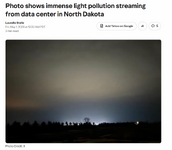
Photo shows immense light pollution streaming from data center in North Dakota
"It doesn't seem very appealing to anyone living in a residential area."www.yahoo.com
View attachment 1068877
Myths vs. Reality: Data Centers And Water Usage - Florida Water and Pollution Control Operators Association
Water has become a flashpoint in debates over data centers. Reports of massive water use have fueled community protests from Arizona to the Netherlands over fears that data centers are draining local water supplies. These concerns are understandawww.fwpcoa.org
"
"
- A medium-sized data center might consume on the order of +/-100 million gallons per year for cooling. (If the average American household uses 300 gallons/day, a mid-size data center would require the equivalent of ~1,000 U.S. households annually).
- Large hyperscale facilities (think of the huge cloud data centers) can use 1 to 5 million gallons of water per day under peak conditions. At the upper end (5 million gal/day), that is as much water in a day as a town of 30,000–50,000 people would use. That startling stat often grabs headlines. However, it’s worth noting this would be a very large data center on a hot day; typical usage might be lower most of the year.
- Nationally, the aggregate impact is significant but not enormous compared to other sectors. All U.S. data centers combined were estimated to consume about 449 million gallons of water per day (1.7 billion liters) as of 2021. That’s roughly 0.3–0.4% of total U.S. daily water withdrawals – a small slice compared to agriculture or power generation. But importantly, data center water use tends to be concentrated in specific regions (often arid or suburban areas), so the local impacts are outsized even if the national percentage is small. About 40% of U.S. data centers are located in areas of high or extreme water stress, meaning those communities really feel each gallon.
Turning the data center boom into long-term, local prosperity | Brookings
Local leaders are questioning the credibility of Big Tech’s promises of spillover effects that will produce high-quality economic development beyond near-term construction.
"
"
- The standard data center development model—speedy dealmaking and opaque negotiations—delivers short-term construction jobs and revenue, but little durable local economic upside.
- As to the historical answers to those questions, they are mixed. Yes, data centers can contribute to local economic development, including by generating meaningful tax revenues. But for all that, the current, often-secretive site selection game tends to pit states and localities against each other, creating a fear-of-missing-out (FOMO) dynamic that limits creativity and leverage.
Given that, local elected officials are frequently rushed into hasty sprints to negotiate complicated power, permitting, and financial incentives with community benefits often tacked on at the end of the discussions only as a supposed sweetener or to counter community unease. As a result, few negotiations explore how siting for data centers can be leveraged into truly win-win partnerships for economic development—ones that unlock high-value tech opportunities in host regions while preserving hyperscalers’ and data center developers’ core business models and timelines.- Using data from 2017, the chamber showed that economic benefits of a typical large data center decline substantially after the construction phase. Similarly, Table 1 below, which was reproduced from research in November 2025 by Michael J. Hicks, summarizes input-output model estimates from multiple studies and shows that long-term, operational employment is small relative to job creation during the construction phase.
I could go on and on. This is not some vague Chinese smear campaign. This is nationwide observation and reporting driven by thousands of real cases and real data. It should not be dismissed or handwaved.
 .
.



What company are you working for now?
Maybe I could look up how the data centers you have built have had a positive impact on those communities.
Do you have a link to your company site?
I would provide some but I can’t back up their actual numbers and I’m always wary of sending information I haven’t personally vetted or experienced. It seems to vary depending on what article or study you look at. Also seems to vary on how large the campus is that is built. Just use Google and you’ll see quite a few different articles. Just be wary of bias for or against data centers. Seems to either deflate or inflate the number of jobs created.


Because....fish....tribes...stupidity at this point as we're tearing dams down in the West.Why in hell aren't the western states building more dams for reservoirs? As far as I can tell, the last dam built in WA was nearly 50 years ago. Oh, not to mention the 2 dozen dams that have been torn out in the last couple years.
These data centers will become commonplace. Y'all better get used to it.

My little town of 1200 people in West Central Iowa has a Bitcoin datacenter. It is a fraction of the size of the propsed DC in this discussion. The property was purchased from a now-defunct cooperative, and after the grain bins, legs, etc..., were torn down, it occupies the same space. It provides high paying jobs (for this area) to around a dozen full timers and seasonal jobs for high school and college kids in the summer.
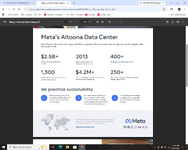
Des Moines and surrounding suburbs have some huge datacenters as well, and the area was attractive to owners due to low utility costs and state incentives. The Meta center in altoona is humongous. Here are some stats from their homepage FWIW.
View attachment 1068919
On a separate but similar note, the arguments against these DC are very interesting as they are similar to the failed arguments used to try to prevent ethanol plant construction. Ethanol plants also consume a tremendous amount of water from local aquifers and then dump a tremendous amount of water "cleaner than when it was extracted" back into local waterways. Ethanol plants also require a huge amount of energy. The dependence on corn as a raw material continues to drive environmental devastation in the midwest including soil erosion, nutrient and chemical runoff, and most notably for people on this forum, massive habitat loss. Then there are the dramatic cancer rates in Iowa and elsewhere...
Most recently "carbon capture" pipelines are the next evolution of the ethanol industry with a private entity pushing legislators in Iowa to allow use of imminent domain for their carbon capture pipeline corridors. The new product "low carbon ethanol" is in demand internationally and demands a premium (more profit) for these private companies.
On the flipside, similar to these DCs, ethanol plant construction creates investment in local communities during construction and afterwards, provides some price relief at the gas pump, and also provide dozens of permanent good paying jobs to locals.
The same arguments can be made for the mining projects that have been discussed on this forum.
There are consequences to technical innovation, and as consumers of these technologies, we have some control over proliferation. If you don't like ethanol, use regular gas and suffer the higher price at the pump. If you don't like mining, stop using electricity and ditch your consumer electronics. If you don't like DCs, stop using the internet and social media, including this forum. We are our own worst enemies, and instead of making our own personal lifestyle changes, most folks just complain about it. Human nature...
I don't think this is true. Forces much larger than any individual consumer or demand dictate what we do and invest in as a society and country. If you don't think those forces/powers have the ability to manufacture demand and consent, as well as subsidize and physically defend and enforce these technologies, then you are misinformedas consumers of these technologies, we have some control over proliferation
I literally cannot purchase non-ethanol gas in the county I live in. I have no choice other than to not drive or drive electric. Either of those are logistically difficult or expensive options. I cannot ditch consumer electronics, or electronics of any kind really, and still maintain a job and income, have my kids attend school, etc. Same with the internet. Impossible. Bills, banking, employment, etc, depend on internet access and use. Therefore it is not a simple "freedom to choose" or "lifestyle changes". You would essentially have to become a hermit and live completely off grid to really implement the ideas you've presented here. There are serious barriers to objection or abstention that have been intentionally constructed and implemented.If you don't like ethanol, use regular gas and suffer the higher price at the pump. If you don't like mining, stop using electricity and ditch your consumer electronics. If you don't like DCs, stop using the internet and social media, including this forum. We are our own worst enemies, and instead of making our own personal lifestyle changes, most folks just complain about it.
Sidebar moderately interesting story:Anyone who thinks growing corn to make ethanol for fuel makes any kind of real economic sense needs his head examined. Take away the absurd subsidies for it and it collapses overnight.

Because there is not enough water to fill it, unless you deprive someone or something (fish) of their water in much of the west. Colorado River is poster child for oversubscribed use.Why in hell aren't the western states building more dams for reservoirs? As far as I can tell, the last dam built in WA was nearly 50 years ago. Oh, not to mention the 2 dozen dams that have been torn out in the last couple years.
These data centers will become commonplace. Y'all better get used to it.



