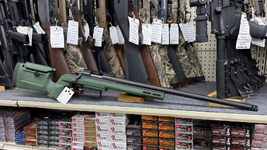
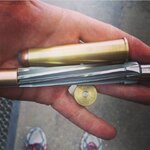
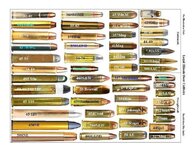
New Guy here. Considering straightwall wildcat.

Not in Michigan, it must have an oal of 1.8 or less


Sent from my iPhone using Tapatalk
OP said he was in Ohio.

I’m not sure exactly how much body taper they allow but there’s really no such thing as a cartridge with truly parallel walls. I’m just not sure exactly how much taper they allow, or if it’s even codified anywhere.
 
A gun shop in nw Ohio was working on a 30-06 trimmed like you suggest and it was loaded with a 44 caliber bullet. It was called 44 Predator. I think they are out of business now, but that is what I recall of the concept.
 
444 Marlin in a single shot with a 24in barrel, throat it to load the cartridge at 2.800, would get it done. Use the 250gr Cutting Edge maximus, load the case with as much CFE-BLK as you can... should be 2650fps or so. That puts you at 1630fps at 400y. Cutting edge wants 1300fps for that bullet.
The $350 CVA would work for this, just have the chamber throated.

Could also do something like a 45-90 with a similar bullet in modern break action, same powder, and run it up to 65kpsi. Gets you to 400y.
 
You need to look into the .41 Great Lakes. Kicks like a .350 legend but thumps like a .450 BM. Available in bolt actions and I believe it’s designed off the .30-06 case
I'm aware of this option, but I'm not sure if it offers any benefits over the 400 Legend?
 
Screenshot_20220123-212804_Instagram.jpg
700 Nitro Rimless? 1000gr cannonball @ 2000 fps. it shoots surprisingly flat.

seriously though, I did a 458x2"/450 Marlin a few years ago. It's nearly(low pressure) 45-70 performance from a short action.

can be made from any Win Mag belted brass.
 
If there isnt an OAL restriction, seems like a .308 straight wall about 5" long would work well, or however long it needs to be to push a 180gr bullet to 2650.

A smokeless muzzleloader would work. Wonder why that hasn't been done yet?
 
Lots of great food for thought so far!

A few more things to think about...

I'm not aware of any restrictions on case taper in Ohio, it just can't have a shoulder.

I'm curious if taking a .375 Win, or even the .40-90 Sharps and loading it with a bullet like Barnes LXR would do the trick? Assuming it would take a modern action and barrel to handle pressures, but what might be the results of this?

Also, being very new to the wildcat scene, I don't really know what all is possible. I know a case can be be fire formed to a larger bullet, but is it possible to re size a cartridge to some thing smaller? and still maintain a straight wall? Thinking down the line of a .444 Marlin downsized to take a .40 bullet. Possible, or no?
 
Lots of great food for thought so far!

A few more things to think about...

I'm not aware of any restrictions on case taper in Ohio, it just can't have a shoulder.

I'm curious if taking a .375 Win, or even the .40-90 Sharps and loading it with a bullet like Barnes LXR would do the trick? Assuming it would take a modern action and barrel to handle pressures, but what might be the results of this?

Also, being very new to the wildcat scene, I don't really know what all is possible. I know a case can be be fire formed to a larger bullet, but is it possible to re size a cartridge to some thing smaller? and still maintain a straight wall? Thinking down the line of a .444 Marlin downsized to take a .40 bullet. Possible, or no?

I don’t see how you would form a straight wall cartridge that went down like that. That would be a serious taper.

An older tapered cartridge that could be used as the basis for something really interesting is a 9.3x72R. The older rifles are often relatively weak actions or steel with a .364 bore. Approximately equivalent to a .38-55. If you made a modern action and used .366 bore, you would have a decent variety of good bullets.

I’ve got some Lapua 185-grain open tip bullets and some Barnes 250-grain TTSX to mess with in my 9.3x62. One of those in a modern action could be really fun. The Speer 270-grain semi-spitzer is also seriously devastating on whitetails. It upsets very consistently with starting velocities in the 2400-2600 range.
 
I don’t see how you would form a straight wall cartridge that went down like that. That would be a serious taper.
The .33 Winchester was based on a 45-70 case. The .375JDJ was based on a .444 Marlin.

I have taken .300 Winchester Magnum brass and 7mm Remington Magnum brass and necked it down (this is a multi step operation, FWIW) to make 6.5 Remington Magnum brass. Even to do this with a 7mmRM case, you end up taking the case shoulder, with a diameter of about 0.50", and reforming it into the neck of the 6.5RM, with a diameter of less than 0.30". That is a HUGE amount of reforming. Taking a 45-70 down to .40 or even .35 caliber is no big deal at all.

The great thing about cartridge brass casings is that with enough intermediate die steps you can start with almost anything and turn it into almost anything else.
 
The .33 Winchester was based on a 45-70 case. The .375JDJ was based on a .444 Marlin.

I have taken .300 Winchester Magnum brass and 7mm Remington Magnum brass and necked it down (this is a multi step operation, FWIW) to make 6.5 Remington Magnum brass. Even to do this with a 7mmRM case, you end up taking the case shoulder, with a diameter of about 0.50", and reforming it into the neck of the 6.5RM, with a diameter of less than 0.30". That is a HUGE amount of reforming. Taking a 45-70 down to .40 or even .35 caliber is no big deal at all.

The great thing about cartridge brass casings is that with enough intermediate die steps you can start with almost anything and turn it into almost anything else.

.33 Winchester and .375 JDJ aren’t straight wall cartridges. Much easier to take those down.

But taking a straight wall cartridge down to a smaller taper and maintaining straight walls seems like it would be harder. I have never tried it though.
 
.33 Winchester and .375 JDJ aren’t straight wall cartridges. Much easier to take those down.

But taking a straight wall cartridge down to a smaller taper and maintaining straight walks seems like it would be harder. I have never tried it though.
It can also be odd with what they consider “shoulder” at the taper to neck junction.

I was going to mess around with a 44-40 and some places seemed to indicate it was considered not straight wall.

Then others like a 32-40 are considered straight wall.

In the end I went with something that was clearly allowed and met the max length of all straight wall states. I chose 45 Raptor which is way overkill, but was a fun project.

IMG_1449.jpeg
 
I don’t see how you would form a straight wall cartridge that went down like that. That would be a serious taper.

An older tapered cartridge that could be used as the basis for something really interesting is a 9.3x72R. The older rifles are often relatively weak actions or steel with a .364 bore. Approximately equivalent to a .38-55. If you made a modern action and used .366 bore, you would have a decent variety of good bullets.

I’ve got some Lapua 185-grain open tip bullets and some Barnes 250-grain TTSX to mess with in my 9.3x62. One of those in a modern action could be really fun. The Speer 270-grain semi-spitzer is also seriously devastating on whitetails. It upsets very consistently with starting velocities in the 2400-2600 range.
This is a fascinating option! I wonder what it would do in a modern gun, with the right bullets.
Worth pursuing.
 
.33 Winchester and .375 JDJ aren’t straight wall cartridges. Much easier to take those down.

But taking a straight wall cartridge down to a smaller taper and maintaining straight walks seems like it would be harder. I have never tried it though.
The aren't straight but their parent cases started out straight. At the end of the day, a long tapered wall is just a 'shoulder' by another name. Or a series of shoulders. And you can always slightly over-form them then fire-form them back to fit a tapered chamber.

Don't get me wrong, I've never done this - I just know that brass can be worked an insane amount if you lube it and anneal it and take small steps.

I went out and dug around in my junk box and found an artifact from my 6.5RM project - that's a .375H&H case, a 7mmRM case, and a reformed 7mmRM case where I'd chopped off the neck at the neck/shoulder junction, then did an intermediate step with a .350RM resizing die then a cut-off .300WM resizing die then a 6.5RM resizing die. Note how the shoulder of the original case was turned into a half-inch of long skinny neck, without the walls collapsing. All I'd have needed to done to 'finish' this case would have been to cut the neck off at the correct length (or cut it long and then trim to length and chamfer. With some rifles and some brass I would have needed to ream or turn the necks (for example, you can't use Norma brass for case forming smaller stuff without turning the necks, the walls are too thick) but with this brass, it wasn't needed. Just trim, load, and shoot, and for some reason that case never got finished when I sold the rifle. But notice how long the cylindrical portion is. Compare that to the .375 parent case, which, incidentally, will almost hold a .355" bullet tightly as-is in its unfired state, and if you'll notice, has almost zero shoulder:
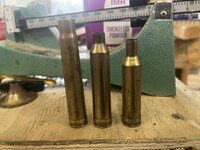
7cae8a43-a3bb-40aa-ac81-ce8897bef96d.jpgIt would be dirt simple to reform that .375 case. You could probably do it in a single step, or no more than two steps, with the first being an intermediate step that added more taper to the entire case body and the second finishing the taper and leaving a short neck to hold a .358 to .375 caliber bullet.

The advantage to such a rifle, in this case, is that you can actually *find* .375H&H brass.

If brass was available, you could also start with the .375 Flanged Nitro Express 2.5" (note that the 2.5" case is a different case altogether from the standard .375 Flanged Nitro Express) and if you had modern brass and a rifle that could handle 65kpsi ammo, you could very easily turn such a thing into a legit 400-yard cartridge. The .375H&H reformed to straight-wall should be even easier, because you could do it at lower pressures.

I mean, recoil is gonna be serious either way. But the OP already knew that.

 
Back
Top