Need assistance diagnosing 1911 issue

Grease is a base oil that is thickened with additives to prevent flow. In guns we want flow.

That's another common misunderstanding - part of the problem is we use the same word to describe the gunk on the back of the stove as we do for the modern complex lubricating greases that were invented in the 1920s. But it's not at all how complex greases work.

Think of grease as a sponge - the "thickener" matrix is the sponge part, and it has different oils and additives sucked up inside it. Each oil and additive is selected and proportioned to achieve specific performance properties needed on a specific machine type, when engineered from the ground up. The proportions of the oils (as well as their individual viscosities) vs amount of sponge matrix is what determines how "thick" a grease is, along with how much flow it does or doesn't have. Again, you can have these modern complex greases be as thick as a block of clay, or as light as cooking oil. That's what the NLGI scale is about - rating thickness and, to some degree, flow.

The key understanding, is to think of grease as a "lubricant deployment device", serving as pump, gasket, and reservoir, all at once. In a system without an actual pump, you want that grease to minimize the friction between the moving surfaces, while also staying put. The oils and additives deploy while work is occurring on those surfaces, and then start getting sucked back up as the work stops, over time. This is a property of good greases called thixotropy. And by staying put during the machine's cycling, the top part of the grease is acting as a seal and a gasket to protect the lower levels from air, dirt, and oxidizing agents. That gasket/seal property is an important factor too - a good, properly weighted grease in a gun will keep sand, unburned powder, and brass shavings at the surface of the grease, without allowing it to get to the bearing surfaces to cause friction.

Regarding flow specifically, guns are unsealed machines - if you have flow, especially with a thin or a hot oil, it flows away from the friction surfaces. Both from gravity and the cycling. This one property is why the homebrew lightweight grease I share above will shoot about 2000 rounds on one application, while remoil will get through 100-200 on a given gun before flowing away, thinning out, and drying out.
 
That's another common misunderstanding - part of the problem is we use the same word to describe the gunk on the back of the stove as we do for the modern complex lubricating greases that were invented in the 1920s. But it's not at all how complex greases work.

Think of grease as a sponge - the "thickener" matrix is the sponge part, and it has different oils and additives sucked up inside it. Each oil and additive is selected and proportioned to achieve specific performance properties needed on a specific machine type, when engineered from the ground up. The proportions of the oils (as well as their individual viscosities) vs amount of sponge matrix is what determines how "thick" a grease is, along with how much flow it does or doesn't have. Again, you can have these modern complex greases be as thick as a block of clay, or as light as cooking oil. That's what the NLGI scale is about - rating thickness and, to some degree, flow.

The key understanding, is to think of grease as a "lubricant deployment device", serving as pump, gasket, and reservoir, all at once. In a system without an actual pump, you want that grease to minimize the friction between the moving surfaces, while also staying put. The oils and additives deploy while work is occurring on those surfaces, and then start getting sucked back up as the work stops, over time. This is a property of good greases called thixotropy. And by staying put during the machine's cycling, the top part of the grease is acting as a seal and a gasket to protect the lower levels from air, dirt, and oxidizing agents. That gasket/seal property is an important factor too - a good, properly weighted grease in a gun will keep sand, unburned powder, and brass shavings at the surface of the grease, without allowing it to get to the bearing surfaces to cause friction.

Regarding flow specifically, guns are unsealed machines - if you have flow, especially with a thin or a hot oil, it flows away from the friction surfaces. Both from gravity and the cycling. This one property is why the homebrew lightweight grease I share above will shoot about 2000 rounds on one application, while remoil will get through 100-200 on a given gun before flowing away, thinning out, and drying out.
Wow, that is some PhD level knowledge right there. I used to own part of a lubricant company (specialized in grease) and you explained that better than I've ever seen it worded. Thanks for the mini-lesson in lubricants
 
That's another common misunderstanding - part of the problem is we use the same word to describe the gunk on the back of the stove as we do for the modern complex lubricating greases that were invented in the 1920s. But it's not at all how complex greases work.

Think of grease as a sponge - the "thickener" matrix is the sponge part, and it has different oils and additives sucked up inside it. Each oil and additive is selected and proportioned to achieve specific performance properties needed on a specific machine type, when engineered from the ground up. The proportions of the oils (as well as their individual viscosities) vs amount of sponge matrix is what determines how "thick" a grease is, along with how much flow it does or doesn't have. Again, you can have these modern complex greases be as thick as a block of clay, or as light as cooking oil. That's what the NLGI scale is about - rating thickness and, to some degree, flow.

The key understanding, is to think of grease as a "lubricant deployment device", serving as pump, gasket, and reservoir, all at once. In a system without an actual pump, you want that grease to minimize the friction between the moving surfaces, while also staying put. The oils and additives deploy while work is occurring on those surfaces, and then start getting sucked back up as the work stops, over time. This is a property of good greases called thixotropy. And by staying put during the machine's cycling, the top part of the grease is acting as a seal and a gasket to protect the lower levels from air, dirt, and oxidizing agents. That gasket/seal property is an important factor too - a good, properly weighted grease in a gun will keep sand, unburned powder, and brass shavings at the surface of the grease, without allowing it to get to the bearing surfaces to cause friction.

Regarding flow specifically, guns are unsealed machines - if you have flow, especially with a thin or a hot oil, it flows away from the friction surfaces. Both from gravity and the cycling. This one property is why the homebrew lightweight grease I share above will shoot about 2000 rounds on one application, while remoil will get through 100-200 on a given gun before flowing away, thinning out, and drying out.

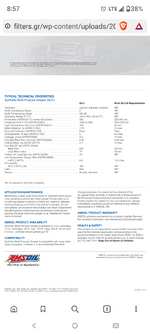
Sometime you should read the spec sheets grease manufacturers publish. They will list the base oil, the viscosity of the thickeners, and the additive package. They also have great details such as the drop point, oil separation temperature, and how long it takes for the ADDITIVES TO HARDEN.
 
Sometime you should read the spec sheets grease manufacturers publish. They will list the base oil, the viscosity of the thickeners, and the additive package. They also have great details such as the drop point, oil separation temperature, and how long it takes for the ADDITIVES TO HARDEN.

Yes, they do list many important ratings/results/properties, and components. They're packed with great info for people who know how to read and interpret them, especially in relation to a given application. I'd love to see one that lists "how long it takes for additives to harden", especially if it specifies exactly which additive that might be, and under what conditions it might occur (ambient, open-air, operating temps, etc).
 
Back
Top