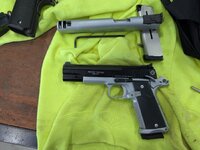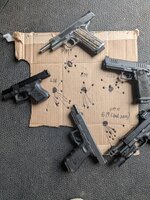
1911’s in general, 9mm versions specifically

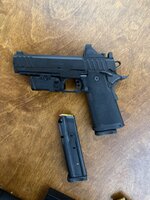
Admittedly it’s a big boy. X300v, Acro, safariland ALS. Just based on that, you can imagine what it is used for and in daylight/nighttime use.

Oh yeah, I get that. Doesn’t bother me to tape the GS for that.


Edit: let me contribute to this thread in a productive way. That specific staccato and several atlas magazines has over 8,000 124gr and 2,000 147 gr through it with zero malfunctions.


Inconceivable!
 
The grip circumference is large enough that a 90 degree trigger press while riding the safety on a 2011 causes the top web of my hand to not put enough pressure where the grip safety disengages. It seems to be an interplay between the angle a disengaged safety holds my thumb, the location the grip safety disengages, and the size of my hand.

If the grip safety on my staccato disengaged with pressure closer to the top of the beaver tail, this wouldn’t be an issue. It disengages lower down. So my grip (right handed in this case) puts pressure along the right side of the gun, and the web of my hand is putting pressure into the beaver tail grip junction. The angle of keeping my right thumb on the safety causes the web of my hand to not put enough pressure where the grip safety is designed to disengage.

I have never experienced this issue on 1911s.

Changing the stock trigger to a short Atlas also allowed me to press the 2011 trigger with a lot more of my finger without compromising grip. Before that change, I would have to grip the gun differently than every other pistol.

It bears repeating that I have small hands, and a 2011 is the beefiest pistol I shoot.

The hand size/geometry thing is something I don't hear talked about much...not sure if it's because instructors don't want to allow it to be an excuse or a mental issue for their students, or if it's just not well recognized or understood how to account for it. But over the years, I've noticed that a lot of the really top, high-performance handgunners I've personally seen seem to have abnormally large hands. It's definitely not a universal, but it's a pronounced pattern I've seen. And when I've heard them instruct, a lot of them don't seem to recognize how that's working for them in ways that are difficult to replicate for people with different hand geometries.

I first dealt with this back in the 1990s when switching from 1911s to a couple of Para Ordnance double-stack .45s. They were quite a bit blockier and thicker in circumference, and I had to re-work my grip a bit. I don't have small hands, but their geometry kinda results in similar problems with thick handguns. XL to XXL palms in thickness, but L finger length. When I touch thumb-tip to finger tips, I have less empty space than some girls I've dated, even though my hands are comparatively enormous to theirs. That empty space translates to reach and leverage when gripping a gun - or lack thereof. It's a really quick way to gauge what kind of guns and grips are going to be more or less work for someone.

A lot of the problems you're describing are ones I deal with too on 1911s/2011s - the biggest issues definitely relate to the thumb safety. Even with extra-short triggers, it's still extremely difficult to ride the thumb safety without also riding the slide and causing malfunctions. I've gone through about half a dozen different grip styles in how my support-hand's working the gun, and the best performing ones also result in the meat of the upper heel of my left hand, just below the thumb joint, activating the thumb safety slightly and interfering with the trigger internally. I don't want to give up that performance from the grip or reliability of riding the thumb safety, so I just picked up a couple of shielded thumb-safeties to fit onto a couple of my guns.

Regarding grip safeties, I had to open up the pathway in my Staccato C's for reasons similar to what you're describing, and similar to what Form's describing, though not as fully. But the trigger was contacting it enough during the press, that I needed to open it up more than a little, until I couldn't feel the grip safety moving at all during the shot process. But that C is a heck of a lot easier across the board to grip and shoot without a bunch of reworking of the hand positioning than any of the 2011s I've picked up.

One other 1911-esque gun that solves a lot of these problems, that might be worth considering for CCW, is the Dan Wesson DWX Compact. Excellent ergos, good beavertail but no grip safety, and super thin for a double-stack. The full-size DWX is blockier and chunkier, and wasn't interesting to me, but the Compact is one of the most slept-on, underrated CCW guns out there, for anyone in the SAO/1911/2011 space. I've got close to 20k rounds on mine, with the only reliability issue being a need to replace the extractor spring after about 10k rounds.
 
It actually uses 1911 internals - hammer, sear, disconnector, sear spring are all 1911. The trigger itself is physically unique, as the bow is wrapping around CZ75 mags, but it's functionally a 1911 trigger.
Oof, this conversation is taking an expensive turn...

@Formidilosus, any strong opinions on CZ vs 2011/1911 ergos? I'm assuming you're firmly in the camp that the single stack 1911 is the king for speed accuracy?
 
I think we covered this before, but does a commander length 1911 in 9mm make things significantly harder in regards to performance and reliability?
 
Oof, this conversation is taking an expensive turn...

@Formidilosus, any strong opinions on CZ vs 2011/1911 ergos? I'm assuming you're firmly in the camp that the single stack 1911 is the king for speed accuracy?

The 1911 grip is better. The DWX should have been a 1911 grip and CZ slide, instead of the other way around. However, as stated the DWX compact would be about third or fourth on my list. Proper 1911, Staccato C or CS, good 2011, and then maybe tied between Staccato HD and DWX.
 
The 1911 grip is better. The DWX should have been a 1911 grip and CZ slide, instead of the other way around. However, as stated the DWX compact would be about third or fourth on my list. Proper 1911, Staccato C or CS, good 2011, and then maybe tied between Staccato HD and DWX.

To be fair, had I gotten the Staccato C first, I wouldn't have considered anything else. But there were just enough teething problems with the DWXc, combined with learning that the Staccato C was being discontinued, that it was an easy decision. To be equally fair though, I absolutely love that DWX Compact, as it still feels more at home in my hand than the C - but I also seem to be shooting the C just a hair better. It's like having two girlfriends - one has better pancakes, the other has better play, and I don't want to give up either.
 
Ok I must be too stupid for a 1911...

Got my Kimber apart to swap the grip and trigger. Per the Red Dirt video I need to put the gun together minus the safeties to test and adjust pre travel...

But how the F is this spring supposed to sit so the hammer will half and full cock?

How is the tab on the far left supposed to sit? Everything says it's supposed to be on top. But apparently I need to sell these 1911 parts and go back to a Glock

53fc2947a788140269c2802d7919d030.jpg
 
Ok I must be too stupid for a 1911...

Got my Kimber apart to swap the grip and trigger. Per the Red Dirt video I need to put the gun together minus the safeties to test and adjust pre travel...
I got you.
IMG_0869.jpeg
IMG_0870.jpegIMG_0871.jpeg
IMG_0872.jpeg
IMG_0873.jpeg

And to check if you’ve added too much pre-travel (missing the half cock) the hammer needs to be under spring tension with the mainspring inserted. With the red dirt triggers you are turning a screw that is physically pushing the trigger to the rear. Push too far and the sear will be under constant tension. Keep pushing and the hammer will drop at the slightest bump.
-you can see how dangerous this can be if too much pre-travel is added.

Give yourself a small amount of trigger take up before hitting the wall. You don’t want the sear to be under constant tension from the trigger. This gives the sear enough clearance off the disconector for it to function safely.

Then be sure to go through the safety checks.
Engineer Armory has a great video about how to make sure your sear, disconnector, safety, and hammer are all functioning safely.
 
I got you.
View attachment 1049617
View attachment 1049618View attachment 1049619
View attachment 1049620
View attachment 1049621

And to check if you’ve added too much pre-travel (missing the half cock) the hammer needs to be under spring tension with the mainspring inserted. With the red dirt triggers you are turning a screw that is physically pushing the trigger to the rear. Push too far and the sear will be under constant tension. Keep pushing and the hammer will drop at the slightest bump.
-you can see how dangerous this can be if too much pre-travel is added.

Give yourself a small amount of trigger take up before hitting the wall. You don’t want the sear to be under constant tension from the trigger. This gives the sear enough clearance off the disconector for it to function safely.

Then be sure to go through the safety checks.
Engineer Armory has a great video about how to make sure your sear, disconnector, safety, and hammer are all functioning safely.

I got it to half cock and cock. Then lost it

Let me try again with your adult supervision


Thanks!!!!
 
Ok, so my pre travel adjustment screw has been screwed so far forward that when I went to pull the trigger and double check it the screw fell.

Took a replacement screw started it, put the works back together and she's working now.

Ha thanks
 
Got the gun together then checked how I did. Trigger was stupid sponges and crawled to reset.

Back to 1911 parts on my bench.

Set screw on my Red Dirt is set so the head is flush to the bow, then backed off a half a turn.

But I must have something else going because the trigger barely wants to return to cocked position. It slowly crawls back to 0.

Tons of take up.

I thought a p365 trigger was bad... ha

Bed time. Try again tomorrow.
 
Haha. SSS was actually the first pistol class I took. And he said my 1911 was the first he had ever seen make it through a week long class without a malfunction- actually had several G19’s malfunction in the class, including his. Hahaha.

I’ve taken a lot of classes, and was already a decent competitor when I took it, but Surgical Speed Shooting is probably still the overall most impactful pistol course I have taken.
Folks, copies of Stanford's book are still available secondhand if anyone is interested - ABE has a few: https://www.abebooks.com/servlet/Se...=search_f_hp&sts=t&tn=surgical speed shooting

He also did a couple of videos for the now-defnct Paladin Press, that might still be available here and there ...
 
Ben Stoeger has said that he has seen more AD/NDs with single action-manual safety equipped guns than any other type.

What do you think drives that?

I imagine he is around more people using pretty light triggers and other modifications.

There may be a context of someone that is not super confident swiping the safety off early, like in or near the holster, combined with “prepping” a light trigger, easily resulting in a discharge into the ground in front of the shooter. But he has not really elaborated to say that’s the case.
Yeah, I think he did in a video he and Joel posted sometime in just the last month or so ... it wasn't so much an issue with manual safeties as it was with people using very light competition triggers and coming onto the trigger too early, whether 'prepping' or just inserting trigger finger into the guard at a point when it's not as likely to be an issue on a heavier and/or DA trigger.
 
I'll just throw in my 2 cents. I've got one 9mm 1911 - Sig Stainless Traditional. One of my favorite pistols! Haven't had any issues with feeding/ejecting. I mostly shoot my reloads - 115gr plated round nose over 4.2gr Titegroup. I've also loaded up jacketed, hard cast lead and powder coated bullets. All shoot great! The hard cast was messy. I've pretty much left it stock. I did get Sig target grips for it. That's all I've done to it.
 
Back
Top