When you figure that out PM me and we’ll both be rich.What is it in human psychology that allows people to ignore clear evidence and still believe they’re more capable than they actually are?


Follow along with the video below to see how to install our site as a web app on your home screen.
Note: This feature may not be available in some browsers.
When you figure that out PM me and we’ll both be rich.What is it in human psychology that allows people to ignore clear evidence and still believe they’re more capable than they actually are?

What is it in human psychology that allows people to ignore clear evidence and still believe they’re more capable than they actually are?
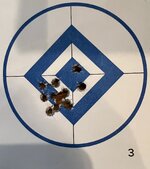
What gun/caliber is that? Is it for sale lol?View attachment 938929This is what brought the question up in my mind today. ( ignore the bottom shot. It was my son with his .223). These are two five shot groups. 200yards right at about or under 1 inch. This is with my hunting rifle, off a bench, in zero wind, factory ammo. The part that pissed me off and got me thinking was on the upper dot I flew a shot higher and further right than the rest of the shots. I was legitimately mad about it until I started actually thinking about the level of accuracy “needed” to hunt at my self imposed max range of 500 yards. I was curious if there was a rule of thumb when it came to moa off a bench and hunting distances. I fully understand that more accuracy is more better.

ROAL is street slang, used by children.
apple's and orange's?
If we take 1000 shots per group, we see that the average group size trends towards 3x the size of the average 3-shot group.Curious what this looks like for a 5 shot group that is 1.75”
Asking as that is what most of my Fudd buddies shoot from their rifles. I would like to show them the hit % at 400 yards. But then again it may show them they have a 70+% chance and would make a poor decision.


If we take 1000 shots per group, we see that the average group size trends towards 3x the size of the average 3-shot group.
If we assume an average of 1.33 MOA for 3-shot groups and 1.75 MOA for 5-shot groups, this becomes 4 MOA for 1000-shot groups. Using 4 MOA as the ES for the rifle/load/shooter precision, we still mostly keep 1000 shots on a ~12" target at 400 m, assuming some skill in minimizing the other uncertainties involved (wind estimates within +/- 2 mph, etc.)

The sample size makes a big difference. A 1 MOA group for 3 shots is quite different from a 1 MOA group for 10 shots. Greater than 1 MOA for 3, and even 5, shots is larger than I like from my rifles. But 1 MOA for 10 shots from a hunting rifle is very good, IME. As I posted above, with large sample sizes we expect 5-shot groups to be about 1.3x larger than 3-shot groups, and 10-shot groups to be about 1.6x larger. If we were to shoot 1000-shot groups, we would expect their average size to be almost 3x the size of the average 3-shot group.I hand load and can always get better than 1.5 MOA but if I cannot it is not a deal breaker. I remember when 3 MOA was touted as a good enough group for deer out the 300 yards. I am glad we have improved that standard. YouTube boobs push that anything greater than 1 MOA is a "horrible" shooting rifle. It is not. Most of my rifles would be "barely acceptable" according to these guys but I have loads that are consistent in speed (low ES/SD) and around 1 MOA accuracy for 10 or more shots. Just because a rifle is less than 1 MOA at 100 does not equate to 5 MOA at 500. Velocity variance starts to affect group size past about 300 yards. If your ES is 75fps, then your group can be great at 100 yds and absolutely horrible at 500.
This is a way over exaggerated concept that usually stems from small samples as well. When you start shooting 10-20 shot strings in front of a chrono, 75-100fps ES is not uncommon to see out of a hunting rifle. The 9 ES 2 SD BS you see on the interwebs is from cherry picked 3 shot groups. You can still shoot small groups at long range because the low shot could be the fast one, and the high shot could be the slow one, and they could converge on target. Some silly characters call that "positive compensation" and believe they can control and "tune" it, but it's all part of the fallacy. The only thing real is the target, and you have to shoot the shots to see where they actually go.Just because a rifle is less than 1 MOA at 100 does not equate to 5 MOA at 500. Velocity variance starts to affect group size past about 300 yards. If your ES is 75fps, then your group can be great at 100 yds and absolutely horrible at 500.
Exaggerated how? It is not a concept. It is reality. Bullets drop more when launched slower and therefore will be less accurate when velocities are not consistent. A 100fps difference is about 4" more drop at 500 and probably around 2 feet or more at 1000. Where in my quote did I write 9/2 for ES/SD? I do agree with you that YT boobs will tout low ES/SD with only 3 or 5 shots.This is a way over exaggerated concept that usually stems from small samples as well. When you start shooting 10-20 shot strings in front of a chrono, 75-100fps ES is not uncommon to see out of a hunting rifle. The 9 ES 2 SD BS you see on the interwebs is from cherry picked 3 shot groups. You can still shoot small groups at long range because the low shot could be the fast one, and the high shot could be the slow one, and they could converge on target. Some silly characters call that "positive compensation" and believe they can control and "tune" it, but it's all part of the fallacy. The only thing real is the target, and you have to shoot the shots to see where they actually go.
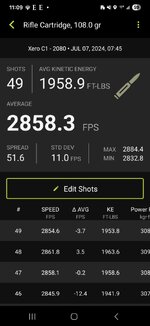
Not when dispersion and random distribution enter the chat. Like I said, the low one can be the high velocity, and the high one be the low, and they converge. Even Hornady's senior ballistician states dispersion is pretty much linear out to 500 yards. It's just not as big of a hindrance as a ballistic calculator would lead you to believe by running numbers on individual shots. I've recorded 75fps spreads on large sample testing of my load in my 6.5 PRC, and also taken a decent amount of cold bore shots at my 10" CBC qualifying target at 804 yards, and over the last 10 or so if I missed it was due to an under or over estimated wind call, not elevation. I recorded all of them through a spotter to get as much feedback as possible.Exaggerated how? It is not a concept. It is reality. Bullets drop more when launched slower and therefore will be less accurate when velocities are not consistent.
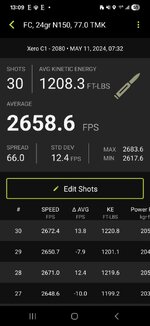
I think that can be cartridge and component dependent. But I'd take a load that repeatedly does .6" for 10 shots with an ES of 75 over a 1.5" load with an ES of 15.It is not hard to load to an ES under 75 in a hunting rifle for large samples.
The key is process markers cannot be used as a replacement for good results. Results always win, process markers are just a guide in getting to results. Sub 1.5 MOA is all I need (from a large sample). For either of those, I would consider other factors as well in load selection (bullet, pressure, Etc). Well, I hope I would, sometimes number just make me happy.I think that can be cartridge and component dependent. But I'd take a load that repeatedly does .6" for 10 shots with an ES of 75 over a 1.5" load with an ES of 15.

As the saying goes with any precision endeavor “the last 5-10% is going to require as much or more effort that the first 90-95%”…or something along those lines.How much time and money does it take to go from a 1 MOA group to a 1/2 MOA group?
Not from 16 to 8, or 8 to 4, or 4 to 2, or 2 to 1. Those are all easily done with modern methods and equipment. But once you are at or close to 1 MOA, the time and money needed to halve it again goes up immensely. And the benefits become essentially irrelevant on animals with 8” vitals below 500 yards.
Telling a hunter to buy a $500-1000 match barrel instead of $500-1000 worth of practice ammunition is just pointless once he’s shooting 1” to 1.5” groups from a bench. At that point, his maximum range is whatever distance he can hit 10/10 inside that 8” circle from a given position and under field conditions. For some folks, the maximum range offhand is 50 yards or maximum range with any wind is 200 yards. Or whatever. And getting a match barrel or “better ammo” won’t increase the maximum range offhand or in the wind any appreciable amount.
I understand the temptation. It’s fun to shoot tiny little groups on paper. It builds confidence in ourselves and our equipment. But in non-static hunting situations, that ability and that confidence is hollow.

As the saying goes with any precision endeavor “the last 5-10% is going to require as much or more effort that the first 90-95%”…or something along those lines.
So to translate your basketball analogy to terms that address my shooting; if i have my1” (12 shot) groups, rather than be 3,4 or even 5% better from a bench, i should go out and build my field fundamentals up to the 90-95% level as a better investment. This makes sense. And someday when i need another hobby, i can lool into reloading and chasing that last 5% from a bench.





